Die Wahl Ihrer nächsten Mining-Maschine ist eine der wichtigsten Geldentscheidungen, die Sie treffen werden, wenn Sie es mit dem Bitcoin-Mining ernst meinen. Derzeit scheinen zwei der am häufigsten genannten Optionen aus derselben Produktreihe zu stammen: der Antminer S21 XP Hyd und der Antminer S21 Pro. Sie haben beide das Bitmain-Emblem und arbeiten mit der gleichen SHA-256-Arbeitslast, aber ehrlich gesagt sind sie für sehr unterschiedliche Arten von Minern konzipiert. Das eine ist ein wassergekühltes Biest, das für richtige Einrichtungen gedacht ist, also für die Art, in der man einen Plan für Kühlung, Wasserleitungen und all das hat. Das andere ist ein luftgekühltes Arbeitstier, das fast überall Platz findet, auch wenn der Platz etwas eng ist oder der Aufbau weniger ausgefallen ist.
Und hier ist die kurze Aufnahme, bevor wir näher darauf eingehen. Der S21 XP Hyd ist schneller und deutlich energieeffizienter, hat aber zu Beginn einen viel höheren Preis und erfordert ja auch eine Wasserkühlung. Der S21 Pro ist in der Regel günstiger, einfacher zu bedienen und eignet sich gut für kleinere Betriebe oder Leute, die sich auf die Probe stellen. Dennoch verbraucht es etwas mehr Strom pro Terahash. Wer also „gewinnt“, ist vor allem eine Zahlensache, wie viel Sie für Strom bezahlen und wie viel Sie heute einsparen möchten.
Wir werden auch ehrlich zum Markt sein. Anfang Juni 2026 wird Bitcoin um $63,500, gehandelt, ein deutlicher Rückgang gegenüber seinem Allzeithoch im Oktober 2025 bei $126,000. Der Netzwerkschwierigkeitsgrad liegt bei etwa 138,96 Billionen, und die Mining-Margen sind knapp. Deshalb ist Effizienz wichtiger als je zuvor; Eine Maschine, die in diesem Markt Strom verschwendet, kann still und leise Geld verbluten lassen, während eine effiziente Maschine sich über Wasser hält.
Lernen Sie die beiden Bergleute kennen: Ein kurzer Überblick
Der Antminer S21 XP Hyd ist ein hydrogekühltes Schwergewicht. Es wird um 473TH/s ausgegeben, während es 5676W zieht, also ja, das ergibt ungefähr 12 J/TH, was die Hauptschlagzeile ist, über die alle reden. Es benötigt die Wasserkühlungshardware, um überhaupt richtig zu funktionieren, daher ist es grundsätzlich auf organisierte Farmen und Hosting-Setups ausgerichtet, die bereits über die Leitungen, die Flusskontrolle und so weiter verfügen. Es erschien im März 2025.
Jetzt fühlt sich der Antminer S21 Pro viel vertrauter an, eine Art Plug-and-Play, kein zusätzliches Hydro-Rig. Es funktioniert 234 TH/s, und es ist auch ein 245 TH/s-Behälter verfügbar, bei 3,510W, sodass es in der Nähe von 15 J/TH landet. Dieser ist luftgekühlt und verfügt über vier eingebaute Lüfter; Es ist tendenziell lauter und aus Kostengründen schont es auch den Geldbeutel erheblich. Es wurde im Juli 2024 auf den Markt gebracht und ist ein Dauerbrenner für private Bergleute und kleinere Bauernhöfe.
Hier’s ein kurzer Schnappschuss, um die Bühne zu bereiten:
| Merkmal | Antminer S21 XP Hyd | Antminer S21 Pro |
| Hashrate | 473 TH/s | 234 TH/s (bis 245 TH/s) |
| Leistungsaufnahme | 5,676W | 3.510 W |
| Effizienz | ~12 J/TH | ~15 J/TH |
| Kühlung | Hydro (Wasser) | Luft (4 Lüfter) |
| Freigegeben | März 2025 | Juli 2024 |
| Preis | $8,799 | $2,249 – $2,399 |
| Am besten für | Bauernhöfe mit Wasserkühlung | Home & Kleinbauern-Bergleute |
Stellen Sie es sich wie Autos vor. Der S21 XP Hyd ist die Hochleistungsmaschine, die eine richtige Garage und ein bisschen Know-how braucht. Der S21 Pro ist der zuverlässige Alltagsfahrer, den Sie fast überall parken können. Weder ist “ besser” im luftleeren Raum; Sie passen einfach auf unterschiedliche Treiber, eine Lücke, die die gesamten Spezifikationen, die Effizienz und die ROI-Geschichte unten prägt.
Vollständige Spezifikationen im Vergleich
Erste Säule: die Hardware selbst. Nachfolgend legen wir das vollständige Datenblatt jeder Maschine dar und stellen sie dann direkt in einer Tabelle zusammen. Dies ist der Abschnitt, den Sie als Lesezeichen speichern sollten, wenn Sie die beiden Werte auf dem Papier abwägen.
Antminer S21 XP Hyd: Vollständige Spezifikationen
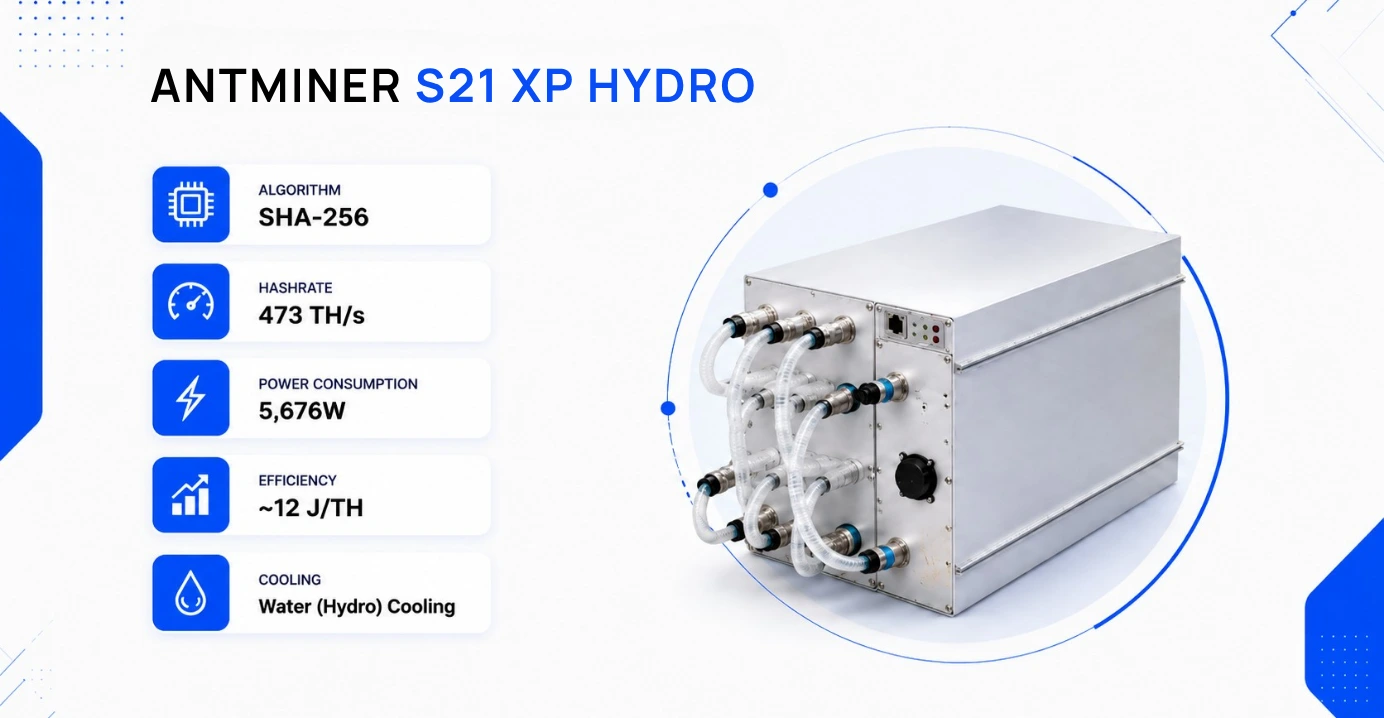
Beginnen wir mit der größeren Maschine. Der Antminer S21 XP Hyd wurde für Miner entwickelt, denen es wichtig ist, aus jedem einzelnen Watt so viel Hash-Rate wie möglich herauszuholen, und die auch über die nötige Kühlung verfügen, um damit tatsächlich umgehen zu können. Nachfolgend finden Sie die vollständige Aufschlüsselung der technischen Daten direkt aus der Produktliste.
| Spezifikation | Detail |
| Hersteller | Bitmain |
| Modell | Antminer S21 XP Hydro |
| Veröffentlichung | März 2025 |
| Algorithmus | SHA-256 |
| Hashrate | 473 TH/s |
| Stromverbrauch | 5,676W |
| Effizienz | ~12 J/TH |
| Kühlung | Wasser-(Hydro-)Kühlung |
| Spannung | 380–418V |
| Wasserfluss | 8.0 – 10.0 |
| Wasserdruck | ≤ 3.5 |
| Flüssiger pH-Wert | 8.5 – 9.5 |
| Nettogewicht | 12,8 kg |
| Abmessungen (Einheit) | 339 x 173 x 207mm |
| Vernetzung | RJ45 Ethernet 10/100M |
| Betriebstemp | 05 – 45°C |
| Luftfeuchtigkeit | 05 – 95% |
| Garantie | 365 Tage |
Das herausragende Merkmal ist hier die Effizienz. Mit etwa 12 J/TH ist dies eine der schlanksten Maschinen, die Sie kaufen können. Vereinfacht gesagt leistet es für jede Stromeinheit viel mehr Arbeit als ältere oder luftgekühlte Geräte. Wenn der Preis von Bitcoin’ niedrig und der Schwierigkeitsgrad hoch ist, sorgt genau dieser Effizienzvorteil dafür, dass eine Maschine profitabel bleibt, während weniger effiziente Einheiten in die Verlustzone geraten.
Das Hydro-Design macht diese Zahlen irgendwie glaubwürdig. Anstatt dass Lüfter nur heiße Luft herumblasen, zirkuliert der S21 XP Hyd Flüssigkeit, um die Wärme von den Chips abzuleiten. Auf diese Weise kann das Gerät ohne thermische Drosselung voll ausgelastet werden. und es hält den Lärm im Vergleich zu einer luftgekühlten Box deutlich niedriger. Außerdem ist es für die Leistung überraschend kompakt, da es keine sperrigen Lüftergehäuse benötigt und das Ganze kompakter bleibt.
Der Nachteil besteht darin, dass Sie es einfach auf ein Regal stellen und anschließen können. Sie benötigen einen Wasserkreislauf, einen Trockenkühler oder Wärmetauscher, geeignete Leitungen und die richtige Kühlmittelchemie (beachten Sie den pH-Wert-Bereich von 8,5 – 9,5). Deshalb’s, warum es’s eher auf Bauernhöfe und Hosting-Sites als auf ein Gästezimmer ausgerichtet ist. Wenn Sie’eine Einzelperson sind Bitcoin-Miner Ohne diese Infrastruktur können die Einrichtungskosten und die Komplexität ein echtes Hindernis darstellen. Sie können die vollständigen Produktdetails nachschlagen Antminer S21 XP Hyd. Im Lieferumfang ist das PSU enthalten, und es gibt eine 365-Tage-Garantie, was wirklich beruhigend ist, insbesondere da es sich um eine große Investition handelt.
Antminer S21 Pro: Vollständige Spezifikationen
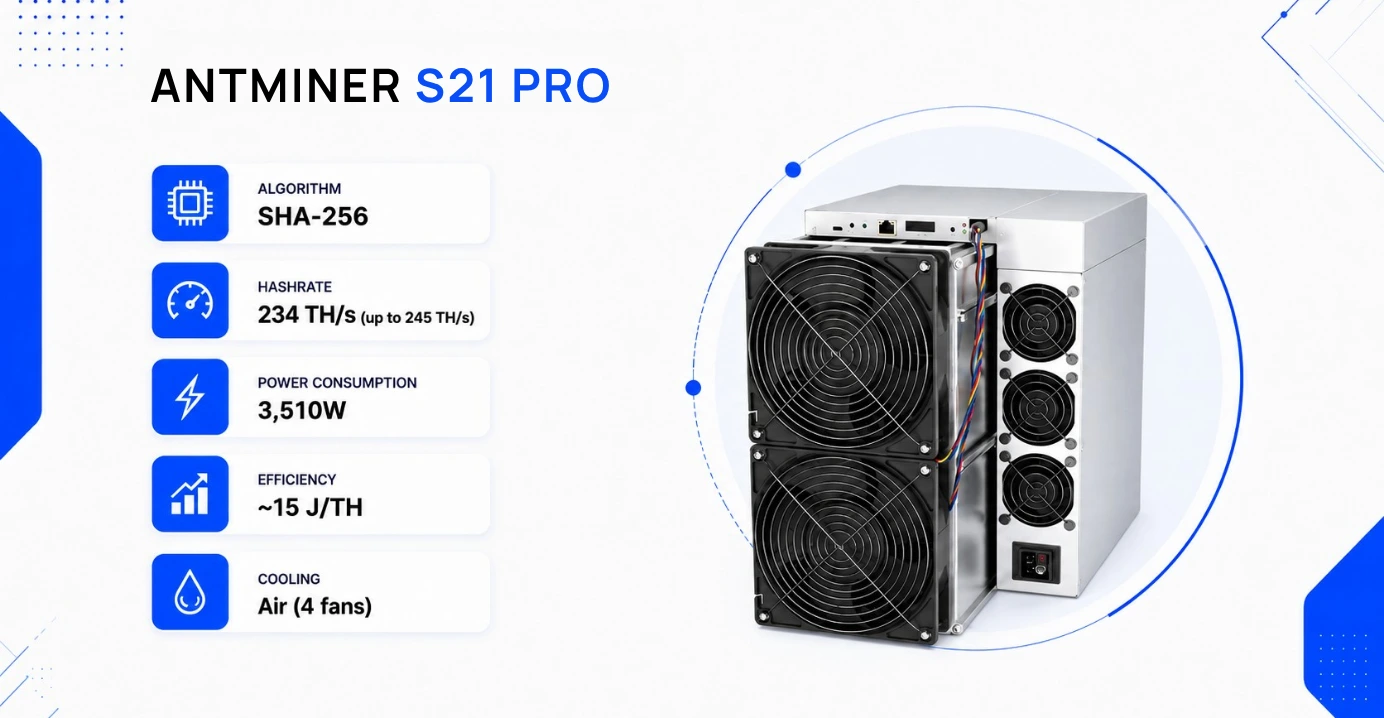
Werfen wir nun einen Blick auf die S21 Pro, die Maschine, die wahrscheinlich auf mehr Einkaufslisten steht, einfach weil sie einfacher zu besitzen ist. Es verfolgt zwar keine Rekordeffizienz, bietet aber ein ausgewogenes Verhältnis zwischen Geschwindigkeit, Einfachheit und Preis. Hier’s das vollständige Datenblatt.
| Spezifikation | Detail |
| Hersteller | Bitmain |
| Modell | Antminer S21 Pro |
| Veröffentlichung | Juli 2024 |
| Algorithmus | SHA-256 |
| Hashrate | 234 TH/s (bis 245 TH/s) |
| Stromverbrauch | 3.510 W |
| Effizienz | ~15 J/TH |
| Kühlung | Luft (4 Lüfter) |
| Geräuschpegel | 76 dB |
| Spannung | 220–277V |
| Nettogewicht | 20 kg |
| Abmessungen (Einheit) | 450 x 219 x 293 mm |
| Vernetzung | Ethernet |
| Betriebstemp | -20 – 45°C |
| Luftfeuchtigkeit | 10 – 90% |
| Garantie | 365 Tage |
Das größte Verkaufsargument des S21 Pro’ ist sein normaler Betrieb. Es handelt sich im Grunde genommen um eine in sich geschlossene, luftgekühlte Box mit vier eingebauten Ventilatoren, also schließen Sie sie einfach an die Stromversorgung an, richten Sie sie auf den Pool und bauen Sie sie ab. Es gibt keinen Wasserkreislauf, keine Rohrleitungen und kein zu verwaltendes Kühlmittel. Für die meisten Anfänger ist diese Einfachheit viel wert.
Mit etwa 15 J/TH ist es’s immer noch eine moderne, leistungsfähige Maschine, nur nicht so schlank wie das Hydromodell. Um es ins rechte Licht zu rücken: Ältere Geräte aus der S19-Ära liefen oft mit 20–30 J/TH oder schlechter, sodass der S21 Pro eine große Verbesserung gegenüber allen Geräten darstellt, die ein paar Jahre alt waren. It’s ist ein legitimer ASIC-Miner der aktuellen Generation, der sich in einem ausgeglichenen Energiemarkt behaupten kann.
Der Haken ist Hitze und Lärm. Dieser 76 dB-Wert ist ungefähr so laut wie ein Staubsauger, der ununterbrochen läuft, daher ist er nicht etwas, das man in einem Wohnraum haben möchte. Es benötigt eine solide Luftzirkulation und Belüftung, idealerweise einen eigenen Raum, eine Garage, einen Schuppen oder eine Unterkunft. Der große Betriebsbereich (bis -20°C) macht ihn flexibel für kühlere Klimazonen. Der Spannungsbedarf (220–277V) ist im Gegensatz zu den höheren 380–415V, die das Hydrogerät bevorzugt, auch für viele Heim- und Kleinunternehmensanlagen geeignet.
Sie können die aktuellen Preise und Lagerbestände überprüfen der Antminer S21 Pro Hier. Mit einem viel niedrigeren Einstiegspreis und einer 365-Tage-Garantie ist es’ eine zugängliche Möglichkeit, ohne großes Infrastrukturprojekt ernsthafte Hashrate zu erzielen.
Direkter Vergleich der technischen Daten
Nachdem wir nun jede Maschine für sich gesehen haben, lassen wir sie direkt anordnen. Hier’s das vollständige nebeneinander.
| Spezifikation | Antminer S21 XP Hyd | Antminer S21 Pro |
| Hashrate | 473 TH/s | 234 TH/s (bis zu 245) |
| Strom | 5,676W | 3.510 W |
| Effizienz | ~12 J/TH | ~15 J/TH |
| Kühlung | Hydro/Wasser | Luft (4 Lüfter) |
| Lärm | Sehr niedrig | ~76 dB (laut) |
| Spannung | 380–418V | 220–277V |
| Gewicht | 12,8 kg | 20 kg |
| Abmessungen | 339 x 173 x 207 mm | 450 x 219 x 293 mm |
| Betriebstemp | 5 – 45°C | -20 – 45°C |
| Veröffentlichung | März 2025 | Juli 2024 |
| Preis | $6,779 | $2,249 – $2,399 |
| Schwierigkeiten bei der Einrichtung | Hoch (benötigt Wasserkreislauf) | Niedrig (Plug and Play) |
Ein paar Dinge fallen einem sofort ins Auge, wenn man sie zusammen sieht.
- Rohgeschwindigkeit: Der XP Hyd produziert mehr als die doppelte Hashrate des Pro. Wenn Ihr Ziel ein maximaler Hash pro Box ist, wird dies nicht der Fall sein.
- Effizienz: 12 vs. 15 J/TH ist ein bedeutender Abstand, der für das Hydromodell etwa 27 % effizienter ist. Mit den Jahren des Laufens summiert sich dieser Unterschied.
- Vorabkosten: Der Pro kostet etwa ein Viertel des XP Hyd. Sie könnten drei oder vier S21 Pro zum Preis einer Hydroeinheit kaufen.
- Aufwand zum Laufen: Der Pro ist Plug-and-Play. Der XP Hyd ist ein Projekt, kein kleines Detail für Einsteiger.
Es hilft auch, in Dollar pro Terahash an Hardware zu denken. Der XP Hyd läuft etwa $14.33 pro TH Kapazität ($6,779÷ 473). Der S21 Pro läuft ungefähr $9.61 pro TH ($2,249 ÷ 234). Bei dieser einzelnen Kennzahl ist es günstiger, die Hashrate des Pro zu kaufen. Die Hardwarekosten sind jedoch nur die halbe Miete. Die Stromkosten im Laufe der Zeit sind die andere Hälfte, und bei diesen ’s dreht sich die Effizienz um, was uns zur zweiten Säule bringt.
Effizienz im Vergleich
Zweite Säule: Effizienz. Spezifikationen auf dem Papier sind eine Sache, aber wie viel Arbeit jede Maschine pro Watt leistet, entscheidet über Jahre hinweg über Ihre Stromrechnung. Hier schlüsseln wir die J/TH-Nummern und die Kühlsysteme auf, die sie ermöglichen.
Der J/TH-Showdown
Effizienz ist die wichtigste Kennzahl im Bergbau, und es kann sich lohnen, etwas langsamer zu fahren, um das Wesentliche zu verstehen. Diese Metrik wird in Joule pro Terahash (J/TH) gemessen und manchmal auch als W/TH geschrieben. Es beantwortet im Grunde die Frage, wie viel Strom eine bestimmte Maschine verbraucht, sodass Sie eine Rechenleistung im Wert von einem einzigen Terahash erhalten können. Niedriger ist besser. Ein niedrigerer J/TH bedeutet mehr Hashing bei gleicher Stromrechnung.
Hier’s die Lücke zwischen unseren beiden Maschinen:
| Maschine | Strom | Hashrate | Effizienz |
| S21 XP Hyd | 5,676W | 473 TH/s | ~12 J/TH |
| S21 Pro | 3.510 W | 234 TH/s | ~15 J/TH |
Die Rechnung ist einfach: Teilen Sie Watt durch Terahash. Für XP Hyd: 5.676 ÷ 473 = 12. Für Pro: 3.510: 234 = 15. (Der 245 TH/s-Behälter des Pro landet etwas besser, etwa 14.3 J/TH.) Das Hydromodell ist also etwa 27 % schlanker pro Arbeitseinheit.
Warum ist das so wichtig? Denn Strom ist Ihr größter laufender Kostenfaktor, und er hört nie auf. Der Kauf der Maschine ist ein einmaliger Erfolg. Die Stromrechnung kommt jeden Monat für die Dauer Ihrer Nutzung an. Im Laufe einer mehrjährigen Lebensdauer werden Sie in der Regel mehr für Strom ausgeben als für die Hardware selbst. Wenn Sie bei jedem Terahash ein paar Joule einsparen, können Sie erhebliche Einsparungen erzielen.
Effizienz ist der Schutzwall, der einen Bergmann schützt, wenn die Preise fallen und der Schwierigkeitsgrad steigt. In einem starken Bullenmarkt ist fast alles profitabel, sogar ineffiziente Ausrüstung. In einem harten Markt wie Mitte 2026 verdienen die effizienten Maschinen weiter, während die durstigen abgeschaltet werden. Das’ ist auch der Grund, warum die Branche Jahr für Jahr stetig in Richtung niedrigerer J/TH marschiert und warum der S21 XP Hyd in der Nähe von 12 J/TH eine Prämie verlangt.
Ein praktisches Mitbringsel: wenn Sie ’re Einkäufe tätigen ASIC-Miner, don’t schau dir einfach die Hashrate an. Eine auffällige TH/s-Zahl bedeutet wenig, wenn die Maschine Strom verbraucht. Überprüfen Sie immer die Effizienz und vergleichen Sie sie dann mit Ihrem örtlichen Stromtarif. Eine “langsamere”, aber schlankere Maschine kann eine schnellere, durstigere Maschine übertreffen, sobald die Stromrechnungen da sind.
Hydro- vs. Luftkühlung: Was das für Sie bedeutet
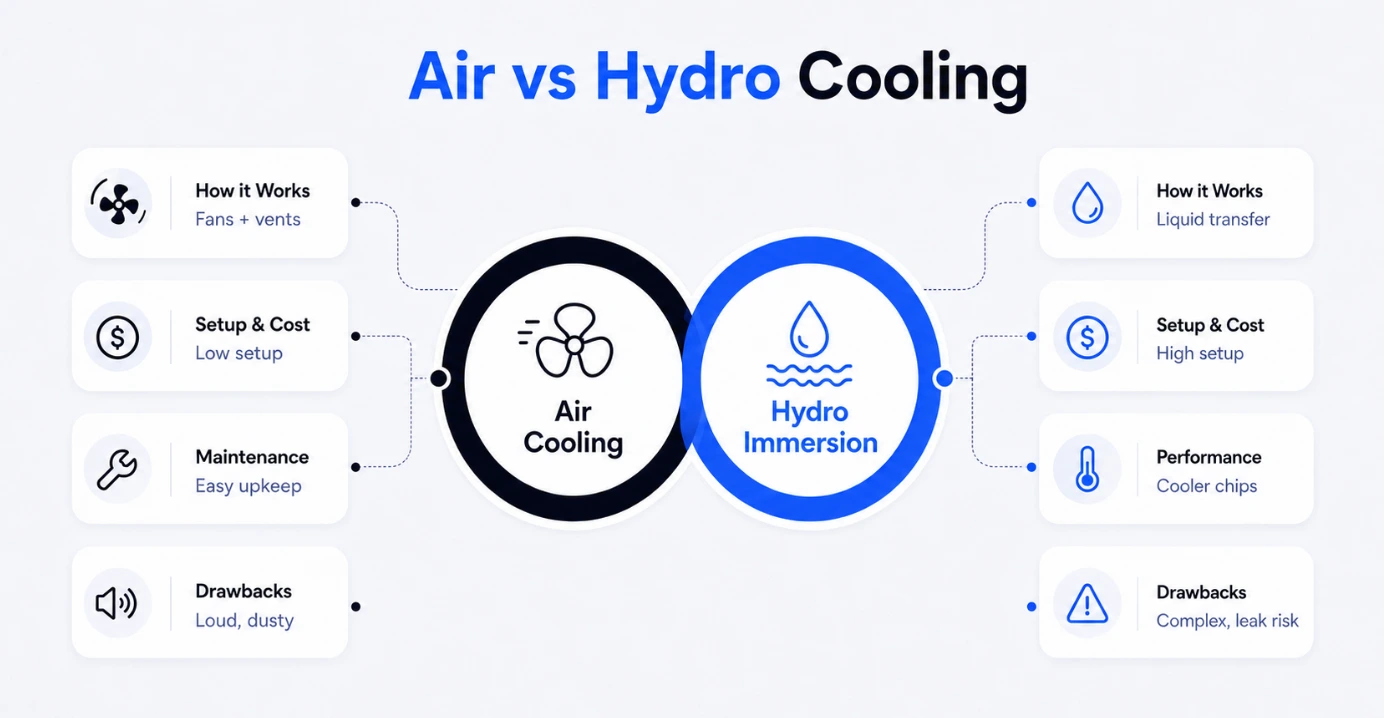
Der Kühlungsunterschied ist eine kleine Fußnote; Es verändert, wie und wo man schürfen kann, und es’ ist der Grund dafür, dass die beiden Maschinen so unterschiedliche Effizienzwerte erreichen.
Luftkühlung (S21 Pro) ist der klassische Ansatz. Vier Lüfter saugen kühle Luft durch das Gerät und blasen heiße Luft nach hinten heraus. Es’s ist einfach, bewährt und erfordert außer einer guten Belüftung keine zusätzliche Hardware. Die Nachteile sind Lärm- und Wärmemanagement. Um 76 dB herum ist der S21 Pro ehrlich gesagt ziemlich laut; Sie möchten es nicht in der Nähe eines Schlafzimmers oder eines Büros haben. Und es gibt auch eine ganze Menge Wärme an den Raum ab, sodass Sie unbedingt einen stabilen Luftstrom benötigen, um eine Überhitzung und anschließende Drosselung zu verhindern.
Zu den geeigneten Häusern für ein luftgekühltes Gerät gehören:
- Eine freistehende Garage oder Werkstatt
- Ein Schuppen oder Nebengebäude mit Luftzirkulation
- Ein Keller mit starker Belüftung
- Eine Hosting-Einrichtung, die die Kühlung für Sie übernimmt
Hydrokühlung (S21 XP Hyd) lässt eine Art Flüssigkeit zirkulieren, um die Wärme von den Chips wegzuleiten. Anschließend wird diese Wärme an einen Trockenkühler, einen Wärmetauscher oder einen Kühlturm im Freien weitergeleitet. Auch die Vorteile sind ziemlich groß: Es läuft leiser, kann eine höhere Leistungsdichte bewältigen und hilft dabei, die Chips auf konstanter Temperatur zu halten, selbst wenn die Arbeitslast sehr hoch ist. Diese Stabilität ist einer der Gründe, warum die Hydroeinheit eine so hohe Effizienz erreichen kann. Aber Wasserkraft ist eine Infrastrukturverpflichtung. Sie’ll benötigen:
- Ein geschlossener Wasserkreislauf mit Pumpen und Rohrleitungen
- Ein Wärmeabfuhrsystem (Trockenkühler oder Kühlturm)
- Korrekte Kühlmittelchemie (pH-Wert der Flüssigkeit 8,5 – 9,5)
- Überwachung von Durchfluss und Druck
- Höhere Spannungsversorgung (380–418V)
Daher ist die Entscheidung über die Kühlung oft die Entscheidung für den Kauf. Kein Wasserkreislauf und keine Pläne zum Bau eines solchen? Der S21 Pro ist Ihre Maschine. Betreiben Sie bereits einen Bauernhof mit Flüssigkeitskühlung oder bauen Sie einen? Der S21 XP Hyd wird diese Infrastruktur mit erstklassiger Effizienz und geringerem Lärm belohnen. Ein Bonus: Die aus Wasserkraft gewonnene Wärme lässt sich leicht wiederverwenden und viele große Betriebe recyceln sie zum Heizen von Gebäuden, Gewächshäusern oder Wasser.
ROI im Vergleich
Dritte Säule, und ehrlich gesagt, diejenige, die darüber entscheidet, ob Sie Geld verdienen: Kapitalrendite. Wir werden die aktuellen Mining-Belohnungen festlegen, den tatsächlichen Gewinn nach Stromkosten berechnen, die Amortisationszeit festlegen und dann den Break-Even-Strompreis für jede Maschine ermitteln.
Aktuelle Bitcoin Mining-Belohnungen
Um ehrlich über ROI zu sprechen, benötigen wir die heutigen Zahlen von ’. Das Mining-Einkommen hängt von vier beweglichen Teilen ab: der Blockbelohnung, dem Bitcoin’s-Preis, der Netzwerkschwierigkeit und der Hashrate Ihrer Maschine’s. Hier’s das Bild von Anfang Juni 2026.
- Block-Belohnung: Seit der Halbierung im April 2024 verdienen Bergleute 3,125 BTC pro Block, zuzüglich Transaktionsgebühren. Blöcke werden etwa alle 10 Minuten gefunden, sodass im gesamten Netzwerk etwa 144 Blöcke pro Tag abgebaut werden. Die nächste Halbierung wird etwa im Jahr 2028 erwartet, wodurch die Subvention auf 1.5625 BTC gekürzt wird.
- Bitcoin Preis: BTC schwebt herum $63,500, deutlich unter dem Rekord vom Oktober 2025 in der Nähe von $126,000. Zum ersten Mal seit 2024 fiel er am Wochenende zuvor sogar unter $60,000. Niedrigere Preise bedeuten geringere Margen, weshalb Effizienz im Vordergrund steht.
- Netzwerkschwierigkeit: Die Schwierigkeit liegt in der Nähe 138,96 Billionen, wobei die gesamte Netzwerk-Hashrate zuletzt etwa 780 EH/s betrug. Die nächste Anpassung (voraussichtlich für den 13. bis 14. Juni 2026) wird voraussichtlich um etwa 9 % zurückgehen, was teilweise darauf zurückzuführen ist, dass einige große Betreiber ihre Kapazitäten in Richtung KI verlagern. Ein Rückgang des Schwierigkeitsgrads ist eine gute Nachricht für Bergleute, die online bleiben.
Hier’erläutert im Klartext, wie Belohnungen an Ihren Automaten fließen:
- Das Netzwerk prägt etwa 450 BTC pro Tag (144 Blöcke × 3.125 BTC).
- Ihr Anteil entspricht Ihrer Hashrate dividiert durch die gesamte Netzwerk-Hashrate.
- Mehr Schwierigkeit bedeutet einen geringeren Anteil pro Terahash; Ein höherer BTC-Preis bedeutet, dass jede Münze mehr wert ist.
Basierend auf dem aktuellen Schwierigkeitsgrad verdient ein einzelner Terahash sehr ungefähr $0.029 pro Tag im Bruttoumsatz zum heutigen Preis (vor Strom). Hier’s sind die Bruttoeinnahmen für jede Maschine, vor Stromkosten:
| Maschine | Hashrate | Täglich BTC | Tägliches Brutto (USD) | Monatlich brutto |
| S21 XP Hyd | 473 TH/s | ~0.000226 BTC | ~$14.36 | ~$431 |
| S21 Pro | 234 TH/s | ~0.000106 BTC | ~$6.72 | ~$202 |
Hierbei handelt es sich um Schätzungen, die sich täglich je nach Preis und Schwierigkeit ändern. Betrachten Sie sie als Momentaufnahme, nicht als Versprechen. Lassen Sie nun ’s die Stromrechnungen abziehen.
Rentabilität und Amortisation
Lassen Sie ’s vorsichtig und klar über die Annahmen sein: ein Bitcoin-Preis von $63,500, aktueller Schwierigkeit nahe 138,96 Billionen und der Bruttoumsatz oben. Dann subtrahieren wir den Strom zu einigen gängigen Tarifen. Erstens, täglicher Stromverbrauch:
- S21 XP Hyd: 5,676W × 24h = 136 kWh pro Tag
- S21 Pro: 3,510W × 24h = 84.24 kWh pro Tag
Jetzt Netto-Tagesgewinn bei drei Stromtarifen (Umsatz minus Stromkosten):
| Stromtarif | S21 XP Hyd netto/Tag | S21 Pro netto/Tag |
| $0.05 / kWh | ~$7.76 | ~$2.51 |
| 1 TP 22 T 0,07 / kWh | ~$5.12 | ~$0.82 |
| $0.10 / kWh | ~$1.16 | ~ -$1.70 (Verlust) |
Beachten Sie die Geschichte. Bei günstiger Leistung ($0.05) profitieren beide Maschinen. Durch $0.10/kWh rutscht der S21 Pro in die roten Zahlen, während der effizientere XP Hyd noch (knapp) positiv ist. Effizienz ist buchstäblich der Unterschied zwischen Gewinnen und Verlusten in einem weichen Markt.
Als nächstes die Amortisationszeit (wie lange dauert es, den Kaufpreis durch Gewinn zurückzuerhalten), wobei $6,779 für den XP Hyd und $2,249 für den Pro verwendet werden:
| Stromtarif | S21 XP Hyd Amortisation | S21 Pro Amortisation |
| $0.05 / kWh | ~2,4 Jahre | ~2,5 Jahre |
| 1 TP 22 T 0,07 / kWh | ~3,6 Jahre | ~7,5 Jahre |
| $0.10 / kWh | Sehr lang/unpraktisch | Unrentabel |
Here’s die Wendung, die die Leute überrascht. Bei sehr günstigem Strom amortisiert sich der S21 Pro tatsächlich schneller, weil er viel günstiger in der Anschaffung ist. Aber wenn die Leistung teurer wird, setzt sich der effiziente XP Hyd durch und bleibt dort leistungsfähig, wo der Pro’t kann.
Ein paar ehrliche Vorbehalte. Diese Zahlen gehen davon aus, dass Schwierigkeit und Preis konstant bleiben, was jedoch nie der Fall ist. Wenn BTC steigt, schrumpfen die Amortisationen schnell; Wenn der Schwierigkeitsgrad steigt oder der Preis fällt, dehnen sie sich aus. Der prognostizierte Rückgang des Schwierigkeitsgrads im Juni 2026 würde die Gewinne etwas steigern, und die Transaktionsgebühren bringen einen kleinen Bonus mit sich. Durch die Halbierung im Jahr 2028 werden die Erträge letztendlich sinken, daher gehen wir nicht davon aus, dass die heutigen Einnahmen von ’ für immer anhalten.
Break-Even-Strompreis: Die Zahl, die darüber entscheidet
Wenn Sie sich an ein Konzept aus diesem ganzen Artikel erinnern, machen Sie es zu diesem: Ihrem Break-Even-Strompreis. It’ ist die Rate, mit der Ihre Maschine genau keinen Gewinn erzielt. Der Umsatz entspricht den Stromkosten. Oberhalb dieses Satzes verlieren Sie Geld. Darunter profitieren Sie.
Die Formel ist einfach:
Break-Even-Rate = Tagesumsatz ÷ täglich genutzter kWh
Anschließen unserer beiden Maschinen an $63,500:
| Maschine | Tagesumsatz | Täglich kWh | Break-Even-Rate |
| S21 XP Hyd | ~$14.36 | 136 | ~$0.109 / kWh |
| S21 Pro | ~$6.72 | 84.24 | ~$0.080 / kWh |
Dieser einzelne Vergleich erfasst das gesamte Effizienzargument. Der S21 XP Hyd verdient bis zu ca $0.109/kWh, während der S21 Pro aufhört, herumzugewinnen $0.080/kWh. Dieser Abstand von fast 3 Cent ist der Effizienzvorteil, der in eine harte Grenze umgewandelt wurde. Wenn Ihr Strom $0.09/kWh kostet, verdient die Hydromaschine und die Pro verliert, obwohl sie’re die gleiche Arbeit leisten.
Diese Break-Even-Raten ändern sich auch mit dem Preis von Bitcoin’. Wenn BTC steigt, steigt der Umsatz und Ihre Break-Even-Rate steigt (Sie können sich teureren Strom leisten). Wenn BTC fällt, passiert das Gegenteil und die durstigere Maschine geht zuerst in die Verlustzone. Finden Sie also Ihren tatsächlichen Gesamtstromtarif und vergleichen Sie:
- Deutlich unter beiden Zahlen (sagen wir $0.05): Entweder profitiert die Maschine. Wählen Sie ein Budget und eine Einrichtung.
- In der Mitte (sagen wir $0.085): Die effizienten XP Hyd-Gewinne; der Pro wahrscheinlich nicht’t.
- Über beiden (sagen wir $0.12): Beides ist zum aktuellen Preis nicht rentabel. Warten Sie auf günstigeren Strom, einen höheren BTC-Preis oder schauen Sie sich das Hosting an.
Praktische Anleitung für Bergleute
Technische Daten, Effizienz und ROI verraten Ihnen, welche Maschine passt. Dieser Teil hilft Ihnen bei der Umsetzung: Wer sollte welches kaufen, wie Sie es Schritt für Schritt einrichten und wie Sie die größtmögliche Rendite aus Ihrer Wahl herausholen.
Welchen Miner sollten Sie kaufen?
Keine der Maschinen ist allgemeingültig “best,”, daher hängt die richtige Antwort von Ihren Stromkosten, Ihrer Einrichtung und Ihrem Budget ab. Hier sind die realistischen Käuferprofile.
Wählen Sie Antminer S21 XP Hyd, wenn:
- Sie betreiben bereits einen wassergekühlten Bauernhof oder bauen einen solchen.
- Ihr Strom ist moderat bis teuer (Effizienz schont Ihre Margen).
- Sie möchten die maximale Hash-Rate und den geringsten Lärm pro Maschine.
- Sie denken langfristig und wollen das schlankste J/TH, das Sie heute kaufen können.
- Sie haben Zugriff auf eine Leistung von 380–418V und eine ordnungsgemäße Wärmeableitung.
Wählen Sie Antminer S21 Pro, wenn:
- Sie’Sie sind Heimarbeiter oder leiten einen kleinen Betrieb.
- Sie verfügen über günstigen Strom und möchten die schnellste Amortisation zu den niedrigsten Einstiegskosten.
- Sie möchten keine Rohrleitungen, Pumpen oder einen Kühlkreislauf bauen.
- Sie können mit dem Lärm umgehen (Garage, Schuppen oder Hosting).
- Sie’kaufen Sie im Laufe der Zeit lieber mehrere Geräte als eine teure Maschine.
Hier’s ist eine einfache Möglichkeit, es sich vorzustellen. Mit einem $9,000-Budget könnten Sie einen S21 XP Hyd für 473 TH/s mit sehr effizientem Hash oder etwa vier S21 Pro für etwa 234 TH/s mit etwas leistungsstärkerem Hash kaufen. Die Vorteile bieten Ihnen eine höhere Gesamt-Hash-Rate und eine einfachere Bereitstellung, aber eine höhere Gesamtstromrechnung und viel mehr Lärm und Wärme. Die einzelne Hydroeinheit bietet Ihnen eine sauberere Effizienz und eine einfachere Verwaltung, wenn Sie die Wasserkühlung unterstützen können. Es’s gibt auch einen Risikoaspekt: Wenn Sie Ihr Budget auf mehrere Profis verteilen, bedeutet dies, dass bei einem Ausfall die anderen immer noch laufen, während eine große Hydromaschine eine einzige Fehlerquelle darstellt (obwohl beide eine 365-Tage-Garantie haben).
Schritt-für-Schritt: Einrichten Ihres Miners
Sobald Sie Ihre Maschine ausgewählt haben, ist es ganz einfach, sie zum Laufen zu bringen, wenn Sie einem klaren Prozess folgen. Hier’s finden Sie eine praktische Anleitung, die für beide Modelle funktioniert, mit Hinweisen, wo sie sich unterscheiden.
- Bereiten Sie Ihren Raum und Ihre Kraft vor. Stellen Sie sicher, dass Sie über die richtige Stromversorgung verfügen. Der S21 Pro will 220–277V; Der S21 XP Hyd benötigt 380–418V und einen betriebsbereiten Wasserkreislauf. Stellen Sie sicher, dass Ihr Stromkreis die Last sicher bewältigen kann; Ein Elektriker ist eine günstige Versicherung. Planen Sie Belüftung (Luft) oder Wärmeabfuhr (Wasserkraft) ein.
- Kühlung anschließen (nur Hydro). Schließen Sie beim XP Hyd den Wasserkreislauf an, füllen Sie ihn mit Kühlmittel im richtigen pH-Bereich (8,5 – 9,5) und überprüfen Sie Durchfluss und Druck. Überprüfen Sie das Gerät vor dem Einschalten auf Undichtigkeiten. Verzichten Sie auf den luftgekühlten Pro, sorgen Sie einfach für einen klaren Luftstrom.
- Schließen Sie den Strom und das Netzwerk an. Schließen Sie das mitgelieferte PSU an und verlegen Sie ein Ethernet-Kabel mit Ihrem Router oder Switch. Beide nutzen eine Kabelverbindung; dort’s kein Wi-Fi. Einschalten und booten lassen.
- Suchen Sie die IP-Adresse des Miners’. Verwenden Sie die Geräteliste Ihres Routers, das Bitmain’s IP Reporter-Tool oder einen Netzwerkscanner. Geben Sie IP in einen Browser ein, um das Dashboard zu öffnen.
- Melden Sie sich an und konfigurieren Sie Ihren Pool. Melden Sie sich an (ändern Sie sofort das Standardkennwort) und geben Sie Ihre Pool-Details ein: Pool-URL (Stratum-Adresse), Worker-Name und Kennwort (häufig nur “x”).
- Richten Sie es auf einen Pool und speichern Sie es. Beliebte Pools sind Foundry USA, Antpool, F2Pool, und ViaBTC. Fügen Sie einen Backup-Pool hinzu, damit Sie das Mining fortsetzen können, wenn einer ausfällt.
- Bestätigen Sie das Hashing. Achten Sie auf das Dashboard auf eine Hashrate, die sich in der Nähe der Nennspezifikation (473 oder 234 TH/s) einpendelt. Überprüfen Sie die Chiptemperaturen und den Lüfter- oder Strömungsstatus.
- Überwachen und optimieren. Richten Sie Warnmeldungen für Ausfallzeiten oder Überhitzung ein und aktualisieren Sie die Firmware nur aus offiziellen Quellen. Von hier aus geht es vor allem um die Wartung: Halten Sie es kühl, sauber und beobachten Sie es.
Tipps zur Maximierung Ihres ROI
Der Kauf der richtigen Maschine ist der erste Schritt. Wenn Sie intelligent vorgehen, steigern Sie Ihre Rendite.
- Achten Sie vor allem auf billigen Strom. Strom ist Ihr höchster wiederkehrender Kostenfaktor, daher summiert sich im Laufe der Jahre bereits eine Reduzierung um einen Cent pro kWh. Informieren Sie sich über Nebentarife, Solar- oder Niedrigpreisregionen.
- Erwägen Sie ein Hosting, wenn der Strom zu Hause teuer ist. Wenn Ihr Tarif über Ihrem Break-Even-Wert liegt, kann die Unterbringung in einer Anlage mit billigem Industriestrom aus einem verlustbringenden Setup einen profitablen machen.
- Wählen Sie den richtigen Pool aus und fügen Sie ein Backup hinzu. Wählen Sie einen seriösen Pool mit niedrigen Gebühren und konfigurieren Sie einen sekundären Pool, damit ein einziger Ausfall Ihre Einnahmen nicht beeinträchtigt.
- Halten Sie es kühl und sauber. Hitze verkürzt die Lebensdauer. Staubfilter für Lufteinheiten; Durchfluss-, Druck- und Kühlmittelprüfungen für Wasserkraft. Stabile Temperaturen bedeuten eine stabilere Hashrate.
- Geben Sie vor jedem Kauf Ihre eigenen Zahlen ein. Verwenden Sie einen Mining-Rechner mit Ihrem tatsächlichen Stromtarif, dem aktuellen Preis und der Live-Schwierigkeit. Verlassen Sie sich nicht auf die Best-Case-Schätzung des Verkäufers.
Ein letzter Tipp zur Denkweise: Bergbau ist ein Marathon, kein Sprint. Die Bergleute, die zuletzt die Kosten verwalten, ihre Ausrüstung warten und bei Preisschwankungen ruhig bleiben. Ein zuverlässiger, effizienter Bitcoin-Miner, der jahrelang günstig läuft, schlägt fast immer ein auffälliges Setup, das durchbrennt oder mit Verlust läuft.
Schlussfolgerung
Welches sollten Sie also kaufen? Wenn man die drei Säulen der Reihe nach durchgeht, wird die Antwort klar. Laut technischen Daten ist der XP Hyd mehr als doppelt so schnell; Was die Effizienz betrifft, ist es bei ~12 J/TH etwa 27 % schlanker als bei ~15; und bei ROI wechselt der Gewinner abhängig von Ihrer Leistungsrate.
Die Antminer S21 XP Hyd ist Effizienz-Champion. Bei ~12 J/TH und 473 TH/s liefert es mehr Hashrate pro Watt und bleibt auch bei höheren Stromtarifen profitabel, was es zur intelligenten langfristigen Wahl für Farmen mit Wasserkühlung und Miner mit moderaten bis hohen Stromkosten macht. Der Kompromiss besteht in einem höheren Preis und einer echten Infrastrukturverpflichtung.
Die Antminer S21 Pro ist das zugängliche Arbeitstier. Bei ~15 J/TH und 234 TH/s ist es’ günstiger in der Anschaffung, einfach zu betreiben und ein fantastischer Einstiegspunkt, insbesondere wenn Sie über billigen Strom verfügen und die schnellste Amortisation ohne den Aufbau eines Kühlkreislaufs wünschen. It’s ist die praktische Wahl für Heim- und Kleinbergleute.
Führen Sie die Berechnung durch, die wir durchgegangen sind: Finden Sie Ihren Break-Even-Stromtarif, vergleichen Sie ihn mit dem heutigen Bitcoin-Preis nahe $63,500 und dem aktuellen Schwierigkeitsgrad und wählen Sie die Maschine aus, die in Ihrer Situation profitiert. Don’t Kaufen Sie allein aufgrund der Hash-Rate, kaufen Sie aufgrund der Effizienz und Ihrer tatsächlichen Stromkosten.
Unabhängig davon, in welche Richtung Sie sich entscheiden, ist der Kauf bei einer vertrauenswürdigen Quelle genauso wichtig wie die Auswahl der richtigen Hardware. Bei Asic-MarktplatzBeide Maschinen sind auf Lager, inklusive Netzteil, 365-Tage-Garantie, weltweitem Expressversand und technischem Support rund um die Uhr, der Sie bei der Inbetriebnahme unterstützt.
Nehmen Sie sich Zeit, rechnen Sie nach und wählen Sie die Maschine aus, die zu Ihrem Budget, Ihrem Platzangebot und Ihrem Stromtarif passt. Viel Spaß beim Bergbau.
Häufig gestellte Fragen
-
Was ist der Unterschied zwischen S21 XP Hyd und S21 Pro?
Die Antminer S21 XP Hyd ist eine wassergekühlte Maschine, die 500 TH/s bei ~11 J/TH liefert und für landwirtschaftliche Betriebe mit Wasserkühlungsinfrastruktur gebaut wurde, während die S21 Pro eine luftgekühlte Maschine ist, die 234 TH/s bei ~15 J/TH produziert und die jeder anschließen und betreiben kann. Der XP Hyd kostet $8,799 und erfordert eine umfangreiche Einrichtung, während der S21 Pro bei $2,249 beginnt und für Heimbergleute und kleine Betriebe geeignet ist.
-
Wie viel verdient der Antminer S21 Pro pro Tag?
Bei aktuellen Bitcoin-Preisen nahe $63,500 und einer Netzwerkschwierigkeit von etwa 138,96 Billionen generiert der S21 Pro einen Bruttotagesumsatz von etwa $6.72. Nach Abzug der Stromkosten reicht der Nettogewinn von etwa $2.51/Tag bei $0.05/kWh bis zu einem Verlust bei $0.10/kWh.
-
Welcher Antminer ist am profitabelsten?
Welcher Antminer am profitabelsten ist, hängt ganz von Ihrem Stromtarif ab; Der S21 XP Hyd bleibt bis etwa $0.109/kWh profitabel, während der S21 Pro etwa bei $0.080/kWh die Gewinnschwelle erreicht. Wenn Ihr Strom günstig ist (unter $0.07/kWh), kann der niedrigere Kaufpreis des S21 Pro’ eine schnellere Amortisation bedeuten; Bei höheren Raten überwiegt der Effizienzvorteil des XP Hyd’.
-
Ist Antminer S21 noch profitabel?
Ja, der S21 Pro bleibt profitabel, solange Ihr Stromtarif unter der Break-Even-Schwelle von ungefähr $0.080/kWh zum heutigen ’s Bitcoin-Preis in der Nähe von $63,500 bleibt. Die Margen sind geringer als zu Spitzenzeiten von Bitcoin’s $126,000, daher ist es wichtig, vor dem Kauf die genauen Stromkosten zu kennen.
-
Welche Version von S21 ist die beste?
Die beste S21-Version hängt von Ihrem Setup ab. Der S21 XP Hyd ist die erste Wahl für effizienzorientierte landwirtschaftliche Betriebe mit Wasserkühlung, während der S21 Pro am besten für Heimbergleute und kleine Betriebe geeignet ist, die einen einfachen, erschwinglichen Einstiegspunkt suchen. Wenn Sie die Wasserkraftinfrastruktur unterstützen können, verschafft Ihnen die Effizienz von XP Hyd’ ~11 J/TH einen klaren langfristigen Vorteil unter schwierigeren Marktbedingungen.
-
Wie viel Strom verbraucht der Antminer S21 XP Hyd?
Der S21 XP Hyd verbraucht 5,500W und benötigt eine 380-415V-Stromversorgung sowie einen funktionierenden Wasserkühlkreislauf. Bei einem 24-Stunden-Betrieb entspricht das einem täglichen Stromverbrauch von 132 kWh.
-
Wie viel Strom verbraucht Antminer S21 Pro pro Tag?
Der S21 Pro bezieht 3,510W aus einer standardmäßigen 220–277V-Versorgung, was bei Dauerbetrieb insgesamt etwa 84.24 kWh Strom pro Tag ergibt. Bei $0.07/kWh entspricht das ungefähr $5.90 an täglichen Stromkosten.

Peter Davis
Peter Davis ist ein versierter Blockchain-Analyst und technischer Autor mit über vier Jahren Erfahrung im Kryptowährungssektor. Sein Fachwissen umfasst die Blockchain-Infrastruktur, ASIC-Mining-Hardware und die Märkte für digitale Vermögenswerte, wo er für die Übersetzung komplexer technischer Konzepte in präzise, aufschlussreiche und zugängliche Analysen für ein globales Publikum bekannt ist.
Mit einer soliden Grundlage in technischer Forschung und Marktbewertung konzentriert sich Peters Arbeit auf die Verbindung von Blockchain-Innovationen mit praktischen Mining- und Investitionsstrategien. Seine Texte zeichnen sich durch analytische Tiefe, Klarheit und einen Fokus auf datengestützte Erkenntnisse aus, die sowohl Profis als auch Enthusiasten durch die sich entwickelnde Kryptolandschaft führen.
Angetrieben von einer tiefen Leidenschaft für Web3-Technologie und dezentrale Systeme, produziert Peter weiterhin maßgebliche, forschungsbasierte Inhalte, die das Verständnis für die ASIC-Mining-Leistung, die Blockchain-Effizienz und die breitere Dynamik, die die Zukunft des digitalen Finanzwesens prägt, verbessern