Kurze Zusammenfassung
Smart software now tunes mining machines, warns you before parts fail, and helps cut power waste. Many large mining companies are also using their power and buildings for artificial intelligence work, because bitcoin mining pays less than it used to. Bitcoin’s hashrate is back above 1 ZH/s and difficulty sits at 140.58 trillion, so competition is high. Small miners gain the most from better efficiency, less downtime, and clear shutdown rules.
How Is Artificial Intelligence (AI) Changing Crypto Mining Today?
AI in Crypto Mining is changing the business in two ways. The first is inside the mining farm, where smart software helps machines run cooler, use less power, and stay online. The second is outside it, where big mining companies rent their power and space to artificial intelligence customers.
If you run a few machines at home or on a small farm, the first change is the one you can use. The second mostly changes who you compete with. This guide explains both in plain words, shows where the Bitcoin network stands now, looks at three Bitmain machines, and gives you a step-by-step plan to follow.
How Is Artificial Intelligence Used Inside a Mining Operation?
Mining sounds simple. You plug in a machine, point it at a pool, and collect payouts. Running it well is harder. Heat, dust, voltage, and electricity prices all move through the day, and every unit has its own quirks. In AI-powered mining farms, machine learning turns thousands of small readings into clear signals that help operators keep every machine running well.
How Does Machine Learning Tune Hashrate and Power?
Modern firmware and farm-management platforms read temperature, fan speed, voltage, and hashrate from each board. Some of them then adjust chip frequency and voltage to hit a goal, such as the lowest watts per terahash at a safe temperature. You can do the same by hand on two or three machines. Across hundreds of units, automated tuning saves a lot of time.
Efficiency is the number to watch. For bitcoin machines, it’s measured in joules per terahash (J/TH), and a lower figure means fewer watts for the same work. The Antminer S21 XP is rated at 13.5 J/TH. You get that by dividing 3,645 watts by 270 TH/s.
Can Software Predict Hardware Failures Before They Happen?
Often, yes, at least for the common problems. A failing fan or a weak hash board rarely dies without warning. It drifts first, and software that keeps history can flag the drift early.
Signals worth tracking:
- One board’s hashrate keeps dipping while the others stay steady
- Chip temperatures rise at the same fan speed
- Rejected shares or hardware errors start climbing
- Fans sit near maximum speed in a cool room
Catching these early turns a surprise outage into a planned repair. When a machine earns modest daily profit, a week offline stings.
How Does Smarter Power Management Help?
Electricity is the biggest bill, so timing matters. Price-aware software can lower output during expensive hours and ramp back up when rates fall. In some markets, large operators also get paid by grid programs to cut load when demand spikes. A small miner can borrow the same idea with a simple timer or a smart plug, as long as the machine’s manufacturer allows it.
Can Smart Software Help You Choose Between Coins and Pools?
It can, and this is where many small miners see the quickest payoff. Profit calculators and switching tools compare expected earnings across algorithms, pools, and payout rules every few minutes. They factor in fees, minimum payouts, and how often a pool finds blocks. You still make the final call, but you stop guessing. A machine that supports several coins, like a Scrypt unit, gains the most from this kind of comparison.
Why Are Big Miners Moving Toward Artificial Intelligence Computing?
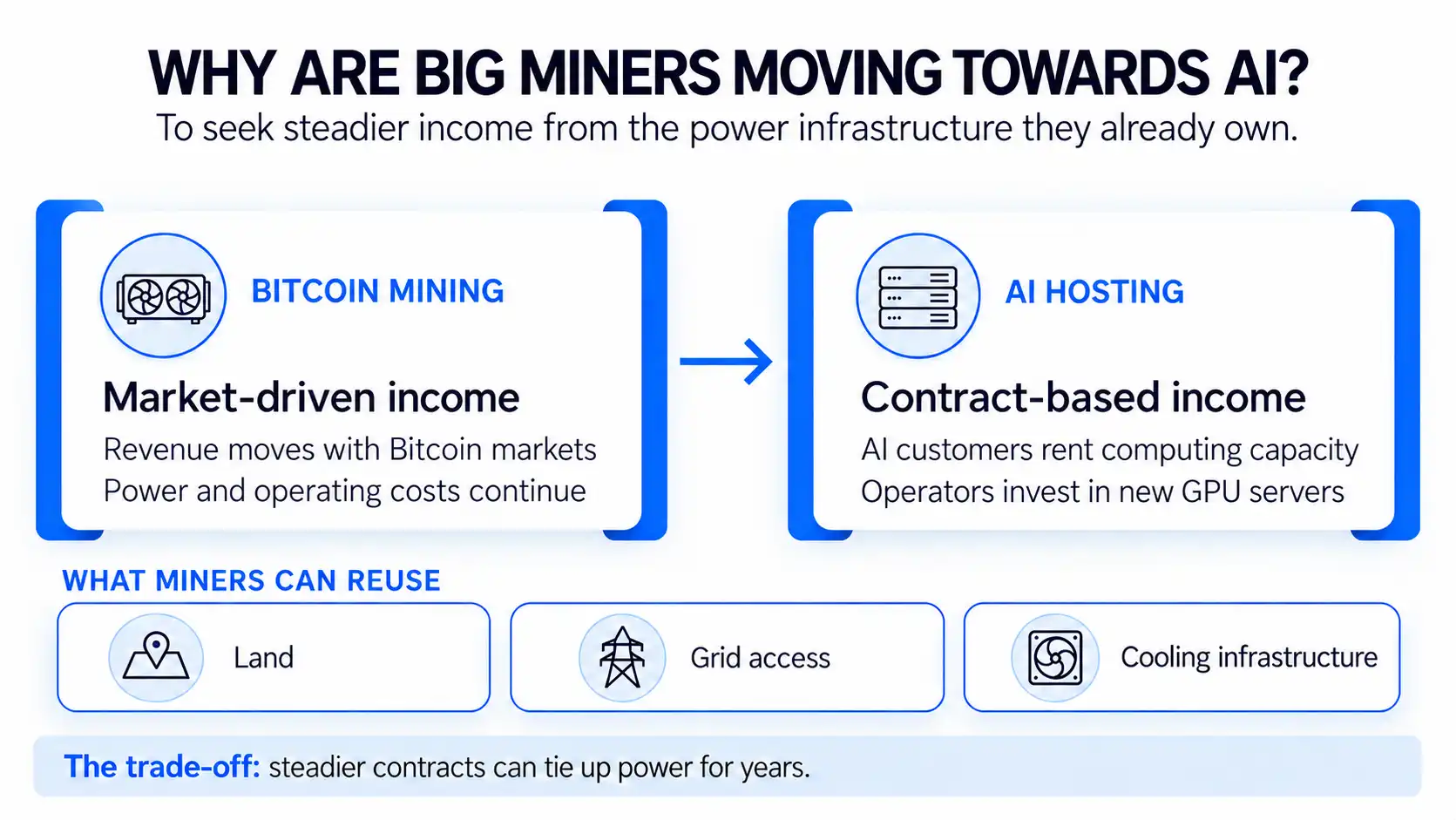
Money is the short answer. Hashprice, which is the daily revenue a miner earns per petahash of hashing power, fell to roughly $28 to $30 per petahash per day in the first quarter of 2026. CoinShares also put the weighted average cash cost to produce one bitcoin at listed miners at about $79,995 around the same time. When costs sit that close to the coin’s price, owners look for steadier income.
Artificial intelligence companies need what miners already own: land, grid connections, and cooling. CoinShares has said listed miners could earn as much as 70% of their revenue from artificial intelligence and high-performance computing (HPC) contracts by the end of 2026, up from about 30% earlier in the year. Public miners were also reported to be developing around 30 gigawatts of capacity aimed at artificial intelligence work. MARA and CleanSpark both said in May that they would expand their focus in this direction.
That pivot has a side effect you can see on-chain. Some miners switched machines off, and the difficulty adjustment on June 14 fell 10.09%, one of the larger drops in Bitcoin’s history.
| Faktorisieren | Bitcoin Bergbau | Artificial Intelligence Hosting |
|---|---|---|
| Hardware | ASIC machines built for one algorithm | GPUs and servers |
| Einnahmen | Moves with coin price and difficulty | Often set by long-term contracts |
| Flexibilität | Can switch off or relocate quickly | Power is locked in for the contract term |
| Entry cost | A single machine is enough to start | Needs large capital and grid access |
| Best fit | Home miners, small farms, hosted units | Large operators with big power capacity |
Not every company is making the same bet. A miner that signs a long lease can’t flip that power back to bitcoin if prices jump. Those who stay in mining could face less competition if more rivals leave.
What Do the Bitcoin Network Numbers Look Like Right Now?
Here’s where things stand in late October. Hashrate recovered above 1,000 EH/s in mid-October, which equals 1 ZH/s. The October 16 retarget at block 971,712 raised difficulty by 5.92%, from 132.72 trillion to 140.58 trillion. The block reward remains 3.125 BTC after the April 2024 halving.
| Metrik | Latest Reading | What It Means for You |
|---|---|---|
| Network hashrate | Above 1,000 EH/s (dashboards differ) | More competition for each block |
| Schwierigkeit | 140.58 trillion | Each machine earns slightly less per terahash |
| Last adjustment | +5.92% on October 16 | Rewards for the same hashrate dipped |
| Blockbelohnung | 3,125 BTC | Fixed until the next halving |
| Hashpreis | About $28 to $30 per PH/s per day in Q1 | Margins stay thin for older machines |
Dashboards don’t always agree. Readings for the same week ranged from roughly 927 EH/s to 1,080 EH/s depending on the averaging window. Early estimates for the next adjustment, due around the end of October, also vary. Treat any single number as a snapshot. For a crypto miner, the practical takeaway is simple: recheck your profit estimate after every retarget instead of trusting last month’s math.
What Are the Real Benefits for Miners in 2026?
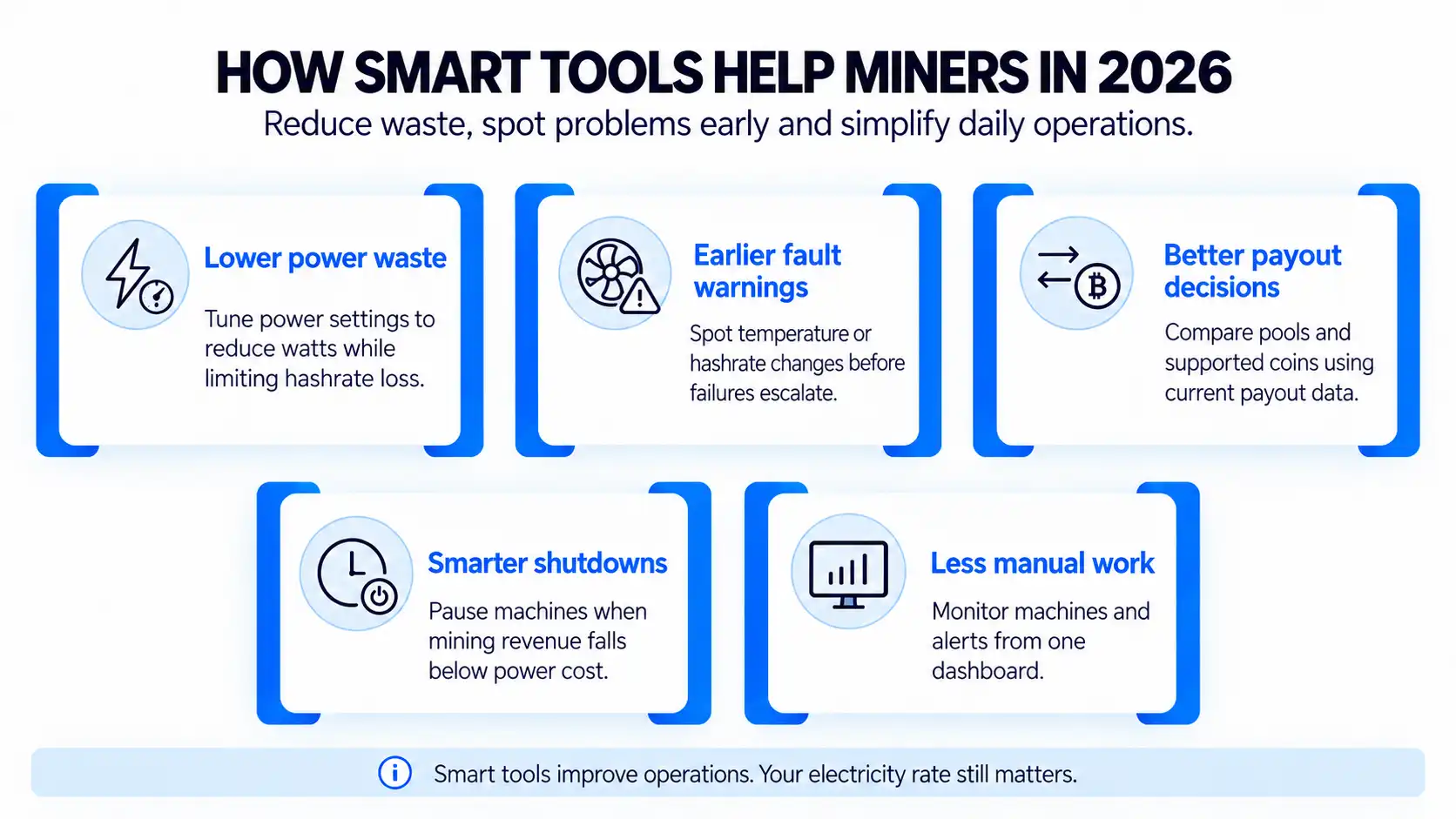
Smarter tools won’t turn a bad power contract into a good one. They do shave costs and protect uptime, and those gains add up when margins are tight. AI helps most with repetitive monitoring jobs, which matters in ASIC mining, where one overheated board can erase a day’s profit.
- Lower power waste: Tuning each machine to its sweet spot trims watts without a big loss in hashrate.
- Fewer surprise failures: Early warnings let you replace a fan before a board overheats.
- Better decisions about coins and pools: Software can compare payouts across algorithms and pools, so you don’t have to rely on a hunch.
- Smarter shutdown timing: Automatic rules can switch machines off when revenue drops below your power cost.
- Less manual work: One dashboard replaces walking the rack with a laptop.
| Vorteil | Who Gains Most | How to Capture It |
|---|---|---|
| Efficiency tuning | Home and small-farm miners | Test firmware settings one change at a time |
| Failure prediction | Farms with 20+ machines | Set alerts on temperature and board hashrate |
| Power scheduling | Anyone on time-of-use rates | Use timers or curtailment rules |
| Profit tracking | Every miner | Refresh your calculator after each retarget |
The clearest link between smart tools and AI mining profitability is simple arithmetic. If tuning cuts your draw by 5% and your power bill is your highest cost, that saving lands directly on your bottom line.
Which Antminer Models Fit Today’s Market?
Three Bitmain machines show how different the choices can be. Each one is built for a different algorithm, so they don’t compete head to head. ASIC mining rewards hardware built for one algorithm, so the machine you choose sets your coin, your power draw, and your noise level before any software gets involved. Figures below are manufacturer ratings and recent prices, and both can change.
| Spezifikation | Antminer S21 XP | Antminer L9 | Antminer Z15 Pro |
|---|---|---|---|
| Algorithmus | SHA-256 | Scrypt | Equihash |
| Main coin | Bitcoin | Dogecoin, Litecoin | Zcash |
| Hashrate | 270 TH/s | 15 to 17 GH/s | 840 KSol/s |
| Strom | 3,645 W | 3,360 to 3,570 W | 2,780 W |
| Effizienz | 13,5 J/TH | About 210 J/GH | 3,31 J/KSol |
| Lärm | 76 dB | 75 dB | 75 dB |
| Größe | 449 x 219 x 293 mm | 400 x 195 x 290 mm | 428 x 195 x 290 mm |
| Garantie | 365 Tage | 180 days | 180 days |
| Recent price | $3,299 | $2,539 | $8,299 to $11,799 |
What Is the Antminer S21 XP Built For?
Die S21 XP mines Bitcoin on the SHA-256 algorithm. It draws 3,645 W and needs 220 to 277 V input, weighs 18.7 kg, and runs four fans. Bitmain rates it for temperatures from -20 to 45 °C, and a power supply ships with it. Low watts per terahash is its main appeal.
What Does the Antminer L9 Offer?
Die L9 runs Scrypt, so it mines Dogecoin and Litecoin, plus Bells. The hashrate depends on the version you pick, from 15 to 17 GH/s, and power ranges from 3,360 to 3,570 W. At 16 GH/s and 3,360 W, that works out to about 210 J/GH. The unit weighs about 14.2 kg and carries a 180-day warranty.
Where Does the Antminer Z15 Pro Fit?
Die Z15 Pro uses Equihash and delivers 840 KSol/s at 2,780 W, which is 3.31 J/KSol. It has two fans, weighs 16.95 kg net, and works between 0 and 40 °C. Besides Zcash, it can also handle Horizen, Komodo, Pirate Chain, and Hush. Supply comes in batches, with December and March to April 2027 arrivals expected.
How Much Can These Machines Earn?
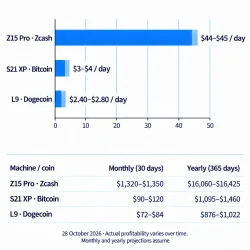
The table below shows calculator estimates pulled at the time of writing. The electricity rate behind them isn’t stated, so rerun the numbers with your own rate before you decide anything.
| Machine and Coin | Profit per Day | Profit per Month | Profit per Year |
|---|---|---|---|
| S21 XP, Bitcoin | $3- $4 | $90-$120 | $1,095 |
| L9, Dogecoin | $2.40- $2.80 | $72-$84 | $876-$1,022 |
| Z15 Pro, Zcash | $44- $45 | $1320-$1350 | $16,494.40 |
On Dogecoin, the L9 earns a steady but modest profit compared with the other machines. It suits miners who want a lower upfront cost and are happy with smaller daily returns.
Take the Zcash row with care. It’s far higher than the other machines, and Zcash’s price and difficulty can swing hard. Check a live calculator before you trust it.
Here’s a rough payback check using the lowest recent price and today’s monthly profit:
- S21 XP: $3,299 divided by $90 is about 37 months
- L9 on Dogecoin: $2,699 divided by $72 is about 37 months
- Z15 Pro: $8,299 divided by $1,320 is about 6 months, if the calculator holds
Those are illustrations, not forecasts. Profit moves with these factors:
- Electricity price per kWh
- Coin price on the day you sell
- Network difficulty, which resets about every two weeks
- Uptime, pool fees, and cooling costs
- Hardware price and shipping or import taxes
A lower payback on paper doesn’t protect you if a coin’s price falls by half. Live prices and monitoring data make AI mining profitability estimates less of a guess, though they never become a promise.
How Can You Add Smart Tools to Your Mining Setup, Step by Step?
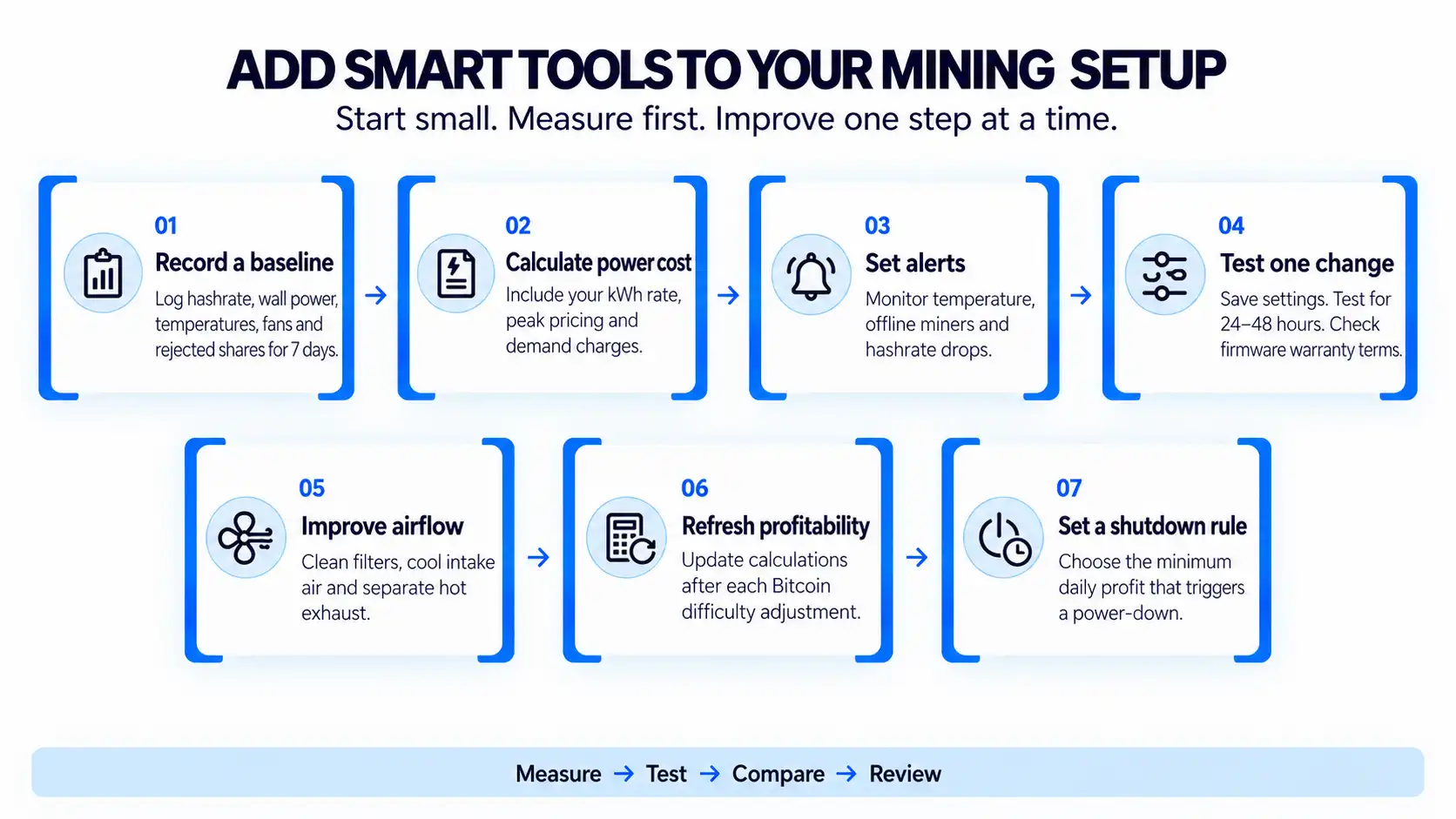
You don’t need a data center. A Kryptominer with a few machines can get most of the benefit with free or low-cost tools. Work through these steps in order.
- Record a baseline for seven days. Log hashrate, watts at the wall, chip temperatures, fan speeds, and rejected shares. You can’t judge a change without this.
- Know your true power cost. Find your rate per kWh, any peak-hour pricing, and demand charges. Put the real number into your calculator.
- Set up monitoring and alerts. Use your pool dashboard, the miner’s own web page, or farm software. Alert on temperature, offline units, and hashrate drops.
- Test tuning one change at a time. Adjust one setting, run 24 to 48 hours, and compare efficiency. Save your original settings first, and check what your warranty says about custom firmware.
- Fix the environment. Clean filters, keep intake air cool, and separate hot and cold aisles if you have more than a few machines.
- Review after every difficulty adjustment. Retargets happen every 2,016 blocks. Update your profit numbers each time.
- Write a shutdown rule. Decide in advance what daily profit per machine triggers a power-down, so emotion doesn’t make the call.
A few real-world notes. A 3,645 W machine pulls roughly 15 amps at 240 volts, so give it a dedicated circuit with headroom and let a licensed electrician confirm the setup. At 75 to 76 dB, a loud unit belongs in a garage or outbuilding, not a spare bedroom. Budget for shipping, duties, and a spare fan too.
What Are the Risks of Relying on Artificial Intelligence in Mining?
Smart tools help, but they aren’t magic. Keep these cautions in mind:
- Aggressive tuning can shorten hardware life. Pushing voltage for a bit more hashrate may cost you a board.
- Warranty terms vary. Check whether custom firmware affects coverage before you flash anything.
- Cloud dashboards hold your data. Review what a service can see about your machines and wallet addresses.
- Predictions are estimates. Treat AI tools as advisors, and confirm a warning with your own readings.
- Industry shifts can move the market. Miners selling coin reserves to fund new computing projects may add short-term price pressure.
Schlussfolgerung
Start small and measure everything. AI in Crypto Mining rewards patient operators who track efficiency, keep machines cool, and update their math after each retarget. Hashprice near record lows leaves little room for guesswork, and the bigger players are already moving part of their capacity elsewhere.
If you’re researching hardware, the S21 XP, L9, and Z15 Pro give you a useful look at how three different algorithms compare on power and output. Whichever one you lean toward, ASIC Marketplace is one place to compare specs and current pricing before you commit. Run your own numbers, start with one machine, and let the data guide your next move.
Häufig gestellte Fragen
-
What are the benefits of AI in crypto mining?
Smart tools tune each machine for lower power use, warn you early when fans or boards start to fail, and help you choose better coins and pools. Together, these cut waste and downtime, which matters when mining margins are thin.
-
Can AI improve mining profitability?
Yes. Lower power draw and fewer outages raise your profit per machine, as in the example where a 5% power saving goes straight to your bottom line. It can’t guarantee earnings, because coin price and network difficulty still decide the final result.
-
Is AI useful for home miners?
Yes. Free or low-cost tools for monitoring, alerts, and profit tracking help a few machines run cooler and stay online. The biggest gains come from steady tuning and clear shutdown rules, not from big spending.

Peter Davis
Peter Davis ist ein versierter Blockchain-Analyst und technischer Autor mit über vier Jahren Erfahrung im Kryptowährungssektor. Sein Fachwissen umfasst die Blockchain-Infrastruktur, ASIC-Mining-Hardware und die Märkte für digitale Vermögenswerte, wo er für die Übersetzung komplexer technischer Konzepte in präzise, aufschlussreiche und zugängliche Analysen für ein globales Publikum bekannt ist.
Mit einer soliden Grundlage in technischer Forschung und Marktbewertung konzentriert sich Peters Arbeit auf die Verbindung von Blockchain-Innovationen mit praktischen Mining- und Investitionsstrategien. Seine Texte zeichnen sich durch analytische Tiefe, Klarheit und einen Fokus auf datengestützte Erkenntnisse aus, die sowohl Profis als auch Enthusiasten durch die sich entwickelnde Kryptolandschaft führen.
Angetrieben von einer tiefen Leidenschaft für Web3-Technologie und dezentrale Systeme, produziert Peter weiterhin maßgebliche, forschungsbasierte Inhalte, die das Verständnis für die ASIC-Mining-Leistung, die Blockchain-Effizienz und die breitere Dynamik, die die Zukunft des digitalen Finanzwesens prägt, verbessern