If you’ve been watching criptomoneda mining in the last few years, you’ve likely noticed something major is shifting. It’s not about just buying the most powerful ASIC mining machine and then pointing it at a pool. The mining industry of 2026 will be smarter, more efficient, and more data-driven than it has been previously.
Artificial Intelligence has sneaked into the nooks and crannies within the ASIC mining farm’s operations. From how cooling systems perform in real-time to the way rigs are monitored, repaired, or even replaced, AI is the invisible hand that makes everything run more effectively. As the market becomes more competitive due to rising difficulties in the network and fluctuations in Bitcoin prices, miners who fail to take advantage of this trend will be able to feel it in their bottom line.
The truth is that operating a profitable mining business in 2026 is no longer an exercise in hardware. Indeed, having the right ASIC mining machines is still crucial. However, the farms leading the way right now are those that have the best technology with AI-driven layers of intelligence, such as predictive analytics, as well as automated power management, intelligent cooling, and even machine-learning algorithms that determine the most optimal moment to sell or mine.
This blog explains everything you must be aware of. We’ll guide you through the most recent ASIC hardware specifications and the actual mining benefits from May 2026. We’ll describe precisely the ways AI is used within contemporary mining operations. We’ll also provide an easy-to-follow guideline for integrating AI into your operation, regardless of whether you’re running an individual farm or an industrial-scale facility.
What Is an ASIC Mining Farm?
ASIC means Application-Specific Integrated Circuit. So basically, it’s not like a general-purpose computer or a GPU rig where you can juggle all kinds of tasks. An ASIC miner is put together for one job, and one job only, basically to work on the cryptographic puzzles that confirm transactions on a blockchain network like Bitcoin. Since it’s made exclusively for that, it can do it super quickly, and with a lot more efficiency compared to other hardware types, honestly.
The term “ASIC ” refers to an ASIC mining facility that is essentially an establishment that ranges from a garage that has a couple of machines to a massive warehouse data center that houses thousands of units. The ASIC mining machines are stacked in rows, connected to power sources, connected to the internet, and ready to go on all hours of the day.
Here’s what a typical mining farm setup includes:
- Mining ASIC: the primary equipment (Antminer S21 Pro, Whatsminer M6DS++, etc.)
- Power supply units (PSUs): High-wattage power supply units that supply miners.
- Cooling infrastructure: The cooling infrastructure includes HVAC systems, tanks for immersion, or hydro-cooling systems
- Network equipment: switches, routers, and Ethernet cabling to ensure dependable connectivity.
- Monitors and dashboards: Software that keeps track of each miner’s hashrate, temperature, time of operation, and amount of money they earn.
- Connections to mining pools, Pools like Foundry USA, AntPool, or F2Pool.
The larger the farm, the more power it uses, as well as the higher heat it creates, and the more difficult it gets to manage. This is where AI comes in. Since, at a large scale, the margin for error is very tiny, manually directing thousands of rigs simply isn’t enough anymore.
Key Industry Numbers (May 2026)
| Métrica | Current Value |
| Bitcoin Network Difficulty | ~145 Trillion |
| Bitcoin Price (approximate) | $74,000 – $100,000+ |
| Hashprice (approx.) | ~$32–$40 per PH/day |
| Global AI in Mining Market Size | USD $35.47 Billion (2025) |
| Projected AI in Mining Market by 2034 | USD $828.33 Billion |
| CAGR of AI in Mining (2026–2035) | ~41.92% |
These numbers tell the story. The stakes are enormous. The efficiency gap between an AI-optimized farm and a traditionally managed one is only going to widen from here.
How AI Is Changing the Way Mining Farms Operate
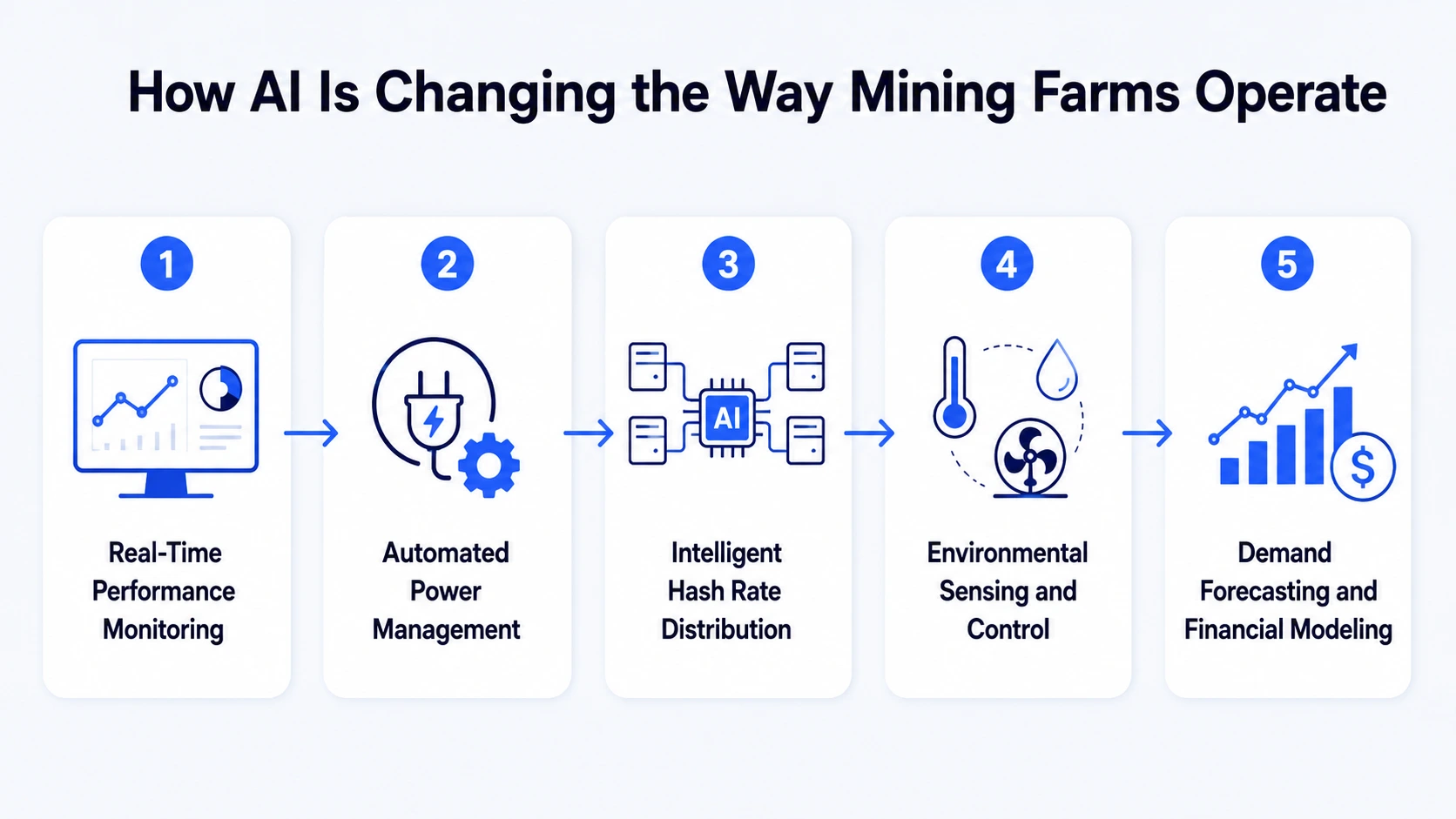
If people say “AI is changing mining farms,” what do they mean by that in terms of practical application? To unlock the secrets of human behavior’s a rundown of the main ways artificial intelligence can be used currently in real-time operations around the globe.
Real-Time Performance Monitoring
Traditional monitoring tools give you data after the fact: you see that a miner dropped its hashrate hours ago, or you only find out a board failed when your earnings dip. AI-powered monitoring systems do things a bit differently; they’re ingesting thousands of data points per second from every miner in your fleet, temperature readings, fan speeds, voltage levels, and hashrate output included. Then, machine learning algorithms are used to spot irregular patterns early, basically before the situation turns into a real issue.
Instead of reacting in response to the failure, you’re preventing them from happening. AI systems might indicate the fact that Miner 24/7 is running 4 °C more than normal, and the fan has shown signs of wear early. It is possible to swap fans before the board gets fried. This is the difference between a repair of $50 and replacing the board for $500+.
Automated Power Management
Electricity is the single biggest ongoing cost in any ASIC mining farm. AI-powered energy management systems monitor power consumption at the individual miner level and at the facility level simultaneously. They can:
- Throttle miners automatically when power costs spike during peak demand hours.
- Run at full speed once the off-peak pricing kicks in.
- Get involved in demand-response programs, for example, ERCOT in Texas, where grid operators are compensated to curtail power usage during periods of stress on the system.
- Balance loads across different power circuits to prevent tripping breakers.
Riot Platforms is a real-world example here. The company reportedly earned approximately $31 million in energy credits during a single Texas heat wave month by shutting down mining rigs when the grid needed relief. That’s AI-assisted energy arbitrage at scale.
Intelligent Hash Rate Distribution
AI algorithms can also find out where the hash power should go. If you are mining more than one coin or bouncing between pools de minería, machine learning models can look at profitability data in real time and sort of nudge or redirect your miners to the best option at that moment. Sometimes it happens automatically, without you needing to watch every detail, which is kind of helpful and also a little bit sneaky in how fast it adapts.
Environmental Sensing and Control
Modern AI systems kind of integrate with environmental sensors throughout the facility to watch ambient temperature, humidity, airflow patterns, and dust build-up. The whole thing automatically tunes cooling outputs, opens and closes vents, and notifies operators about environmental conditions that might damage the hardware or make it less stable over time.
Demand Forecasting and Financial Modeling
Some mining operations that are advanced use AI to predict future mining profits under a variety of scenarios, including Bitcoin price decreases, as well as difficulty and electricity costs, and other changes. They also take proactive decisions on whether to sell, hold, or stop operations temporarily.
Top ASIC Miners of 2026: Specs, Hashrates, and Real-World Rewards
Choosing the right hardware is still foundational. Here’s a look at the top Mineros ASIC currently deployed in professional farms as of May 2026.
Bitmain Antminer S21 Pro (234 TH/s)
This is arguably the most widely used air-cooled Bitcoin miner in professional farms right now.
| Especificación | Valor |
| Tasa de hash | 234 TH/s |
| Consumo de Energía | 3.510W |
| Eficiencia energética | 15 J/TH |
| Algoritmo | SHA-256 |
| Nivel de ruido | 76 dB |
| Temperatura de funcionamiento | -20°C to 45°C |
| Daily Revenue (est.) | ~$8.65 |
| Coste diario de la electricidad (a 0,07 €/kWh) | ~$5.90 |
| Net Daily Profit (@ $0.07/kWh) | ~$2.75 |
| Monthly Net Profit (@ $0.07/kWh) | ~$82.50 |
| Yearly Net Profit (@ $0.07/kWh) | ~$1,003.75 |
La Bitmain Antminer S21 Pro uses the BM1370 chip, which is a significant improvement over the BM1368 chip that is used in the regular S21. Each BM1370 chip can deliver approximately 750+ GH/s, which is the reason why the S21 Pro achieves a higher total hashrate using fewer chips than the predecessor.
Bitmain Antminer S21 XP (270 TH/s)
The newest top-tier air-cooled option, Bitmain Antminer S21 XP from Bitmain.
| Especificación | Valor |
| Tasa de hash | 270 TH/s |
| Eficiencia energética | 13.5 J/TH |
| Algoritmo | SHA-256 |
| Liberar | November 2025 |
| Profitability Threshold | Remains profitable down to ~$48,000 BTC |
| Daily Profit (@ $0.04/kWh) | ~$4.41 |
MicroBT Whatsminer M6DS++ (556 TH/s Hydro)
MicroBT Whatsminer M6DS++ is built for large-scale mining farms that require advanced liquid cooling infrastructure.
| Especificación | Valor |
| Tasa de hash | ~600 TH/s |
| Consumo de Energía | ~9,200W (peak) |
| Eficiencia energética | ~15.5 J/TH |
| Tipo de refrigeración | Hydro-cooled |
| Target Operator | Industrial/institutional farms |
| Daily Revenue (est. @ mid-March 2026) | ~$17.81 |
| Daily Net Profit (@ $0.06/kWh) | ~$4.10 to $5.51 |
Antminer S21 (Standard, 200 TH/s)
Antminer S21 is still widely used in mining farms as a reliable workhorse unit.
| Especificación | Valor |
| Tasa de hash | 235 TH/s |
| Consumo de Energía | 3,564W |
| Eficiencia energética | 17.5 J/TH |
| Daily Revenue (est.) | ~$7.30 |
| Net Daily Profit (@ $0.07/kWh) | ~$1.42 |
Quick Comparison Table: Top 2026 ASIC Miners
| Miner | Tasa de hash | Eficacia | Refrigeración | Lo mejor para |
| Antminer S21 XP | 270 TH/s | 13.5 J/TH | Aire | Efficiency-focused farms |
| Antminer S21 Pro | 234 TH/s | 15 J/TH | Aire | High-performance air farms |
| Whatsminer M6DS++ | ~600 TH/s | ~15.5 J/TH | Hidro | Large industrial operations |
| Antminer S21 (standard) | 235 TH/s | 17.5 J/TH | Aire | Budget-conscious operations |
Mining earnings are heavily influenced by the price of Bitcoin, the network’s difficulty, and your electricity costs. With difficulty as high as 140 trillion and Bitcoin trading between $74,000 and $100,000 to mid 2026, miners who pay electricity rates less than $0.07/kWh typically earn a profit. Miners who pay $0.10/kWh or more will have limited margins when using older equipment.
AI-Powered Cooling and Energy Management in Mining Farms
Cooling is the primary cause of profit in the case of an ASIC mining operation. Every watt you use up on heat doesn’t go to hashing Bitcoin. If you’re running hundreds or thousands of miners, inefficient thermal management can do more than just reduce efficiency. It also damages equipment, increases costs for electricity, and even creates fire hazards.
This is among the areas in which AI provides the most tangible and tangible results.
How Traditional Cooling Works (And Why It Falls Short)
In a traditional mining farm setup, industrial fans run at fixed speeds. HVAC systems operate on simple temperature thresholds. If the room hits 30°C, the cooling kicks up to maximum. That’s a blunt instrument. It is inefficient due to over-cooling in certain areas, creating hot spots in other zones. It doesn’t take into account the individual behavior of miners as well as airflow dynamics, or the way that heat patterns change over time as miners get older.
The AI-Powered Cooling Difference
Modern AI cooling management systems treat the farm as a living, breathing thermal map. Here’s what they do differently:
- Individual miner thermal profiling: Each machine gets its own thermal baseline. The AI knows what “normal” looks like for every unit and flags deviations instantly.
- Dynamic cooling based on zone: instead of cooling all warehouses evenly, AI adjusts cooling at the rack or zone level, which sends cooler air to most hot areas and reduces airflow to areas where temperatures are already high enough.
- Predictive load management of cooling loads: This system is able to recognize patterns over the course of time. It recognizes it is Tuesday, and during the summer months, the temperature is usually higher between 2-4 p.m The system prepares the facility for that temperature before it occurs.
- Integrate immersion and hydrocooling: In farms with liquid cooling (increasingly frequent for ultra-high density deployments such as that of the Whatsminer M6DS series), AI systems regulate cooling rates, loop temperatures, and the pressures of pumps to optimize efficiency.
Energy Cost Optimization
AI energy management also goes beyond cooling. At the facility power level, smart systems can:
- Track real-time electricity pricing in markets with variable tariffs
- Automatically scale up mining intensity during the cheapest hours of the day
- Push machines into low-power mode during expensive peak periods
- Flag opportunities to participate in grid demand-response programs for additional revenue
A farm running 1000 Antminer S21 Pro units pulls roughly 3.51 megawatts each day. At $0.07 per kWh, this ends up near 245,700 dollars, monthly for electricity, give or take. If you can cut that load by around 10% thanks to AI-based optimization, you might keep about 25,000 dollars per month, which is almost 300,000 per year. That’s not really a little number.
Predictive Maintenance: How AI Helps Mining Rigs Run Longer
Predictive maintenance is one of the most valuable AI applications in modern mining farms. By analyzing machine temperature, power usage, fan speed, hash rate, and performance patterns in real time, AI can detect early warning signs before they become serious hardware issues.
This helps mining farms reduce downtime, protect ASIC miners, improve operational stability, and keep more machines running efficiently for longer periods. At scale, even small improvements in uptime can support stronger revenue performance and better long-term hardware life.
What Predictive Maintenance Actually Does
Traditional maintenance is either reactive, like fixing it when it breaks, or scheduled, meaning you check it every 30 days, whether it needs it or not. Predictive maintenance is kinda different: it relies on machine learning models that are trained on past failure records, to guess when a particular part might fail before it even does.
The AI system monitors:
- Fan performance data: RPM, power draw, vibration signatures, and acoustic patterns that indicate bearing wear
- Hashboard temperatures: Anomalous heat distribution that suggests a failing chip or a clogged thermal pad
- Voltage fluctuations: Irregular power delivery that could indicate PSU degradation
- Hashrate drift: A gradual decline in output that often precedes a hard failure
- Connectivity patterns: Intermittent connection drops that can indicate controller board issues
If the AI detects a pattern that typically indicates failure, it sends an alert that can be days or even weeks prior to when the actual breakdown has occurred. The technician can take care of the machine within a scheduled maintenance time instead of having to handle an emergency malfunction.
Real-World Impact on Farm Profitability
Suppose you’re running a farm of 500 Antminer S21 Pro units. Each unit earns a net profit of approximately $2.75 per day at $0.07/kWh electricity.
If predictive maintenance reduces your average unplanned downtime from 5% to 1%:
| Métrica | Without AI Maintenance | With AI Maintenance |
| Average daily downtime (units) | 25 units | 5 units |
| Daily lost revenue | $68.75 | $13.75 |
| Monthly lost revenue | ~$2,062 | ~$412 |
| Annual difference | ~$19,800 saved |
Multiply this across a 2,000-unit farm, and you’re looking at nearly $80,000 per year in prevented losses just from better maintenance practices. And that doesn’t even account for extended hardware lifespan, reduced replacement costs, and fewer emergency repair expenses.
AI and Dynamic Mining Pool Optimization
Most miners set up their machines, point them at a pool, and largely forget about pool selection. But in a competitive market, the pool you mine on and how your hash power is distributed across pools can make a meaningful difference in your earnings.
AI-powered mining management platforms are beginning to tackle this with dynamic pool switching algorithms. Here’s the concept:
- The AI monitors real-time data from multiple mining pools simultaneously: fee structures, variance rates, estimated time-to-payout, current pool luck, and block discovery rates.
- It calculates the expected earnings from each pool on an ongoing basis, adjusted for your specific hashrate contribution.
- When the expected earnings from an alternative pool exceed your current pool’s projected earnings by a meaningful margin, the system automatically reroutes your hash power.
This sounds simple, but the calculations are complex. Pool luck fluctuates constantly. Fee structures vary. Some pools use FPPS (Full Pay Per Share), others use PPLNS (Pay Per Last N Shares), and each has different risk/reward profiles for different farm sizes.
Common Mining Pool Formats Compared
| Pool Type | Método de pago | Varianza | Lo mejor para |
| FPPS | Full Pay Per Share + tx fees | Muy bajo | Stable income, large farms |
| PPS+ | Pay Per Share + some tx fees | Bajo | Consistent daily payouts |
| PPLNS | Pay Per Last N Shares | Medio | Long-term miners, lower fees |
| SOLO | Occasional full block reward | Muy alta | Large hash farms only |
AI optimization is most valuable for farms large enough to meaningfully impact pool minero dynamics, typically farms with 1 PH/s or more in total hashrate. For smaller operations, the pool selection decision matters less on a day-to-day basis, though the principle still applies.
Top pools as of 2026 include Foundry USA, AntPool, ViaBTC, F2Pool, and Binance Pool. Each has its own fee structure and payout frequency. AI tools help you navigate these options without having to monitor each one manually.
Mining farms are increasingly becoming a strong foundation for the next generation of AI data centers. As AI companies require large amounts of computing power, stable electricity, and advanced cooling systems, many mining facilities are well-positioned to support this growing demand. Companies such as IREN, Core Scientific, TeraWulf, Riot Platforms, and CleanSpark are exploring or expanding into AI computing workloads because mining farms already have the power infrastructure, industrial cooling, and large-scale operating experience needed for high-performance data operations. This shift creates new growth opportunities for miners by allowing them to use existing infrastructure for both Bitcoin minería and AI hosting, making their operations more flexible, valuable, and future-ready.
Why Mining Farms Are Natural AI Infrastructure
Mining facilities already have:
- Large, stable power contracts at competitive rates
- Industrial cooling systems capable of managing extreme heat loads
- High-density rack infrastructure that can handle 35–50 kW per rack
- Experienced technical teams skilled in managing high-heat, high-power computing environments
- Redundant power systems, including backup generators
The main upgrades needed for AI hosting are high-speed networking (GPUs need much more bandwidth than ASIC miners) and, in some cases, more precise cooling systems for GPU-based workloads.
The Revenue Opportunity
As of Q4 2025, AI and high-performance computing accounted for roughly 30% of revenue across listed miners on average. Projections suggest this could reach 70% by the end of 2026 for operators with executed contracts. IREN’s partnership with Microsoft alone is projected to generate $1.94 billion in annualized revenue at an 85% project-level EBITDA margin, numbers that dwarf what even the most efficient Bitcoin mining operation can produce.
Should You Pivot?
For individual miners and small farms, the AI data center pivot isn’t really an option; it requires massive capital, enterprise sales relationships, and purpose-built infrastructure upgrades. But understanding this trend matters because:
- It shapes Bitcoin’s network dynamics (as large miners leave, difficulty adjustments can actually benefit smaller operators)
- It illustrates where the major players see long-term value
- It may open up opportunities to partner with or provide services to larger operators
For now, the hybrid model of maintaining core mining operations while exploring AI infrastructure revenue streams appears to be the most resilient strategy.
Step-by-Step Guide: How to Start an AI-Integrated ASIC Mining Farm
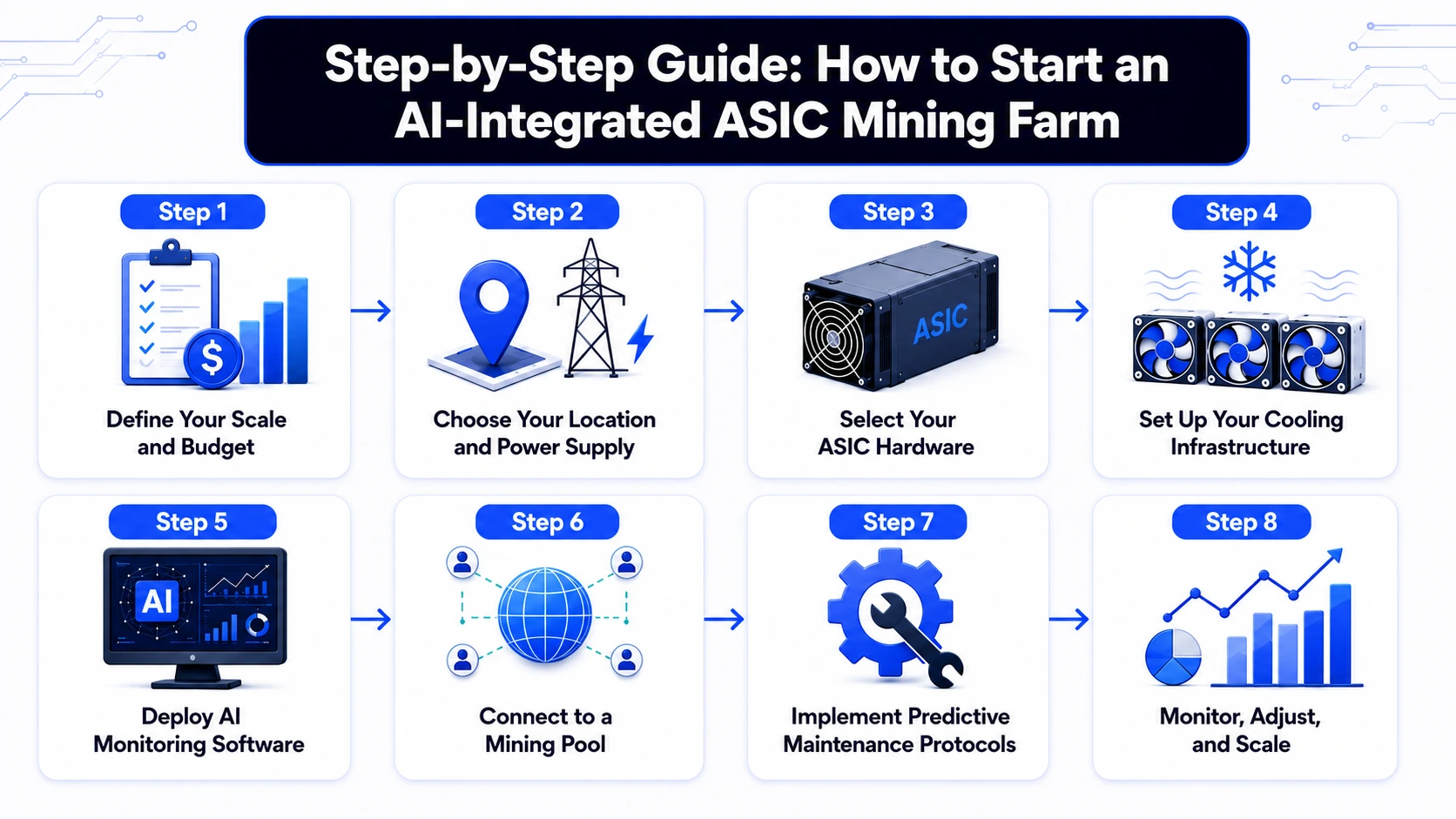
Ready to build or upgrade a mining farm with AI capabilities built in from the ground up? Here’s a practical, step-by-step guide based on what’s actually working in real operations right now.
Step 1: Define Your Scale and Budget
Before you buy a single machine, get clear on your numbers.
- Small farm: 10–50 units. Budget $50,000–$300,000 for hardware. AI tools at this scale are mostly software-based monitoring platforms.
- Mid-scale farm: 100–500 units. Budget $500,000–$3M. Start integrating hardware-level energy management and cooling automation.
- Large farm: 500+ units. Budget $3M+. Full AI stack including predictive maintenance, dynamic pool switching, and environmental control systems.
Step 2: Choose Your Location and Power Supply
Power is everything. Your target electricity cost should be below $0.07/kWh to operate profitably with current-generation hardware. Consider:
- Iceland and Scandinavia: ~$0.03–0.05/kWh (geothermal and hydro)
- Canada (Quebec, Alberta): ~$0.04–0.06/kWh (hydro)
- U.S. (Texas, Wyoming, Montana): ~$0.04–0.07/kWh depending on contracts
- High-cost regions to avoid: Germany (~$0.25/kWh), Japan (~$0.22/kWh)
Make sure your location has the power infrastructure to support your planned load. A 500-unit S21 Pro farm draws approximately 1.76 MW continuously.
Step 3: Select Your ASIC Hardware
For new builds in 2026, we recommend:
- Best efficiency: Antminer S21 XP (270 TH/s, 13.5 J/TH)
- Best value/performance balance: Antminer S21 Pro (234 TH/s, 15 J/TH)
- Large industrial deployments: Whatsminer M6DS++ (556 TH/s, hydro)
Avoid purchasing anything older than the S19 series unless the price is extremely low. Older machines struggle to remain profitable at current difficulty levels.
Step 4: Set Up Your Cooling Infrastructure
Match your cooling to your hardware:
- Air-cooled miners (S21 series): Industrial fans + HVAC with AI-controlled variable speed drives
- Hydro-cooled miners: Closed-loop liquid cooling systems with AI-managed pump controls
- Refrigeración por inmersión option: Dielectric fluid tanks have a higher upfront cost, but the best long-term thermal efficiency
Step 5: Deploy AI Monitoring Software
The following platforms are widely used in professional mining operations:
| Platform | Características clave | Lo mejor para |
| Foreman, MN | Fleet management, real-time alerts | Small-to-mid farms |
| minero impresionante | Multi-pool support, automation | Mid-scale farms |
| Bitmain’s Antspace | Native integration for Bitmain hardware | Bitmain-heavy fleets |
| BraiinsOS+ | Autotuning, efficiency optimization | Performance-focused miners |
| Custom solutions | Full AI stack, custom dashboards | Large industrial farms |
Step 6: Connect to a Mining Pool
Set up accounts with at least two pools for redundancy. Configure your miners to failover automatically if your primary pool goes offline. Use the AI platform’s pool optimization features if available.
Step 7: Implement Predictive Maintenance Protocols
Set your AI system to alert you when:
- Any miner’s temperature exceeds its baseline by more than 5°C
- Fan RPM drops below 80% of normal operating speed
- Hashrate drops more than 3% below expected output
- Voltage readings deviate by more than ±2%
Conduct physical inspections of flagged machines within 24 hours of any alert. Keep a small stock of replacement fans, thermal pads, and PSU components on hand.
Step 8: Monitor, Adjust, and Scale
Review your AI dashboard reports weekly. Look for:
- Underperforming units
- Unusual energy consumption patterns
- Pool profitability trends
- Opportunities to optimize cooling costs
Once your operation is running smoothly at its initial scale, AI tools make it significantly easier to add capacity without proportionally increasing your management overhead.
Comparing Traditional vs. AI-Powered Mining Farms
Let’s put this all together in a direct comparison. Here’s how a traditionally managed farm stacks up against an AI-integrated operation of similar scale.
Assumptions: 500-Unit Antminer S21 Pro Farm, $0.07/kWh electricity
| Category | Traditional Farm | AI-Integrated Farm |
| Monthly hardware monitoring time | 80–120 hours | 20–30 hours |
| Average unplanned downtime rate | 4–6% | 1–2% |
| Monthly lost revenue (downtime) | ~$1,650 – $2,475 | ~$412 – $825 |
| Cooling energy waste | 15–20% excess | 5–8% excess |
| Pool optimization | Manual, infrequent | Automated, real-time |
| Failure detection time | Hours to days | Minutes to hours |
| Hardware lifespan (average) | 24–30 months | 30–40 months |
| Energy arbitrage participation | Rare/manual | Automated |
| Staff required (per 500 units) | 3–5 technicians | 1–2 technicians |
| Estimated monthly operational savings | Baseline | $8,000–$15,000 |
The numbers tell a clear story. An AI-integrated farm running the same hardware in the same location should outperform a traditional operation by a meaningful margin every single month. And at scale, those savings compound dramatically.
Challenges and Risks of AI-Integrated Mining Operations
It would be misleading to paint AI integration as a perfect solution without any downsides. There are real challenges and risks that any miner considering this path needs to understand.
Upfront Cost and Complexity
Deploying enterprise-grade AI monitoring and automation systems isn’t cheap. Licensing fees for advanced platforms, hardware sensors, smart energy management systems, and the network infrastructure to support them can add $50,000–$500,000 or more to a farm buildout, depending on scale. For small operations, the ROI on this investment may not be immediately obvious.
Data Quality and False Positives
AI systems are only as good as the data they receive. Poorly calibrated sensors, network connectivity issues, or misconfigured monitoring agents can lead to false positive alerts, flagging healthy machines as failing, or missing real problems due to data gaps. Building a reliable data infrastructure is a prerequisite for effective AI, and that takes time and expertise.
Vendor Lock-In
Some AI mining management platforms use proprietary firmware or hardware that creates dependency on a single vendor. If that vendor raises prices, goes out of business, or stops supporting your hardware generation, you can be left in a difficult position. Open-source alternatives like BraiinsOS+ help mitigate this risk.
Cybersecurity Exposure
AI-integrated farms are, by definition, more connected than traditional operations. Every sensor, every smart switch, every cloud-connected monitoring platform is a potential attack surface. A compromised mining management system could redirect your hashpower to an attacker’s pool, brick your miners, or expose sensitive financial data. Robust cybersecurity practices, including network segmentation, strong authentication, and regular security audits, are non-negotiable.
Regulatory Uncertainty
In several regions, large-scale mining operations (and the energy consumption they represent) face increasing regulatory scrutiny. Some jurisdictions are exploring taxes on crypto mining energy use or restricting operations in areas with grid stress. AI tools can help you optimize for these constraints, but they can’t eliminate regulatory risk.
The Hardware-AI Gap for Small Miners
One honest reality: most of the most powerful AI capabilities are only accessible and cost-effective at scale. A miner running 10–20 machines is unlikely to see a return on a full enterprise AI stack. For smaller miners, the practical approach is to use accessible, affordable tools like Foreman or BraiinsOS+ for basic automation and monitoring, and scale up AI sophistication as the operation grows.
The Road Ahead: What the Next Five Years Look Like
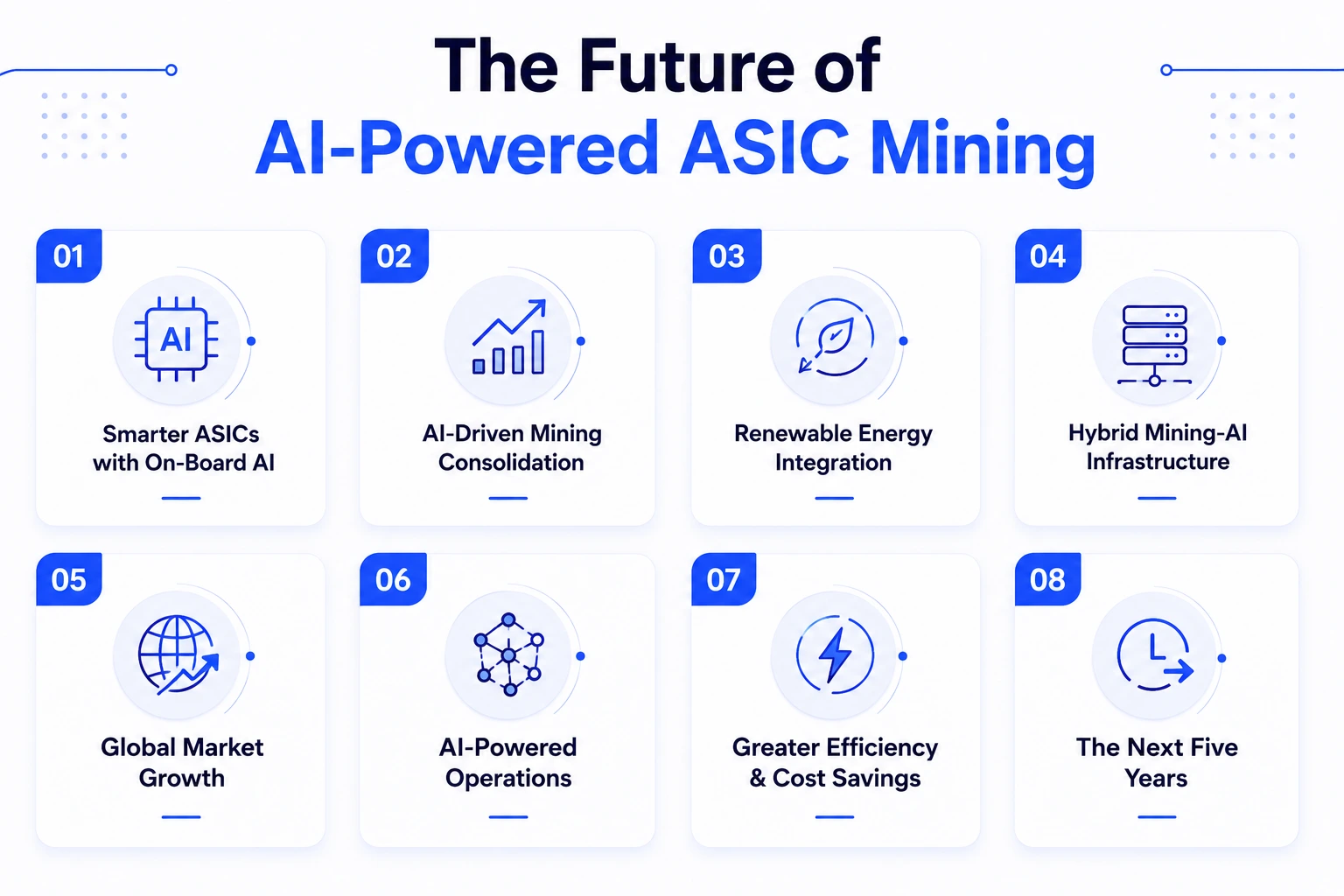
The convergence of ASIC mining and artificial intelligence is still in its early stages, even if it doesn’t feel that way. Here’s what the next five years are likely to bring.
Smarter ASICs with On-Board AI
The next generation of ASIC miners won’t just be faster; they’ll be smarter. Manufacturers like Bitmain and MicroBT are already working on hardware that includes embedded AI chips capable of self-optimizing their power consumption and hashrate based on real-time conditions, without needing external software management. Imagine a miner that automatically underclocks when electricity prices spike and recovers to full speed when prices drop, all without any human intervention.
AI-Driven Mining Consolidation
As AI tools make it easier to operate large fleets efficiently, we’re likely to see continued consolidation in the mining industry. Smaller operations that don’t invest in AI efficiency tools will find it increasingly hard to compete against industrial farms that are running 10–20% more efficiently. This is already happening, but the pace will accelerate.
Renewable Energy Integration
One of the most exciting developments is the growing integration of AI-powered mining farms with renewable energy sources. Solar and wind farms produce variable power: sometimes too much, sometimes not enough. AI systems can match mining farm power consumption in real time to renewable energy availability, effectively using mining as a “flexible load” that helps renewable generators monetize surplus power. This creates a virtuous cycle: cheaper energy for miners, more revenue for renewable generators, and a greener overall footprint for the industry.
The Hybrid Mining-AI Infrastructure Model
The line between a Bitcoin mining farm and an AI computing farm is going to continue blurring. Over the next five years, we’ll likely see more facilities that seamlessly shift their computing resources between Bitcoin mining and AI inference tasks based on real-time profitability comparisons. When Bitcoin mining is more lucrative, the racks run by ASIC miners. When AI inference contracts pay better, they swap in GPU clusters. AI orchestration systems will manage this transition automatically.
Global Market Growth
The broader AI in the mining market is projected to grow from $35.47 billion in 2025 to $828.33 billion by 2034, at a compound annual growth rate of 41.92%. Even accounting for the fact that this figure includes all types of mining (including traditional resource extraction), it signals the enormous scale of investment flowing into AI-driven operational efficiency across the mining sector. Crypto miners who position themselves at the intersection of these trends, combining best-in-class ASIC hardware with AI-driven operations, will be extremely well positioned to capitalize.
What This Means for Individual Miners
- Invest in efficiency first. The miners who survive long-term are the ones with the lowest cost per terahash. Upgrade to current-generation hardware (S21 XP, M6DS series) and pair it with AI optimization tools.
- Learn the tools. You don’t need to be a machine learning engineer to benefit from AI mining tools. Platforms like Foreman and BraiinsOS+ are designed for miners, not data scientists.
- Think about a power strategy. Your electricity cost is your single most important operational variable. AI can optimize around it, but it can’t eliminate it. If your power cost is above $0.09/kWh, you need to either renegotiate your contract or consider relocating.
Stay flexible. The mining industry rewards adaptability. The farms that are thriving in 2026 are the ones that kept their options open, whether that meant pivoting to AI hosting, locking in long-term power contracts, or strategically timing hardware purchases.
A future for AI-powered ASIC mining farms isn’t just a far-off promise. It’s already happening as the gap between those who embrace it and those who don’t is growing each month. The range of AI-driven systems for cooling that reduce energy use, as well as predictive maintenance that can prevent expensive hardware malfunctions and dynamic pool optimization that extracts additional profits from every terahash, the solutions are real, the ROI has been established, and the adoption curve is steep.
If there’s a lesson to be learned from the information in this article, it’s that mining profit in the 2026s and beyond is likely to be measured less by having the biggest machines and more by the person who manages these machines with the greatest efficiency. The hardware race is crucial, as you require current-generation miners, such as the Antminer S21 Pro or the Whatsminer M6DS series, to compete. However, the efficiency race is equally, and that’s why AI always wins.
If you’re just beginning with your first ASIC miners or you’re sizing an industrial business, incorporating AI-aware processes into your system right from the beginning will yield dividends. Start with tools that are easy to access to automate the tasks you are able to do, keep track of every aspect, and keep looking for the next improvement in efficiency.
If you are a miner looking for dependable equipment, reliable and knowledgeable advice on how to navigate this changing environment, Mercado Asic is a go-to place. With a track record of success in sourcing and providing top-quality ASIC mining equipment, from Antminer S21 Pro to newer next-generation models, Asicmarketplace understands what it takes to set up and manage an efficient mining operation in the current market. In a time when AI continues to transform the mining industry, it is essential to have an experienced hardware partner that can make an enormous difference.
Mining’s future is intelligent, efficient, and powered by AI. The issue isn’t if you should change, but how quickly you can reach that point.
Preguntas frecuentes
-
How is AI used in ASIC mining farms?
AI is used in ASIC mining farms to monitor hardware performance, optimize energy consumption, and predict equipment failures before they happen. This helps miners reduce downtime, cut electricity costs, and run more profitable operations overall.
-
Which ASIC miner is the most efficient in 2026?
The Antminer S21 XP is currently the most energy-efficient air-cooled Bitcoin miner in 2026, delivering 270 TH/s at just 13.5 J/TH. It offers the best balance of hashrate and power efficiency for serious mining operations.
-
Can small miners benefit from AI-powered mining tools?
Yes, small miners can benefit from beginner-friendly AI tools like Foreman and BraiinsOS+ to automate monitoring and improve efficiency without needing a large budget. Even basic automation can reduce hardware failures and improve daily earnings over time.

Peter Davis
Peter Davis es un consumado analista de blockchain y redactor técnico con más de cuatro años de experiencia en el sector de las criptomonedas. Su experiencia abarca la infraestructura blockchain, el hardware de minería ASIC y los mercados de activos digitales, donde es reconocido por traducir conceptos técnicos complejos en análisis precisos, perspicaces y accesibles para una audiencia global.
Con una sólida base en investigación técnica y evaluación de mercados, el trabajo de Peter se centra en vincular la innovación de blockchain con estrategias prácticas de minería e inversión. Sus escritos se caracterizan por la profundidad analítica, la claridad y el enfoque en las perspectivas respaldadas por datos que guían tanto a profesionales como a entusiastas a través del cambiante panorama de las criptomonedas.
Impulsado por una profunda pasión por la tecnología Web3 y los sistemas descentralizados, Peter sigue produciendo contenidos de autoridad, basados en la investigación, que mejoran la comprensión del rendimiento de la minería ASIC, la eficiencia de blockchain y la dinámica más amplia que da forma al futuro de las finanzas digitales.