


Resumen rápido
Choosing your first ASIC (application-specific integrated circuit) miner is the most concrete step into Bitcoin mining. This guide helps you sort through the clutter. We offer a simple, easy-to-follow guide on how to select the right ASIC miner, assess the real cost of mining, and guide your first ASIC miner configuration. Don’t get lost in abstract terms; this is about the specifications of mining hardware as well as electrical requirements and mine profitability calculation. Let’s go from curiosity to working with mining equipment. The journey to crypto mining begins here.
How do you choose the best ASIC miner? Do not just purchase the most shiny one. Your purchase must take into account three factors of performance, price, and practicality.
To begin, you must be aware of how hash rates work. It is measured in terahashes/second (TH/s). It’s your mining speed. A higher hash rate is more chance of earn mining rewards. However, speed isn’t the only factor. The other pillar of power usage is which is measured in Watts. Power-hungry machines can wipe out your profit with a staggering electric bill.
This brings us to the most important metric you can use in an ROI evaluation: the energy efficiency measured in joules per terahash (J/TH). A lower value here indicates more Bitcoin extracted per dollar of electricity. When you are deciding on the first time you use an ASIC miner, be sure to consider operational considerations.
How do you feel about the volume? Is your home’s electrical circuit able to be able to handle it? Does it require specific room cooling? This comparison of hardware isn’t only about specs; it’s about comparing a device to real-world conditions. A thorough choice guide will save you from problems in the future.
ASIC Mining Hardware Comparative: Entry-Level vs. Pro
Let’s do this by providing a clear ASIC Mining hardware comparison. We’ll focus on two categories: entry-level mining for beginners and high-end machines for professionals. The miner comparison is based on actual, current models to provide you with an accurate picture. Remember that what is the “best” machine is dependent on the budget you have set and the setup.
Examples of Entry-Level/Budget Miner:
- Hash Rate: 100 to 150 TH/s
- Power Draw: 3000 Watts
- Efficiency: ~30 J/TH
- Noise Level Extremely Loud (75plus dB)
- Recommended for beginners with a dedicated space, higher cost of electricity, or a small budget in the beginning.
Examples of Professional/High-Performance:
- Hash Rate 300+ TH/s
- Power Draw: 6000 Watts
- Efficiency: ~20 J/TH
- Noise Level Very Loud (80plus dB)
- Best for: Large-scale operation with low-cost power, industrial settings.
This is why a straightforward hash rate contest could be untrue. Professional mining is far more efficient and powerful. However, its tremendous volume and sound make it unsuitable for the average home. For a beginner bitcoin mining hardware setup, a basic model is often the better, more secure base for novice miners.
The ASIC Mining Cost as well as Profitability: The Actual Numbers
“How much will one ASIC miner run?” The hardware cost is only one line item. An actual ASIC miner cost and profit analysis will include the entire investment.
Let’s take it apart for an affordable miner that costs $3000.
- Cost of Hardware Upfront: $3000 (The ASIC miner itself).
- Additional Costs: $200-$500 (A solid source of power, high-end cords, surge protectors, as well as a basic cooling fan).
- Ongoing electricity costs are the most significant. If your miner consumes 3000W and the electricity rate of $0.12 for kWh, it will cost you around $10.37 daily to operate.
- Other ongoing costs: Pool fees (1-2 percent), hosting charges, and internet.
For now, to maximize mining profits. It is recommended to make use of a profit calculator online, also known as an ROI calculator. Enter your miner’s hash speed and power consumption, as well as the power cost, the current Bitcoin price, and the network’s difficulty.
This tool conducts the ROI analysis to calculate your daily earnings and time for payback. In early 2026, a time of difficulty in mining, the $3,000 miner could make between $5 and $8 per day, excluding the electricity cost. After the $10.37 electricity cost, you’ll be left with an overall loss.
This is a reason why electricity at a low cost is not a requirement for a good return on investment. Don’t purchase mining equipment without calculating the ROI first.
The Best Value ASIC Miner for Beginners in 2026
Based on the efficiency in terms of availability, efficiency, and ease of use, these are the top contenders for the most efficient ASIC miner for those who are just starting and want to begin in 2026. These are the
entry-level miners that balance performance with ease of use for the beginner setup.
- Bitmain Antminer S21 series. The series is typically the benchmark for efficiency. A model with a 150 TH/s version provides an excellent balance. Its higher efficiency in mining (around 20J/TH) reduces operating costs, which is essential for mining profitability. It’s a sturdy machine manufactured by a well-known brand, but as with every ASIC, it needs massive energy and cooling.
- Whatsminer M50S/M50S+ MicroBT’s Whatsminer series is a great rival. They are renowned for their reliability and performance, and typically come with lower initial costs than comparable Bitmain models. For instance, the M50S has a comparable hash rate and performance, which makes it a top option for your initial Bitcoin mining equipment.
There are two options to choose from:
- Check availability. The ASIC mining market changes rapidly. Check which more modern, efficient models are currently available.
- Compare the Total Cost Price + Shipping + taxes on imports (if relevant).
- Research Support: Check out the warranty service provided by the manufacturer and the credibility of their support staff. Support from a good technical team is crucial for those who are just beginning their mining career.
Keep in mind that”best” is not necessarily the most expensive option; “best” is one that meets your power requirements and budget. Make use of a profit calculator, and look at them in comparison before you decide.
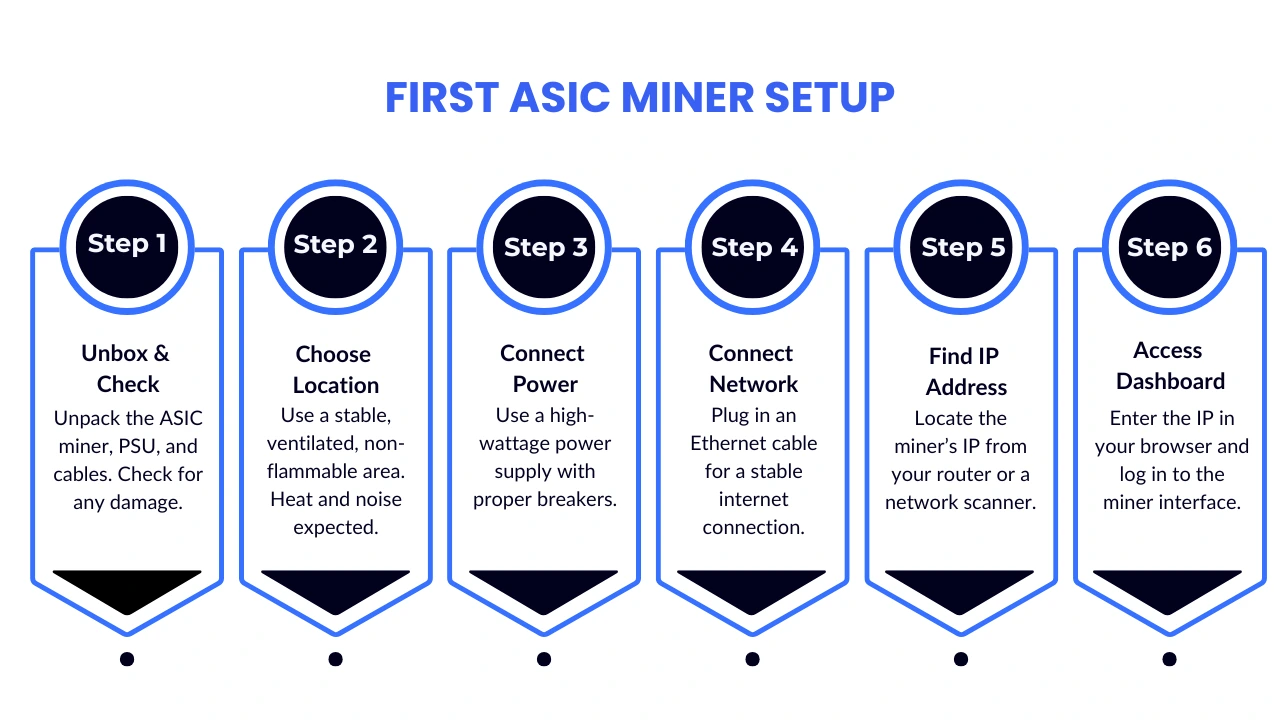
The First ASIC Miner Setup: Your Step-by-Step Guide
The time has come to mine! Here’s your very first ASIC miner setup guide.
Follow these step-by-step steps carefully to ensure a smooth start.
Step 1: Unbox & Inventory. Take care to unpack your mining equipment. It should contain the ASIC miner unit as well as an Power source unit (PSU) and power cables. Examine the damage for obvious signs immediately.
Step 2: Select the correct location. This is crucial to ensure Safety. The miner should be placed on a smooth, hard, non-flammable surface that is an air-conditioned space. Make sure it is away from dust, water, and other flammable substances. Think about noise control and heat control. This machine will be noisy and hot.
Step 3: Join the Power. Be aware that this requires high voltage. Check that your circuit is capable of handling the burden. If you want to run a 3000W mining unit using a 240V power source, you will require a 20-amp breaker. Make use of the PSU and the cables that came with your unit. To ensure electrical Safety, you should employ a licensed electrician to install the appropriate outlet if necessary. This is an essential aspect of fire safety.
Step 4: Make connections to the Network. Utilize the Ethernet cable to link your miner to the router. An Ethernet connection is reliable and vital for continuous mining.
Step 5: Locate the Miner’s IP address. Make use of a network scanner program or look through your router’s list of connected devices to locate the local IP address of your miners.
Step 6: Go to the page for configuration. Input the IP address in the web browser. Sign in (default credentials are usually included in the instruction manual). This is the dashboard you use for the ASIC configuration.
Step 7: Set up for Mining. This is where you enter the information of your mining pool and mining wallet. Set the settings to save, and your crypto mining device’s operation will start!
The Mining Environment includes noise, cooling and Safety.
The ASIC mining machine is a specialized machine, not a silent laptop. The management of its environment is only part of the challenge when it comes to Bitcoin mining.
Let’s take a look at the three main ones of heat, sound and security.
Cooling Equipment: These machines create enormous heat. Temperature fluctuations are your enemy. You need constant, high-volume airflow. For a single miner, powerful exhaust fans inside the room could be sufficient. To prevent heat loss, don’t put it in a closed closet. Specific mining equipment that is more advanced has hydro cooling systems, but this isn’t a good idea to explain in a beginner’s guide.
Noise Control ASIC mining machine operates at 75-80 decibels, as high as the volume of a vacuum that runs continuously. For mining in residential areas, this is the most significant issue.
Solutions comprise:
- Designing a soundproofed enclosure (with ventilation! ).
- It should be placed in an insulated underground garage.
- By using exceptional mining cases, they are able to block out the sound.
Security Precautions for Safety: These are non-negotiable.
- Electric Safety: Make sure you have a designated circuit. Avoid extension cords. Utilize a quality surge protector.
- Safety from fire: Maintain the area free of lint, dust, and other flammable substances. Check regularly for hot electrical connections.
- Ventilation: Make sure that hot air is ejected from the room in order to avoid overheating, which is the most common reason for hardware failure.
The Team is Joining: Mining Pools and Wallet Installation
One-on-one mining using an ASIC miner is like purchasing one lottery ticket. To make a steady, reliable income, join a mining pool. It is a collection of miners that pool their hash power to take part in the benefits. The selection of a pool is an integral part of your setup guide.
How to Pick the Right Mining Pool:
- Estructura de tarifas: The majority of companies charge between 1-2% of earnings.
- Reputation and size: Bigger pools provide larger payouts, but more frequently. Smaller pools provide larger, but less frequent, winnings.
- Payment Method: The payment method, PPS (Pay Per Share), is stable. The PPLNS (Pay per Last Shares) is more profitable over time.
- Server Location: Select the pool server that is geographically near you for a lower latency.
The most popular pools for beginners are Foundry USA, Antpool, and F2Pool. Make a quick comparison with the current metrics. After selecting the pool, it will send you a link to input into the miner’s configuration page.
Wallet Setup: You require an encrypted Bitcoin mining wallet to get the payouts. Do not use an exchange address directly. For those who are new to the field:
- Software wallets: Options like Electrum as well as Exodus are suitable for small sums. You are in charge of the private keys.
- Hardware Wallet: If you want to make serious savings, a Trezor or a Ledger can be considered the gold standard. It protects your keys from theft and is the best option for mining investments.
Set up your pool to transfer the earnings to your wallet account. The crypto mining device is up and running, and you are earning!
The Long Game Maintenance, as well as support for your Mining Journey
Mining hardware is continuously operating under stress. A regular maintenance program is the key to distinguishing mining equipment that lasts for one year from one that runs for three years.
Here’s your routine for cleaning equipment.
Regular Maintenance tasks:
- Every day or Weekly: Check your mining software or your pool dashboard to confirm that your miner is up and running and hashing as it should.
- Monthly: Shut down the power, as well as thoroughly clean the miners. Utilize compressed air to blast dust out of the heatsinks and fan. Dust is the principal insulation that can cause overheating.
- Quarterly: Check the power cables and connections for indications of wear or damage. If the fan is not functioning, it could cause the miner to get burned up in just a few minutes.
Garantía y soporte: Be aware of the warranty policy before purchasing. The majority of ASIC mining equipment comes with a one-year or 180-day warranty. This usually covers manufacturing defects, but also wear and tear due to use.
Be aware of how to reach the support department of the retailer or the manufacturer’s team. Good 24/7 support can help troubleshoot issues. Forums, as well as online communities, are excellent sources of support from other miners.
Make sure your miner is well-maintained. A regular maintenance program for your miner will protect your mining investment and boost the profitability of your mining operation over the long haul.
Conclusión
Congratulations on completing the entire ASIC beginner’s guide! You’ve learned the basic guidelines for choosing the right ASIC miner, the actual costs of mining, as well as the specific steps needed for the novice Bitcoin mining setup. The process of mining crypto is not easy, but it’s rewarding, mixing technical expertise with financial planning.
Remember that success begins by conducting your research. Utilize profit calculators, prioritize efficient energy usage, and thoroughly evaluate your space to ensure noise and heating management. Begin small with a budget mining machine, master the ropes, and grow with care. The journey to mining for beginners is an endurance race, not the equivalent of a sprint.
ASIC Marketplace allows you to find mining equipment with ease, find the best options, compare them and receive assistance from experts. If you’re ready to begin, take a look at the available products, look up prices, learn about the process, follow guides and estimate profits with confidence. Your journey into crypto mining starts with a solid foundation and plan. Get started now by purchasing a mining kit.
Preguntas frecuentes
-
What is the best way to select the right ASIC miner?
Select the minero asic that is based on hash rate and power consumption, as well as energy efficiency, and your electric costs. Then, compare ROI before purchasing. A balanced option is better for novices than the most potent option.
-
How can I earn 1 Bitcoin per day?
Mining one Bitcoin every day takes an enormous amount of hash rate, extremely cheap electricity costs, and numerous professional miners. This isn’t realistic for many home-based miners.
-
How can I earn $100 per day from mining Bitcoin?
For a daily income of $100 you need to be able to work with Bitcoin miners with low power costs, a brilliant pool selection and favorable market conditions, along with careful profit and ROI calculation.
-
What is the top starting Bitcoin miner?
The most effective entry-level Bitcoin miner comes with a moderate hash rate, excellent energy efficiency, less noise and an affordable price for hardware, making it ideal for novices and home setups.

Peter Davis
Peter Davis es un consumado analista de blockchain y redactor técnico con más de cuatro años de experiencia en el sector de las criptomonedas. Su experiencia abarca la infraestructura blockchain, el hardware de minería ASIC y los mercados de activos digitales, donde es reconocido por traducir conceptos técnicos complejos en análisis precisos, perspicaces y accesibles para una audiencia global.
Con una sólida base en investigación técnica y evaluación de mercados, el trabajo de Peter se centra en vincular la innovación de blockchain con estrategias prácticas de minería e inversión. Sus escritos se caracterizan por la profundidad analítica, la claridad y el enfoque en las perspectivas respaldadas por datos que guían tanto a profesionales como a entusiastas a través del cambiante panorama de las criptomonedas.
Impulsado por una profunda pasión por la tecnología Web3 y los sistemas descentralizados, Peter sigue produciendo contenidos de autoridad, basados en la investigación, que mejoran la comprensión del rendimiento de la minería ASIC, la eficiencia de blockchain y la dinámica más amplia que da forma al futuro de las finanzas digitales.

 Español