Resumen rápido
You’ve made the decision to start mining cryptocurrency, watched some YouTube films, and joined a few Reddit forums, and you’re ready to purchase the first ASIC miner. However, here’s something that nobody says immediately: the majority of new miners commit the same costly errors before they’ve even connected their first machine.
Picking the wrong ASIC miner isn’t just annoying. It can mean dropping thousands of dollars on gear that never, or barely, covers itself. The good news, though? Every single one of those missteps is avoidable once you know what to look for.
This guide is for actual people who are new to mining and want straightforward, practical advice. We’ll see why beginners go off track, what questions you should ask first, and how to pick an ASIC miner that really matches up with your specific setup.
¿Qué es un minero ASIC?
minero asic is basically an acronym for “Application-Specific Integrated Circuit”. Now, unlike a general-purpose PC, or even a GPU mining machine that is, an ASIC miner is built for one single goal. It is tailored for a specific thing, and the whole idea is to crack the mathematical algorithm that a given cryptocurrency uses.
Due to the focused design, ASICs have incredible efficiency in their work. The Bitcoin ASIC miner will outperform any GPU rig with Hashing SHA-256 by a large margin. However, the same ASIC is useless to mine Ethereum Classic or Monero because these utilize different algorithms.
Here’s why this matters so much for new miners:
- You can’t repurpose an ASIC miner if the market changes
- Every ASIC is tied to a specific coin or algorithm
- Buying the wrong algorithm means zero returns on your investment
- Hardware becomes obsolete faster than most people expect
Most beginners don’t realize this until after they’ve already bought it. They see a shiny new miner advertised with impressive hashrate numbers, pull the trigger, and then find out it mines a coin that’s barely profitable, or worse, one that’s already been mined out by larger players.
The 7 Biggest Mistakes New Miners Make
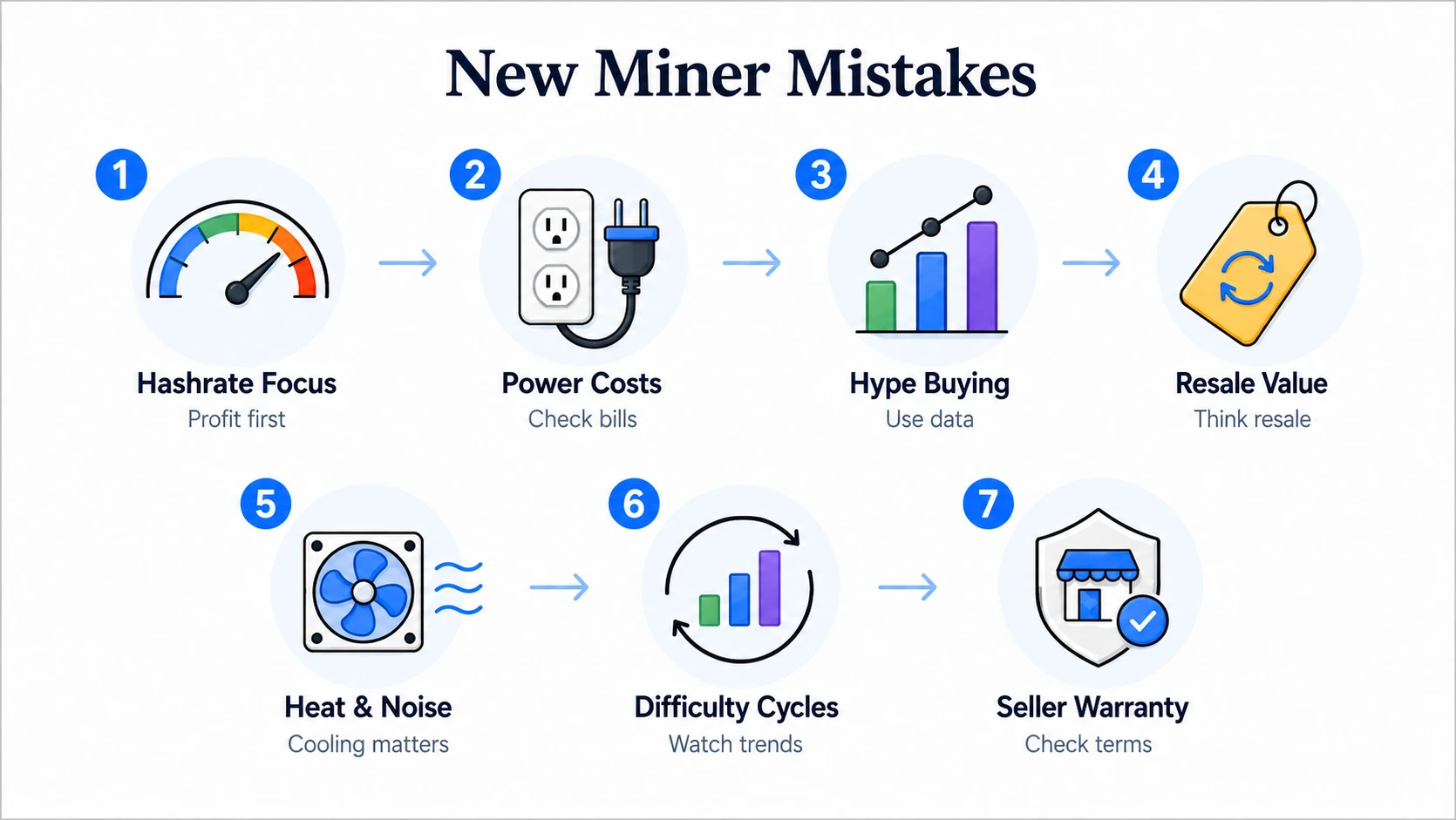
Mistake 1: Chasing Raw Hashrate Without Checking Profitability
This is probably the most common mistake of all. New miners see a spec sheet showing a high terahash number and assume that means more money. Not exactly.
Hashrate alone tells you nothing about profitability. What actually matters is the combination of:
- Hashrate (TH/s, GH/s, or MH/s depending on the algorithm)
- Power consumption (watts)
- Current coin price
- Dificultad de la red
- Your electricity cost per kWh
- Tarifas de piscina
- Hardware cost and expected lifespan
A miner running at 200 TH/s using about 6,000 watts could be way less profitable than another one going 120 TH/s with around 3,200 watts, especially if your electricity is expensive, because the numbers kinda change fast.
example: the Bitmain Antminer S21 Pro brings approximately 234 TH/s, at 3,510 watts. This is around 15 J/TH. Now an older S17 can still manage something like 56 TH/s, but it pulls around 2,520 watts, so it lands closer to 45 J/TH. Sure, the new one is pricier right up front, though the noticeably stronger efficiency rearranges the profit picture, almost instantly, in a way that’s pretty hard to ignore.
The fix: Always check the numbers with a calculator to calculate the profitability of mining prior to purchasing. Make use of tools such as WhatToMine ASIC Miner Value or Crypto Compare. Please enter your real electricity cost, not some national average, or whatever price you guess you pay for electricity on your bill.
Mistake 2: Ignoring Electricity Costs
Speaking of electricity, this is where mining dreams crash and burn, more often than anywhere else. Electricity is probably your largest ongoing expense. Even a very efficient minero asic running 24/7 will still pull a lot of power, and if you are stuck with residential electricity prices in the US, which average roughly $0.13–$0.17 per kWh in 2026, your margins can vanish pretty quickly, real fast.
| Tarifa eléctrica | Monthly Cost (3,500W Miner) | Viability |
| 1 TP 22 T 0,05/kWh | ~$126/month | Highly Profitable |
| 1 TP 22 T 0,08/kWh | ~$202/month | Profitable |
| $0,12/kWh | ~$302/month | Marginal |
| 1 TP 22 T 0,15/kWh | ~$378/month | Break-even or Loss |
| 1 TP 22 T 0,20 €/kWh | ~$504/month | Not Viable |
The miners making consistent money are generally paying under $0.07/kWh. They’re using industrial power contracts, renewable energy setups, or hosting services in low-cost regions like Texas, Kazakhstan, or Iceland.
The fix: Know your electricity rate before you buy anything. If you’re paying over $0.10/kWh at home, either find a hosting facility or reconsider whether home mining is the right move for you right now.
Mistake 3: Buying Based on Hype, Not Data
The crypto mining market is brimming with influencers, affiliate marketers, and promoters with an incentive of money to push users towards specific products. Not all of them are being dishonest, but even well-meaning reviewers often don’t update their content when market conditions change.
Here’s the reality: a miner that was “the best choice” six months ago may now be a money pit. Mining difficulty adjusts constantly. Coin prices swing wildly. New hardware gets released that makes older machines look inefficient by comparison.
New miners often:
- Watch a YouTube video from a year ago and buy based on that
- Follow forum advice without checking when it was posted
- Get excited by manufacturer marketing without independent verification
- Buy during a bull run when everything looks profitable without stress-testing bear market scenarios
The fix: Always check the date on any review or recommendation you read. Look for data from the last 30–60 days specifically. Cross-reference multiple sources. And always model your profitability at coin prices 20–40% lower than current prices to stress-test your investment.
Mistake 4: Underestimating the Importance of Resale Value
ASIC miners do depreciate. That’s kind of unavoidable, I mean, even if you try, the thing still loses value. But the speed at which they depreciate, and also how much resale value they keep, really changes a lot between different models and across those generations.
Some miners hold their value surprisingly well because:
- They mine a coin with strong community demand
- The algorithm hasn’t been overtaken by much newer hardware
- The manufacturer has a solid reputation for reliability
- The model is widely used, so there’s a liquid secondhand market
Others crash in value within months because newer, more efficient miners enter the market, or the coin they mine loses interest.
| Modelo Miner | Original MSRP | Typical Resale (12 months) | Value Retained |
| Bitmain S21 Pro | ~$3,200 | ~$2,000–$2,400 | 62–75% |
| MicroBT WhatsMiner M60S | ~$2,800 | ~$1,800–$2,100 | 64–75% |
| Bitmain S19j Pro | ~$1,500 (now) | ~$800–$1,000 | 53–67% |
| Older S17 Series | ~$300–$400 | ~$150–$200 | ~50% |
The fix: When you’re evaluating a miner, try to think of it like a depreciating asset, not just a machine, right? You want to fold depreciation into your ROI numbers, but the whole picture looks a bit flattering. So pause and ask yourself, if I had to move it, sell it in 12 months, what would I realistically end up with, cash-wise?
Mistake 5: Not Accounting for Heat and Noise
This one catches almost every first-time home miner off guard.
ASIC miners are loud. We’re talking 70–85 decibels for most modern machines, roughly the sound level of a vacuum cleaner running continuously, all day, every day. Some high-performance miners push even louder. This isn’t something you can easily live with in a bedroom or home office.
They also generate a tremendous amount of heat. Like, a 3,500-watt miner puts out about the same kind of output as three standard electric space heaters all running at full blast, so it’s not exactly subtle. With no decent ventilation and cooling, your room temperature is going to rise quickly. Then the miner tends to thermal-throttle, and after a while, your hardware lifespan shortens; sometimes it feels faster than you’d expect.
Common scenarios that go wrong:
- Placing a miner in a bedroom and finding it impossible to sleep
- Setting up in a garage without ventilation in the summer heat
- Running multiple miners in a small space without exhaust fans
- Dealing with neighbor complaints in apartments or townhomes
The fix: Go for purchases from authorized resellers or the well-established markets that have verified reviews, not the random listings. Before you complete it, confirm the warranty conditions in writing; that’s really the key. Make sure you also understand what it covers exactly, because some warranties only cover the control board, while the hash boards are excluded…and usually it’s those hash boards where the failures show up.
Mistake 6: Ignoring Network Difficulty and Halving Cycles
Mining isn’t really static; it shifts, and the amount of Bitcoin ( or any other coin ) you can pull from the same hardware sort of keeps changing, due to two mechanisms that kind of evolve all the time:
Dificultad de la red: As more miners join the network, the difficulty of solving each block increases. This means your same machine produces fewer coins over time, even if nothing else changes. Bitcoin’s difficulty has increased roughly 50–80% year-over-year in recent bull market years.
Halving Events: Bitcoin goes through a “halving” approximately every four years. This cuts the reward for blocks in half. Most recently, the Bitcoin Halving took place in April 2024. It reduced the amount of block rewards by 6.25 BTC to 3.125 BTC per block. The next halving will be expected in 2028.
After each halving, the not-so-efficient miners get pushed out of the profit picture first. Basically, if your setup was just barely making money before halving, it might not survive the next one.
The fix: Always research where a coin is in its halving cycle before investing in specific hardware. Buy machines with efficiency ratings that can still be profitable even with a 50% reduction in rewards. The industry benchmark for competitive Bitcoin mining today is under 20 J/TH.
Mistake 7: Choosing an Unreliable Seller or Ignoring Warranty Terms
The ASIC market is not without its fair share of fraudsters, gray-market resellers, and vendors who offer refurbished units for sale as brand new. A damaged miner and without a warranty or with modified firmware, could cost more than what you paid for a “deal.”
Warning signs of an untrustworthy seller:
- Prices significantly below the market rate with no explanation
- No verifiable business address or contact information
- No warranty offered or warranty terms buried in fine print
- No return policy
- Requests for payment via cryptocurrency only, with no buyer protection
- Recently created websites with no review history
fix: Purchase from authorized resellers or marketplaces with authentic reviews. Make sure you confirm warranty conditions in writing before purchase. Know what warranty coverage is included. Some warranties cover only the control board and not the hash boards, which is often where problems occur.
How to Pick the Right ASIC Miner: A Step-by-Step Framework
So now that you know what to avoid, here’s a practical step-by-step kind of path for picking the right miner, the one that fits.
Step 1: Decide Which Coin You Want to Mine
This is your starting point, ok. Different coins use different algorithms, and like each algorithm kind of needs a different hardware setup, too. So it is not really the same, you see.
| Moneda | Algoritmo | Popular Miners |
| Bitcoin (BTC) | SHA-256 | Antminer S21, WhatsMiner M60 |
| Litecoin (LTC) | Scrypt | Antminer L9, Goldshell LT6 |
| Kaspa (KAS) | kHeavyHash | Antminer KS5 Pro, IceRiver KS5L |
| Dogecoin (DOGE) | Scrypt (merged w/LTC) | Antminer L9 |
| Dash (DASH) | X11 | Antminer D9 |
| Zcash (ZEC) | Equihash | Antminer Z15 Pro |
Step 2: Check Current Profitability
Go to miningnow.com y entrar:
- Your local electricity cost ($/kWh)
- The miners you’re considering
- Current coin price (and also model it at -20% and -40% lower)
Step 3: Evaluate Efficiency (J/TH or J/GH)
Efficiency is measured as the joules per terahash (J/TH). The smaller the number, the greater the efficiency of the mining process. For 2026, this is how efficiency levels break down in the case of Bitcoin miners:
| Efficiency Tier | J/TH Range | Estado |
| Cutting Edge | Under 15 J/TH | Top competitive tier |
| Highly Efficient | 15–20 J/TH | Strong performer |
| Decent | 20–28 J/TH | Still viable at low electricity |
| Aging | 28–40 J/TH | Marginal, high electricity risk |
| Legacy | Over 40 J/TH | Generally not worth buying new |
Step 4: Calculate Your Total Break-Even
Use this simple formula:
Break-Even (months) = Hardware Cost ÷ (Monthly Revenue − Monthly Electricity Cost)
Ejemplo:
- Miner cost: $3,000
- Monthly revenue at current BTC price: $520
- Monthly electricity at $0.07/kWh (3,500W): $176
- Net monthly profit: $344
- Break-even: $3,000 ÷ $344 = ~8.7 months
A break-even under 12 months is generally considered healthy for a new miner. If it’s pushing 18–24 months, the risk profile becomes much harder to justify.
Step 5: Plan Your Setup Before You Buy
Before finalizing your purchase, answer these questions:
- Where exactly is the miner situated?
- Is there enough ventilation and airflow?
- What is the temperature in the surrounding room?
- Have I got the correct electric circuit (240V for the majority of high-power miners)?
- Did I include expenses for cooling in the electricity estimates?
- Does the noise level meet the standards for this particular location?
- Do I have a Surge protector or UPS to provide power stability?
Step 6: Verify the Seller
Before sending money anywhere:
- Does the seller have an official retailer for the brand?
- Do you have independent review sites available on third-party websites?
- Does the warranty have a clear definition in the written form?
- Does the company have a return and substitute policy available for DOA units?
- Is the vendor able to provide a verified physical address?
Top ASIC Miners Worth Considering in 2026
overcoming stress: an updated look at some of the most talked-about ASIC miners of 2026, as well as their main specifications and expected profits.
Bitcoin (SHA-256) Miners
| Modelo | Tasa de hash | Potencia | Eficacia | Est. Monthly Profit* |
| Bitmain Antminer S21 XP Hyd | 473 TH/s | 5,676W | 12 J/TH | ~$480–$650 |
| Bitmain Antminer S21 Pro | 234 TH/s | 3.510W | 15 J/TH | ~$220–$300 |
| MicroBT WhatsMiner M66S | 298 TH/s | 3,578W | 12 J/TH | ~$300–$420 |
| MicroBT WhatsMiner M60S | 186 TH/s | 3.441W | 18.5 J/TH | ~$150–$220 |
| Bitmain Antminer S19k Pro | 136 TH/s | 2,760W | 20.3 J/TH | ~$90–$140 |
*Estimated monthly profit at $0.07/kWh electricity. BTC price assumptions based on mid-2026 levels. Actual results vary.
Kaspa (kHeavyHash) Miners
Kaspa has emerged as one of the most discussed proof-of-work networks for ASIC miners in 2024–2026, with dedicated hardware from Bitmain and IceRiver.
| Modelo | Tasa de hash | Potencia | Est. Monthly Profit* |
| Bitmain Antminer KS5 Pro | 21 TH/s | 3150W | ~$200–$350 |
| IceRiver KS5L | 12 TH/s | 3.400W | ~$120–$200 |
| IceRiver KS3M | 6 TH/s | 3.400W | ~$60–$110 |
*Kaspa’s profitability is highly sensitive to KAS price fluctuations. Verify current rates before purchasing.
Litecoin/Dogecoin (Scrypt) Miners
| Modelo | Tasa de hash | Potencia | Est. Monthly Profit* |
| Bitmain Antminer L9 | 17 GH/s | 3,260W | ~$150–$250 |
| Goldshell LT6 | 1.625 GH/s | 1,800W | ~$60–$110 |
Understanding Mining Pools: Don’t Skip This Part
One aspect that new miners frequently overlook is the importance of joining a mining pool. Solo mining Bitcoin in 2026 is, for all practical purposes, not viable for individual miners. The network is simply too large and competitive.
What is a mining pool?
A mining pool is a group of miners who combine their hashrate to increase the collective chance of solving a block. When the pool solves a block, the reward is distributed proportionally among members based on their contributed hashrate.
Why Pool Mining Is Almost Always the Right Choice
- Provides consistent, predictable payouts instead of sporadic wins
- Reduces variance. You earn small amounts regularly, rather than nothing for months, and then one big payout
- Most pools charge a modest fee of 1–2% of earnings
- Easy to set up. Just configure your miner’s pool settings with the pool URL and your wallet address
Top Bitcoin Mining Pools in 2026
| Piscina | Estimated Network Share | Tarifa | Método de pago |
| Fábrica en Estados Unidos | ~27% | 0% (FPPS) | FPPS |
| AntPool | ~18% | 0–2% | PPLNS/PPS+ |
| F2Pool | ~13% | 2.5% | PPS+ |
| A través de BTC | ~10% | 2–4% | PPS/PPLNS |
| Braiins Pool | ~4% | 2% | FPPS |
For most new miners, Foundry USA or AntPool are solid starting points given their size and reliability. Larger pools mean more consistent daily payouts.
Home Mining vs. Hosting: Which Is Right for You?
This is one of the most important decisions a new miner faces, and it doesn’t get nearly enough attention in beginner resources.
Inicio Minería
Ventajas:
- Full control over your hardware at all times
- No third-party custody risk
- No hosting fees (typically $0.05–$0.10/kWh markup)
- You physically own and can see your equipment
Contras:
- Residential electricity is usually expensive ($0.12–$0.20/kWh)
- Noise and heat are real quality-of-life issues
- You’re responsible for all maintenance and repairs
- Risk of electrical issues or fire if not set up properly
- May need electrical upgrades for 240V circuits
Hosting Services
Ventajas:
- Access to cheap industrial electricity ($0.04–$0.07/kWh)
- Professional cooling and ventilation infrastructure
- No noise or heat at home
- Often includes basic maintenance services
Contras:
- Your hardware is in someone else’s facility
- Hosting fees reduce your margins
- If the facility has issues, your miners go offline
- Less transparency: you rely on their reporting for your stats
- Risk of hosting facility fraud or mismanagement
Which Should You Choose?
| Your Situation | Recommended Option |
| Paying under $0.08/kWh at home | Inicio Minería |
| Paying $0.08–$0.12/kWh at home | Compare hosting quotes carefully |
| Paying over $0.12/kWh at home | Hosting strongly preferred |
| Running 1–2 miners | Home Mining (if setup is viable) |
| Running 5+ miners | Hosting likely more efficient |
| Living in an apartment or an HOA community | Hosting |
Common Myths About ASIC Mining, Debunked
There’s a lot of misinformation floating around in beginner mining communities. Let’s clear up a few persistent myths.
Myth 1: “Mining is passive income. Set it and forget it.”
Reality: Mining requires active monitoring. Miners can go offline, hash boards can fail, pool connections can drop, and firmware issues can arise. Successful miners check their dashboards daily.
Myth 2: “You need a lot of miners to be profitable.”
Reality: Even a single efficient miner can be profitable with low electricity costs. You don’t need a warehouse. You need the right machine and cheap power.
Myth 3: “Newer is always better.”
Reality: A brand-new miner at full MSRP might have a worse ROI than a slightly older model bought at a significant discount on the secondhand market. Run the numbers. Don’t just assume new equals better value.
Myth 4: “Mining Bitcoin is dead for small players.”
Reality: Small-scale miners can still profit, especially with access to low-cost power. The key is efficiency and realistic expectations, not competing with industrial farms, but carving out sustainable margins.
Myth 5: “You’ll mine a full Bitcoin eventually.”
Reality: With a single modern miner, you’ll accumulate small fractions of Bitcoin daily through pool payouts. You’re not “mining a whole coin.” You’re earning proportional shares of block rewards. This is completely fine and how most miners operate.
A Quick Checklist Before You Buy Your First ASIC Miner
Use this as your final review before hitting the purchase button:
Financial Checks:
- I know my exact electricity rate per kWh
- I’ve run profitability numbers at current AND 30% lower coin prices
- I’ve calculated my break-even timeline (targeting under 12–14 months)
- I’ve accounted for hardware depreciation in my ROI model
- I’ve factored in pool fees (typically 1–2%)
Technical Checks:
- I’ve confirmed the miner’s algorithm matches the coin I want to mine
- I understand the efficiency rating (J/TH), and it’s competitive for today’s market
- I know the power requirements and have confirmed my electrical setup can handle it
Setup Checks:
- I have a physical location planned with adequate ventilation
- I’ve addressed noise considerations
- I’ve decided between home mining and hosting
Seller Checks:
- The seller is verified and reputable
- Warranty terms are clear and documented
- There’s a return policy for defective units
What to Do After You Buy: Getting Your Miner Up and Running
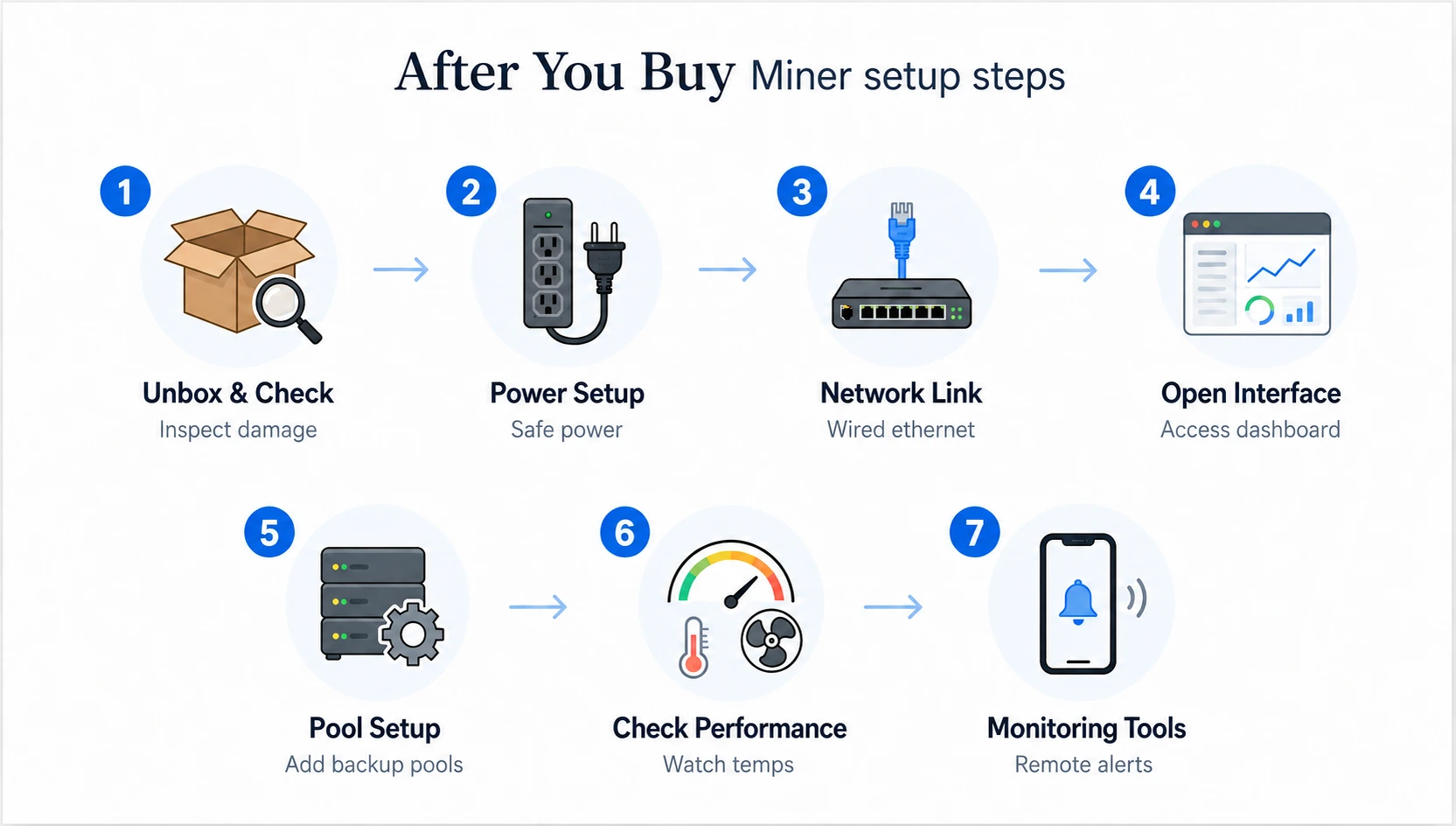
Buying the hardware is just the beginning. Here’s a simplified setup flow for new miners:
Step 1: Unbox and inspect Check for any physical damage before powering on. Document everything with photos in case you need to make a warranty claim.
Step 2: Set Up Power Most modern ASICs use a standard IEC power cord, but require dedicated 240V circuits for higher-wattage models. Never daisy-chain extension cords. Use a proper PDU (Power Distribution Unit) if running multiple machines.
Step 3: Connect to Your Network Use a wired Ethernet connection, not Wi-Fi. Assign a static IP to your miner for easy access through your router’s admin panel.
Step 4: Access the Miner’s Interface Most ASIC miners have a built-in web interface. Access it via the miner’s IP address in a browser. From here, you’ll configure your pool settings and monitor performance.
Step 5: Configure Your Mining Pool Enter your pool’s stratum address, your worker name, and your wallet address. Set up two backup pool connections in case your primary goes offline.
Step 6: Monitor Performance Check your miner’s dashboard daily for the first week. Monitor hashrate, temperature (hash board temps should typically stay under 85°C), fan speeds, and pool-side reported shares.
Step 7: Join a Monitoring Tool Tools like Awesome Miner, Braiins OS+, or manufacturer apps can help you monitor multiple miners from one dashboard and alert you to issues remotely.
How to Maximize Your Miner’s Lifespan and Long-Term Performance
Buying the right ASIC miner is only half the battle. How you maintain it over time has a direct impact on how long it runs efficiently and how much money it makes you in the long run. A well-maintained miner can run for three to five years. A neglected one might fail in under twelve months.
Here are the key maintenance habits every miner should build from day one.
Keep Your Firmware Updated
Manufacturers regularly release firmware updates that improve stability, fix bugs, and sometimes boost performance or efficiency. Running outdated firmware is one of the most common reasons miners experience unexplained drops in hashrate or connectivity issues.
Check the manufacturer’s website every few months and compare the version running on your miner to the latest release. For Bitmain miners, updates are available through the Antminer support portal. For MicroBT machines, check the WhatsMiner official site. Always read the release notes before updating so you know what’s changing.
Some miners also support third-party firmware like Braiins OS+, which can unlock performance tuning options, autotuning features, and better pool compatibility. This is worth exploring once you’re comfortable with the basics.
Clean Your Miners Regularly
Dust is the enemy of ASIC hardware. Over time, dust accumulates on fans and heat sinks, restricting airflow and causing temperatures to climb. Higher temperatures mean thermal throttling, which reduces your effective hashrate and eventually leads to hardware failure if left unchecked.
A good maintenance schedule looks like this:
- Monthly: Visually inspect fans for dust buildup and check that airflow is unobstructed
- Every 3 months: Use compressed air to blow dust out of the unit, especially from the fan blades and heat sinks
- Every 6 months: Do a full inspection, including checking cable connections, hash board seating, and control board condition
If you’re running miners in a dusty or high-humidity environment, clean more frequently. Garages and warehouses tend to accumulate dust faster than climate-controlled spaces.
Watch Your Temperature Metrics
Every ASIC miner has a built-in dashboard that shows real-time temperature readings for each hash board and chip. Make it a habit to review these numbers regularly.
General temperature guidelines for most modern Bitcoin miners:
| Componente | Healthy Range | Warning Zone | Critical |
| Hash Board Temp | 60°C to 80°C | 80°C to 85°C | Above 85°C |
| Chip Temp | 70°C to 85°C | 85°C to 90°C | Above 90°C |
| Inlet Air Temp | 15°C to 35°C | 35°C to 40°C | Above 40°C |
If temperatures are consistently running hot, check your ventilation first. Make sure hot exhaust air is being pushed out of the room and not recirculating back to the miner’s intake. If temps stay high after addressing airflow, the fans may need replacing, or the thermal pads on the hash boards could be worn out.
Know When to Repair vs. Replace
Hash board failures are the most common and costly repair on ASIC miners. A single failed hash board reduces your total hashrate by roughly one-third on most three-board machines. Replacement hash boards can run anywhere from $150 to $600, depending on the model.
Before spending money on repairs, ask yourself:
- Is the miner still under warranty? If so, use it.
- What is the current resale value of the machine?
- Would the repair cost more than 40% of the machine’s current market value?
- Is there a newer, significantly more efficient model available at a reasonable price?
If the repair cost approaches or exceeds half the machine’s resale value, it usually makes more financial sense to sell the machine for parts and upgrade to a newer model. This is especially true for older, less efficient machines where the hashrate per dollar spent on repairs no longer justifies the investment.
Track Your Actual Profitability Monthly
One habit that separates serious miners from casual ones is keeping a simple monthly tracking spreadsheet. Log your actual payout from the pool, your electricity bill for the mining space, and any maintenance costs. Compare that to your expected numbers from when you purchased the machine.
If actual profitability is tracking significantly below your original projections, investigate why. Common culprits include:
- Rising network difficulty eating into your share of block rewards
- Electricity rates are going up without you adjusting your calculations
- A miner running below rated hashrate due to a degraded hash board
- Pool downtime or connection issues are causing missed shares
Staying on top of your numbers means you’ll catch problems early and make better decisions about when to hold, repair, or upgrade your equipment.
The Right Mindset for Long-Term Mining Success
Before we wrap up, it’s worth talking about mindset, because the people who succeed at mining long-term think about it very differently from those who quit after a few rough months.
Mining is not a get-rich-quick scheme. It’s a business that requires patience, attention to detail, and the ability to adapt when market conditions change. Bitcoin’s price will go up and down. Network difficulty will increase. Equipment will age. Power costs may fluctuate. None of this is unusual, and none of it should catch you off guard if you’ve done your planning properly.
The last miners are the ones who:
- Set realistic expectations from the beginning and stick to a plan
- Reinvest a portion of earnings into better hardware over time rather than cashing out everything immediately
- Stay informed about the coins they mine and any upcoming protocol changes
- Treat every equipment purchase as a business decision, not an impulse buy
- Build relationships with other miners through communities, forums, and local meetups to stay ahead of industry trends
Mining can absolutely be a rewarding and profitable long-term activity. But it rewards preparation, discipline, and continuous learning. Going in with that mindset puts you miles ahead of most beginners who chase hype and wonder why their returns don’t match the YouTube thumbnail promises.
Conclusión
Getting into ASIC mining doesn’t have to be a gamble. The miners who consistently profit aren’t necessarily the ones with the biggest bankrolls or the most technical background. They’re the ones who do their homework, run realistic numbers, and avoid the traps that catch beginners off guard.
The ASIC mining space rewards people who treat it like a business, not a lottery ticket. With the right machine, the right power costs, and a realistic plan, it’s still a very viable way to accumulate cryptocurrency and build long-term wealth.
If you’re ready to start shopping for your first or next ASIC miner, Mercado Asic is one of the trusted destinations where you can compare verified hardware listings, check current pricing, and connect with a community of experienced miners who’ve already been through the learning curve you’re navigating right now.
The mistakes covered in this guide are common, but they’re not inevitable. With the right information and a little patience, your first mining investment can be one you look back on with confidence, not regret.
Preguntas frecuentes
-
What is the best ASIC miner for beginners in 2025?
The Bitmain Antminer S21 Pro is a solid starting point for most beginners thanks to its strong efficiency rating of 15 J/TH and wide availability. It strikes a good balance between upfront cost, performance, and resale value compared to cutting-edge models.
-
How much electricity does an ASIC miner use per month?
A mid-range Bitcoin ASIC miner consuming around 3,500 watts runs approximately 2,520 kWh per month when operating 24/7. At a rate of $0.07 per kWh, that works out to roughly $176 in monthly electricity costs.
-
Can I mine Bitcoin at home with a single ASIC miner?
Yes, home mining with a single unit is possible as long as your electricity rate is under $0.10 per kWh and you have a proper space for ventilation and noise. Joining a mining pool ensures you receive consistent daily payouts rather than waiting months for a solo block reward.
-
How long does it take to break even on an ASIC miner?
Break-even time depends on your hardware cost, electricity rate, and current coin price, but most miners target a payback period of 10 to 14 months. Running profitability calculations at both current and 20 to 30 percent lower coin prices before buying helps you set realistic expectations from the start.

Peter Davis
Peter Davis es un consumado analista de blockchain y redactor técnico con más de cuatro años de experiencia en el sector de las criptomonedas. Su experiencia abarca la infraestructura blockchain, el hardware de minería ASIC y los mercados de activos digitales, donde es reconocido por traducir conceptos técnicos complejos en análisis precisos, perspicaces y accesibles para una audiencia global.
Con una sólida base en investigación técnica y evaluación de mercados, el trabajo de Peter se centra en vincular la innovación de blockchain con estrategias prácticas de minería e inversión. Sus escritos se caracterizan por la profundidad analítica, la claridad y el enfoque en las perspectivas respaldadas por datos que guían tanto a profesionales como a entusiastas a través del cambiante panorama de las criptomonedas.
Impulsado por una profunda pasión por la tecnología Web3 y los sistemas descentralizados, Peter sigue produciendo contenidos de autoridad, basados en la investigación, que mejoran la comprensión del rendimiento de la minería ASIC, la eficiencia de blockchain y la dinámica más amplia que da forma al futuro de las finanzas digitales.