Quick Summary
Antminer X9 profitability calculations depend on whether a 1 MH/s RandomX miner generates enough daily income to justify its purchase price? Its rated performance makes it an interesting option for large-scale Monero mining, but the final return depends on electricity costs, network activity, and the price of XMR.
- Delivers 1,000 KH/s (1 MH/s) of RandomX hashrate.
- Uses 2,472 W of rated power.
- Reaches an efficiency of approximately 2.47 J/KH.
- Features four cooling fans and a noise level of around 76 dB.
- Estimated gross revenue is approximately $31.92 per day using the market inputs in this guide.
- At $0.05/kWh, estimated daily operating profit is around $28.64 after a 1% pool fee.
Is the Antminer X9 Profitable for Monero Mining?
Antminer X9 profitability depends on how much Monero the machine earns compared with its electricity costs and mining pool fees. Its 1 MH/s hashrate gives it a measurable share of the network’s computing power, but changes in coin price and network hashrate can affect daily earnings.
Bitmain designed this machine for RandomX, the proof-of-work algorithm used by Monero. The product is also for Zephyr mining, another RandomX-based cryptocurrency. However, this guide focuses on Monero alone, so Zephyr revenue is not included.
The hardware delivers a high hashrate from a single machine, but its purchase price and power requirements need attention. It also needs proper ventilation and a suitable electrical setup.
The best way to judge the investment is to calculate expected daily earnings using network data, XMR price, and your electricity rate.
What Are the Main Performance Specifications?
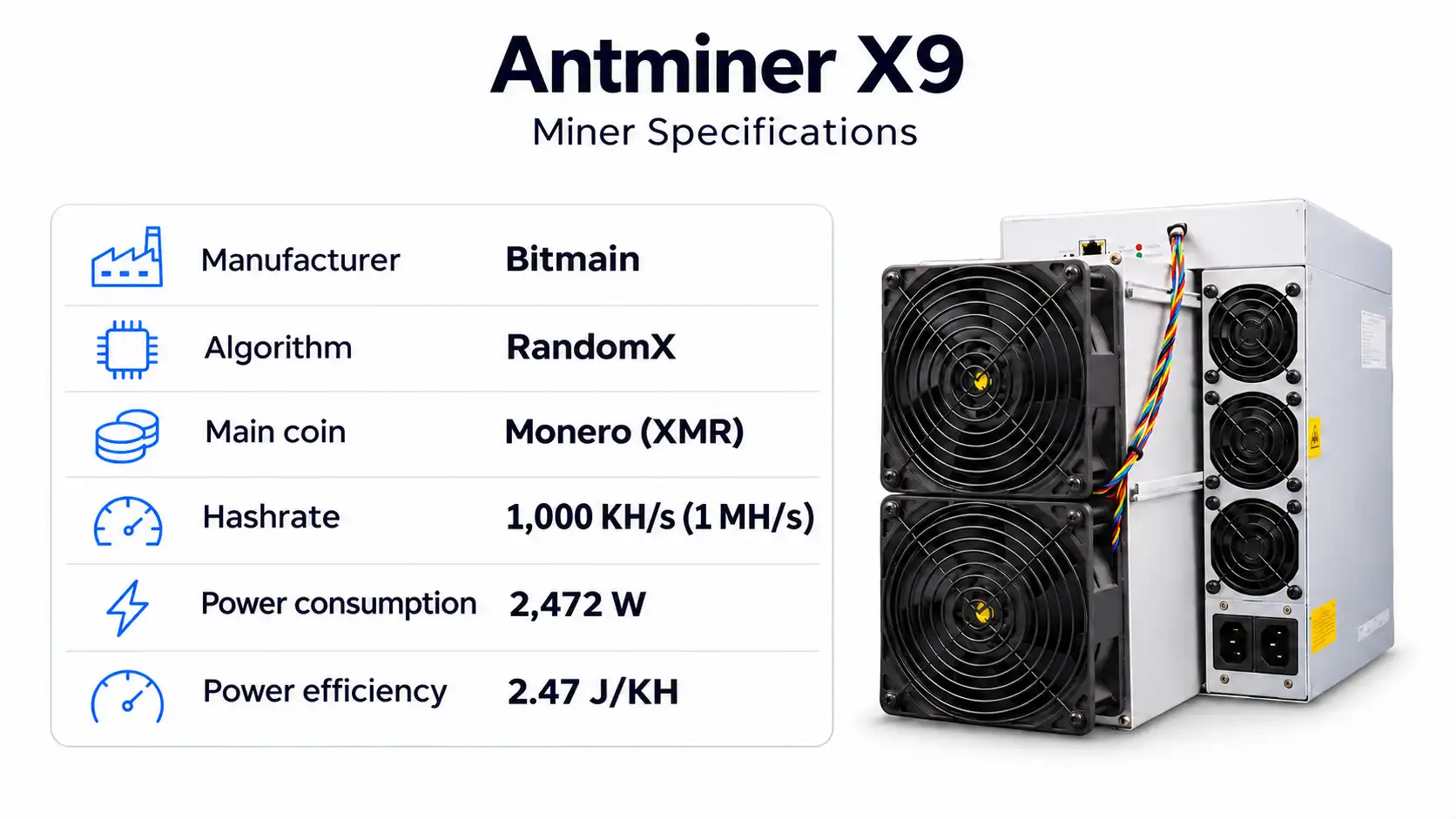
The hardware specifications show what the machine can deliver and what kind of mining environment it needs.
| Specification | Antminer X9 |
|---|---|
| Manufacturer | Bitmain |
| Algorithm | RandomX |
| Main coin covered | Monero (XMR) |
| Hashrate | 1,000 KH/s (1 MH/s) |
| Power consumption | 2,472 W |
| Power efficiency | 2.47 J/KH |
| Cooling | 4 fans |
| Noise level | 76 dB |
| Net weight | 17.5 kg |
| Network connection | Ethernet |
| warranty | 180 days |
How Much Computing Power Does 1 MH/s Provide?
A hashrate of 1 MH/s means the machine can perform around one million RandomX calculations per second.
For comparison, Minerstat lists an AMD EPYC 9754 processor at approximately 65.77 KH/s. The X9’s rated hashrate is around 15.2 times that figure. This is a raw hashrate comparison, not a claim that one miner can replace 15 complete server systems. Server power use, cooling, and other hardware costs must also be considered.
Is It Suitable for Home Mining?
The 76 dB noise level makes this machine better suited to a dedicated mining room or hosting facility than a regular living space.
Its 2,472 W power draw also means it consumes electricity continuously. Before installation, check the electrical circuit, wiring, ventilation, and power protection. A qualified electrician should confirm that the supply can safely support the load.
How Is X9 Profitability Calculated?:
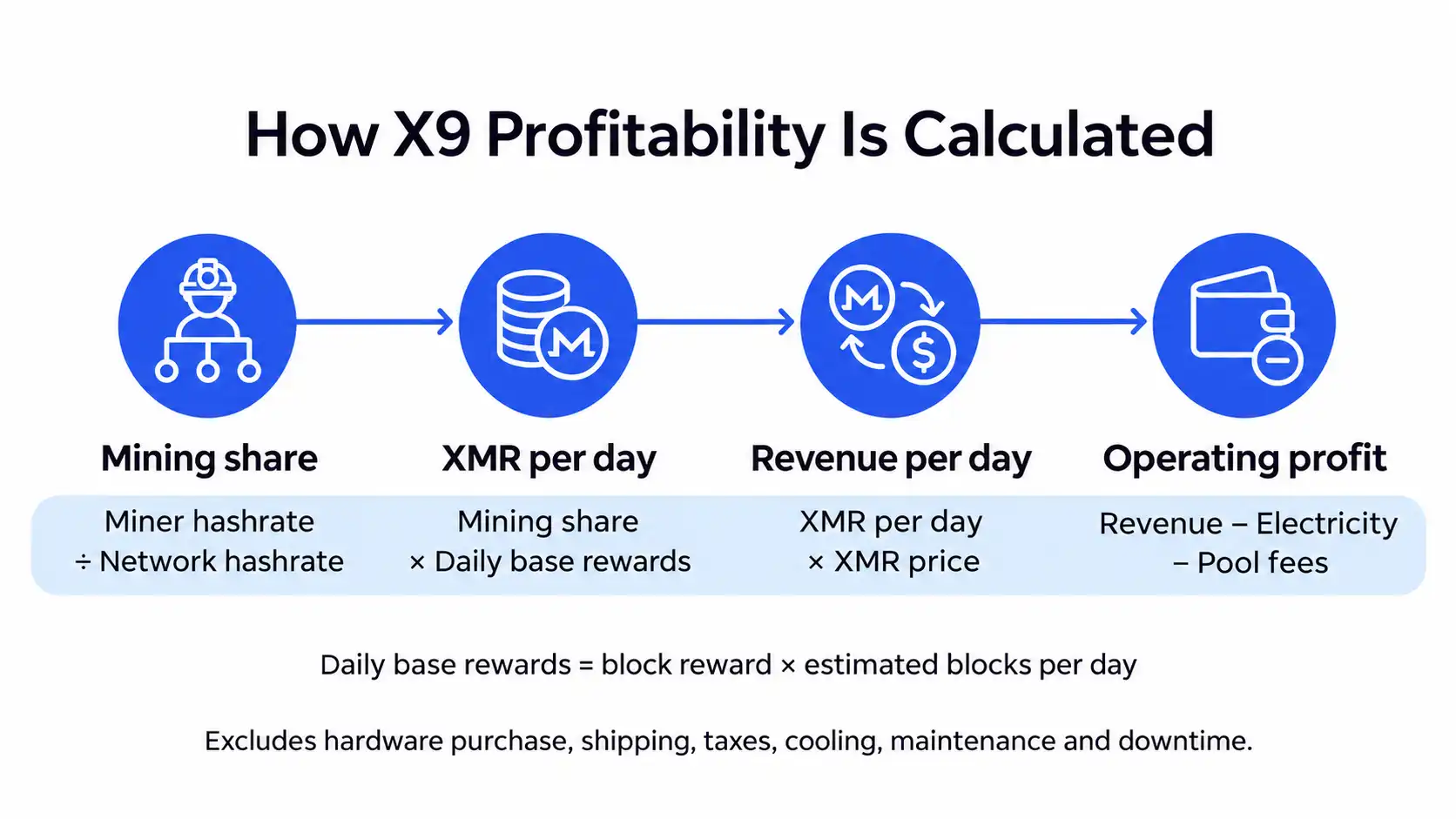
Mining income depends on the machine’s share of the total Monero network hashrate. A larger share generally means a larger expected portion of daily block rewards.
Monero targets a new block approximately every two minutes. Its tail emission provides a fixed base reward of 0.6 XMR per block. Using 720 blocks per day, the network distributes approximately 432 XMR in base block rewards daily. Transaction fees are additional and are not included in this estimate.
The basic calculation is:
Expected XMR per day = (Miner hashrate ÷ Network hashrate) × Daily block rewards
The resulting XMR is then converted into dollars.
Daily operating profit = Gross mining revenue – Electricity cost – Pool fees
This calculation measures operating profit. It does not include hardware purchase costs, shipping, taxes, cooling, maintenance, or downtime.
Which Current Numbers Are Used for the Calculation?
For a more useful estimate, the following model uses the 24-hour average network hashrate rather than relying only on one live reading.
| Input | Value used |
|---|---|
| Miner hashrate | 1,000,000 H/s |
| Network hashrate | 6.73 GH/s (24-hour average) |
| Live network hashrate | 6.65 GH/s |
| Network difficulty | 797.53 billion |
| Base block reward | 0.6 XMR |
| Estimated blocks per day | 720 |
| Daily base block rewards | 432 XMR |
| XMR reference price | $497.33 |
| Power consumption | 2,472 W |
| Example pool fee | 1% |
Using these inputs:
- The miner represents approximately 0.01486% of the network hashrate.
- Its estimated daily reward is around 0.06419 XMR.
- At $497.33 per XMR, gross daily revenue is approximately $31.92.
- A 1% pool fee removes around $0.32.
- Revenue after the pool fee is approximately $31.60 per day, before electricity.
These are estimates based on network averages and the base block reward. Actual payouts change with network activity, transaction fees, pool payment rules, and machine uptime.
How Much Can You Earn at Different Electricity Rates?
Electricity is one of the biggest operating costs in cryptocurrency mining. Even when a machine produces a steady amount of cryptocurrency, a high power rate can reduce the money left after expenses.
The miner consumes 2.472 kW. Running it for 24 hours gives:
2.472 kW × 24 hours = 59.328 kWh per day
The following estimates use $31.60 in daily revenue after the example 1% pool fee.
What Is the Estimated Daily Profit?
| Electricity rate | Daily electricity cost | Daily operating profit | 30-day profit |
|---|---|---|---|
| $0.03/kWh | $1.78 | $29.82 | $894.74 |
| $0.05/kWh | $2.97 | $28.64 | $859.14 |
| $0.07/kWh | $4.15 | $27.45 | $823.55 |
| $0.08/kWh | $4.75 | $26.86 | $805.75 |
| $0.10/kWh | $5.93 | $25.67 | $770.15 |
| $0.15/kWh | $8.90 | $22.71 | $681.16 |
| $0.20/kWh | $11.87 | $19.74 | $592.17 |
The figures show how electricity rates affect the amount left after mining expenses. At $0.05/kWh, daily electricity costs approximately $2.97. At $0.15/kWh, the cost rises to $8.90.
The difference becomes more noticeable over a full month. Miners with lower electricity rates have more room to handle changes in coin price and network difficulty.
What Is the Electricity Break-Even Rate?
Based on this model, the estimated electricity break-even rate is approximately $0.53/kWh after the assumed 1% pool fee.
This is the point where electricity costs consume the estimated mining revenue. It is not a recommended operating rate because it leaves no money for cooling, repairs, hardware recovery, or other expenses.
How Do Network Difficulty and Pool Fees Affect Daily Returns?
Mining income does not remain fixed. The number of miners on the network, XMR price, and mining difficulty all affect the expected reward.
Monero adjusts its mining difficulty after every block based on the previous 720 blocks, covering about 24 hours. When more computing power joins the network, difficulty can rise, reducing the reward share available to each miner.
What Happens When Network Hashrate Increases?
Suppose the network hashrate rises from 6.73 GH/s to 8 GH/s while the machine continues to produce 1 MH/s.
Its share of the network becomes smaller, so its expected daily XMR earnings decrease. The machine hasn’t lost its computing power, but it now competes against a larger share of the network hashrate.
The opposite can happen when network hashrate falls. A miner may then receive a larger expected share of the rewards.
This is why miners should review network conditions before relying on an older profit estimate.
How Do Mining Pool Fees Change Profit?
A mining pool combines the hashrate of several miners and distributes rewards based on their contributions and the pool’s payment method.
Pool fees vary between providers. In this guide, a 1% fee reduces estimated daily revenue by approximately $0.32.
Monero also supports P2Pool, a peer-to-peer mining option. The Monero project lists it with a 0% pool fee and no XMR payout fee. It uses a PPLNS payment method and does not hold miners’ funds in a central pool wallet.
For Monero Miners, the choice between a regular pool and P2Pool depends on payout preferences, connection support, and setup requirements. Always check that the mining firmware supports the selected connection.
What Does the Monero Community Say About P2Pool?
The official Monero account shared a post announcing P2Pool’s availability in the TrueNAS Apps Market. It highlights how decentralized mining tools are becoming easier to access.
Read the Monero post on X about P2Pool.
How Does RandomX ASIC Resistance Affect the Investment?
Before purchasing specialized RandomX hardware, buyers should understand an important detail about Monero.
The Monero project describes RandomX as an ASIC-resistant algorithm. It was designed to favor general-purpose computer hardware and make mining more accessible instead of allowing specialized devices to dominate.
At the same time, Bitmain markets its dedicated RandomX machine with a rated hashrate of 1 MH/s. Buyers should distinguish between advertised hardware performance and guaranteed long-term mining advantages.
Before spending thousands of dollars, ask the seller for:
- Recent mining pool results showing accepted shares.
- Proof of the actual hashrate under normal operating conditions.
- Details about firmware and supported mining endpoints.
- Written warranty, return, and repair terms.
- Confirmation of how the machine handles network or software changes.
Future changes to network rules, firmware support, or mining conditions could affect specialized hardware. Real-world results are more useful than relying only on advertised specifications.
How Does It Compare With WhatToMine and MiningNow?
Mining calculators are useful for checking expected daily returns, but their results depend on the inputs they use.
WhatToMine provides a custom profile for the machine using 1 MH/s and a rounded power setting of 2,500 W. To match this guide, enter 2,472 W along with your electricity rate and pool fee.
MiningNow also allows miners to enter their own hashrate, power consumption, electricity rate, and pool fee. Use the actual hardware figures rather than relying on default settings.
Minerstat shows approximately $31.34 in daily income and $26.59 in daily profit at $0.08/kWh. Its result is close to this guide’s estimate, although small differences can occur because calculators update their network and price data at different times.
For a better x9 profitability estimate, compare at least two calculators using the same inputs. Look at expected daily XMR as well as the final dollar profit.
How Should You Prepare Before Setting Up the Miner?
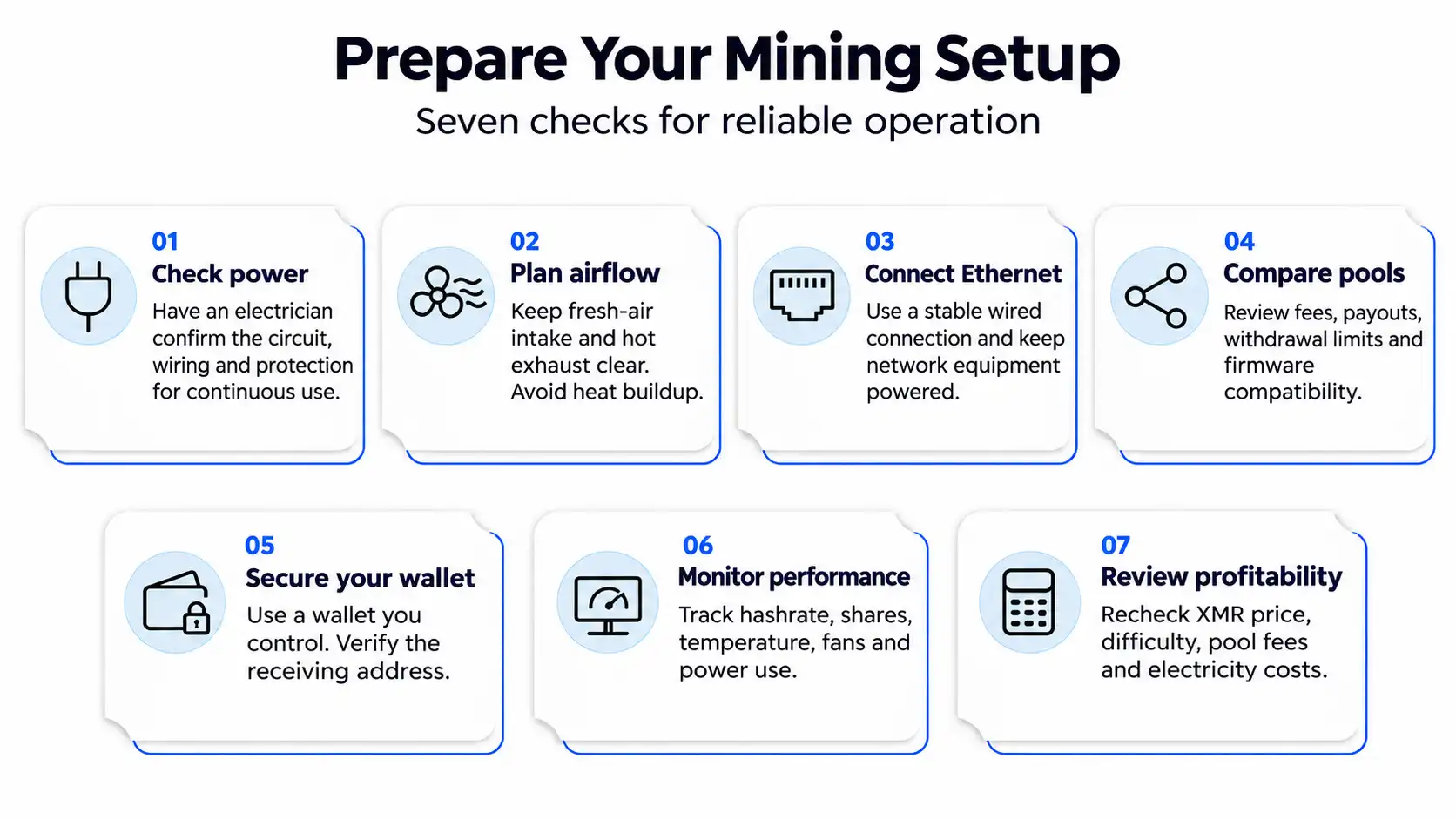
A good mining setup starts before switching on the hardware. Power, cooling, internet access, and pool support all matter when planning continuous operation.
Follow these steps:
- Check the electrical supply: Confirm that the circuit can safely support a continuous load of around 2.5 kW. Use suitable wiring and electrical protection.
- Prepare the cooling area: Keep a clear path for fresh air and hot air exhaust. Avoid closed rooms where heat can build up.
- Check the internet connection: Use stable Ethernet connectivity and keep your networking equipment powered during mining.
- Choose a mining pool: Compare regular pools with P2Pool. Check fees, payout rules, minimum withdrawals, and firmware compatibility.
- Set up a secure wallet: Use a wallet you control and verify the receiving address before adding it to the mining settings.
- Monitor machine performance: Check hashrate, accepted shares, rejected shares, temperature, fan speed, and power consumption.
- Review profitability regularly: Recheck XMR price, network difficulty, pool fees, and electricity charges.
These steps help reduce avoidable downtime and make it easier to track the real operating costs of a mining setup.
Conclusion
The Antminer X9 offers a hashrate of 1 MH/s and a rated power draw of 2,472 W. Using the November 25, 2026 market inputs, this guide estimates $31.92 in gross daily revenue and around $28.64 in operating profit at $0.05/kWh after a 1% pool fee.
The next question is whether those returns justify the hardware cost. The product listing shows a price range of 5,869 and displayed an out-of-stock or waitlist status when checked. At $0.05/kWh, the estimated simple payback period is approximately 198-205 days, before shipping, taxes, cooling, repairs, and downtime.
These figures provide a starting point, not a guaranteed return. Before ordering, confirm stock availability, delivery details, final landed price, and written warranty terms with ASIC Marketplace. Ask for recent proof of RandomX mining performance before committing to the purchase.
FAQs
-
How Much Monero Can the Miner Earn Per Day?
Using the 6.73 GH/s network hashrate and a 0.6 XMR base block reward, the estimate is around 0.06419 XMR per day before pool fees. Actual earnings change with network hashrate, difficulty, and uptime.
-
How Much Electricity Does the Miner Use Daily?
At its rated 2,472 W power draw, it consumes approximately 59.328 kWh in 24 hours. The final electricity bill depends on your rate per kWh.
-
Can It Run on a Regular Home Power Connection?
It needs an electrical circuit that can safely handle a continuous load of nearly 2.5 kW. A suitable circuit, proper ventilation, and noise control should be arranged before installation.
-
How Long Does It Take to Recover the Hardware Cost?
At $0.05/kWh, the example model estimates approximately 198-205 days to cover the hardware price using operating profit after a 1% pool fee. This excludes delivery, taxes, cooling, repairs, and changes in mining income.
-
Is a Mining Pool Better Than Solo Mining?
A regular pool generally provides more frequent payouts, while solo mining can involve long periods without finding a block. P2Pool offers a decentralized alternative with no pool fee, but check hardware and firmware compatibility before using it.

Peter Davis
Peter Davis is an accomplished blockchain analyst and technical writer with over four years of experience in the cryptocurrency sector. His expertise spans blockchain infrastructure, ASIC mining hardware, and digital asset markets, where he is recognized for translating complex technical concepts into precise, insightful, and accessible analysis for a global audience.
With a strong foundation in technical research and market evaluation, Peter’s work focuses on bridging blockchain innovation with practical mining and investment strategies. His writing is defined by analytical depth, clarity, and a focus on data-backed insights that guide both professionals and enthusiasts through the evolving crypto landscape.
Driven by a deep passion for Web3 technology and decentralized systems, Peter continues to produce authoritative, research-driven content that enhances understanding of ASIC mining performance, blockchain efficiency, and the broader dynamics shaping the future of digital finance