ASIC or GPU, which one is better for mining in 2026? That is basically the first question most miners throw at the wall, and yeah, the answer is never the same; it depends on what you want to mine, what your electricity pricing looks like, and how long you intend to stick around in this whole thing. Both options have a spot, but they are kind of built with different intentions, like one is for speed and the other for variety.
ASICs are pretty much in control of Bitcoin mining because their raw efficiency is something GPUs just can’t compete with. GPUs, however, are more flexible, and they can support a bigger menu of coins and algorithms, so the setup can feel broader, even if it’s not as brutally efficient. Before you drop money on hardware, it’s worth gaining a clear understanding of the real differences between ASIC or GPU mining; you could end up with a not-so-cheap mistake.
ASIC or GPU Mining: What is the difference between them?
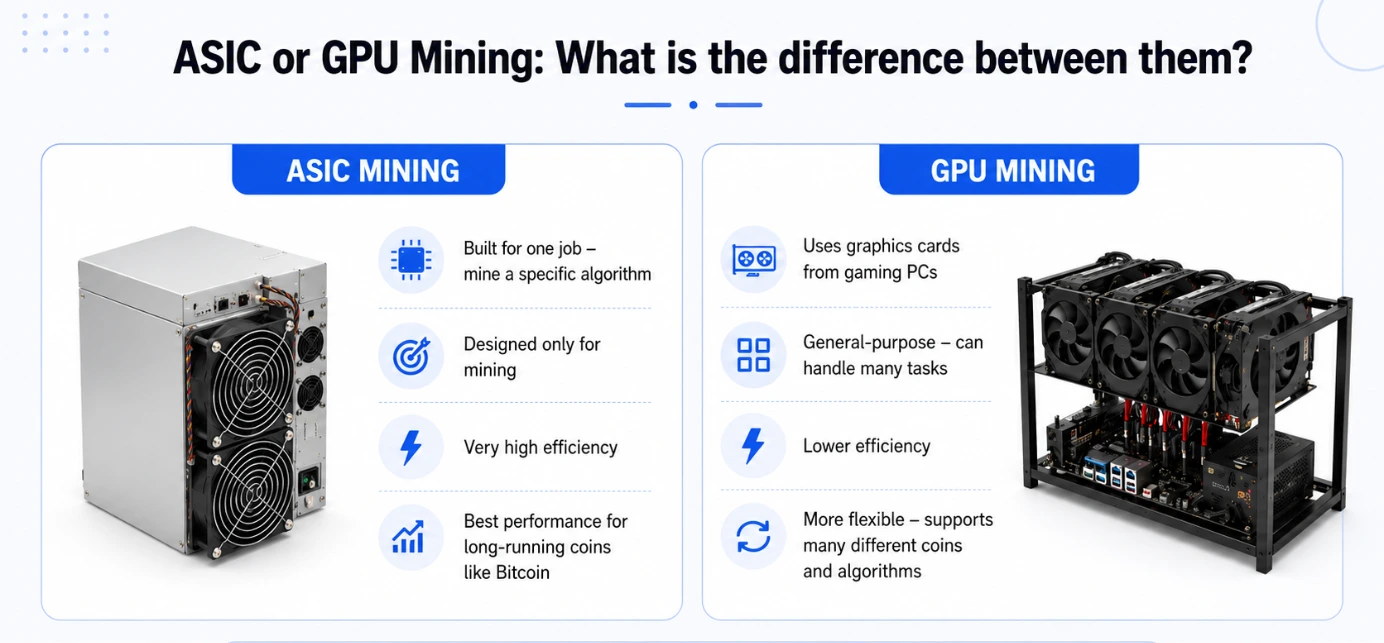
Before we jump into the numbers, it kind of helps to get a grip on what each type of hardware really does, in practice.
ASIC mining uses a chip that is basically built from the ground up to just do one thing: mine a very specific cryptocurrency algorithm. An ASIC miner does not really browse the web; it won’t run games, and it also doesn’t handle spreadsheets or any of that. Every circuit on the board exists in this kind of narrow purpose; it’s there only to chew through mining calculations, quickly and efficiently, as fast as possible.
GPU mining usually uses graphics cards, which are basically the same kind of hardware you see in gaming PCs. A GPU is more like a general-purpose chip, so it can juggle a bunch of different jobs. But in mining, that flexibility also comes with a downside. The GPUs burn more energy for each unit of output, and they just do not keep up with the more specialized ASIC hardware on long-running networks like Bitcoin.
The key takeaway: ASICs win on efficiency. GPUs win on flexibility.
ASIC or GPU: How Miners Compare?
Here’s a bit of a side-by-side look at how these two technologies stack up, using current hardware.
| Spec | Top ASIC (Antminer S21 Pro) | Top GPU (NVIDIA RTX 5090) |
| Hashrate (SHA-256/Bitcoin) | 234 TH/s | ~0.1 GH/s |
| Power Consumption | 3,531W | ~575W |
| Efficiency | 15.1 J/TH | ~5,000+ J/TH (on BTC) |
| Daily Revenue (BTC, $0.07/kWh) | ~$9–12/day | Near zero on Bitcoin |
| Best Algorithm | SHA-256 (Bitcoin) | Altcoin algorithms (RVN, XMR) |
| Resale Value | Low after obsolescence | High (gaming, AI markets) |
| Noise Level | 75–80 dB (industrial) | 45–55 dB (home-friendly) |
| Upfront Cost | $3,600–$10,000+ | $1,500–$3,500 per card |
The numbers tell this pretty clear story for Bitcoin mining. One modern ASIC miner can put out more hashrate than thousands of those high-end GPUs combined on the Bitcoin network. And it’s not really a small advantage, a slight edge. It’s more like a totally different category of performance.
How Much Can You Actually Earn with an ASIC Miner?
It depends on your electricity rate a lot. Like if it moves even a bit, the whole thing looks different. Here’s what the latest, current data suggests for the top ASIC hardware:
How Much Does the Antminer S21 Pro Earn Per Day at $0.07/kWh?
- Daily revenue before electricity: ~$12–15
- Daily power cost at $0.07/kWh: ~$5.93
- Net daily profit: ~$6–9
- Hardware price: ~$3,600
How Much Does the Antminer S23 Hyd Earn Per Day at $0.07/kWh?
- Daily revenue before electricity: ~$25–30
- Daily power cost at $0.07/kWh: ~$9.22
- Net daily profit: ~$15–20
- Hardware price: ~$17,000+
How Much Does the WhatsMiner M66S Earn Per Day at $0.07/kWh?
- Daily revenue before electricity: ~$14–16
- Daily power cost at $0.07/kWh: ~$9.24
- Net daily profit: ~$5–7
- Hardware price: ~$4,767
What Factors Determine Whether an ASIC Miner Is Profitable?
- Electricity rate: the sweet spot is around $0.04–$0.07/kWh. Once you go past $0.10/kWh, most machines have a hard time breaking even, and well, it tends to drag on margins.
- Bitcoin price: when BTC climbs higher, it tends to lift all miners kind of at once. So it’s smart to model profitability using both conservative assumptions and your current price scenario, even if it feels a bit redundant.
- Network difficulty: When more hashrate trickles into the network, the earnings per machine often start to shrink, sort of slowly at first, over time. That happens because competition ramps up in general.
- Cooling setup: hydro-and immersion-cooled units often run with better efficiency, yet they need upfront infrastructure spend.
An ASIC miner running on industrial electricity pricing, and with proper cooling, still can churn out solid and pretty consistent returns, even if it sounds a bit counterintuitive at first. The whole economics part works only if the setup is right.
Can GPU Mining Still Make Money?
GPU mining is not dead, but its role has become much smaller. After Ethereum switched to Proof-of-Stake in 2022, GPU miners lost their most profitable mining option almost overnight and had to move toward less profitable coins and alternative use cases. Now, GPU mining is still somewhat possible, but only in very particular situations:
Where GPU mining still makes sense:
- ASIC-resistant coins, like Monero (XMR), use RandomX, which is built on purpose to fight ASICs. So, GPU miners and CPU miners are still kind of in the same race, with no big unfair advantage.
- Ravencoin (RVN): It runs KawPow, and that algorithm is still pretty GPU-friendly, meaning it keeps the usual setup rather than forcing everything toward ASIC dominance.
- DePIN networks: A growing trend in 2026 involves renting GPU compute power to decentralized AI and rendering networks, which can outperform traditional crypto mining for some setups.
- New altcoin launches: Early-stage coins before ASIC hardware is developed can offer short windows of GPU profitability.
The break-even electricity price for an NVIDIA RTX 5090 mining traditional altcoins sits at about $0.04 per kWh. Most residential electricity rates across the US fall somewhere between $0.10 and $0.16 per kWh, so the typical home GPU miner is losing money even before you factor in the hardware costs.
For Bitcoin specifically, GPU mining is basically not viable at any practical scale in 2026. You would need to run thousands of cards just to get anywhere close to the output you’d see from one mid-tier ASIC miner.
Should You Buy an ASIC Miner or Build a GPU Rig?
Use this quick decision guide based on your situation:
Choose an ASIC miner if:
- You want to mine Bitcoin directly
- Your electricity cost is under $0.07/kWh
- You have a dedicated space with proper ventilation or cooling
- You are comfortable with a long-term commitment to one algorithm
- You want maximum output per square foot
Choose GPU mining if:
- You want the flexibility to switch between multiple coins
- You are mining ASIC-resistant coins like Monero
- You want hardware that retains resale value outside of mining
- Your setup is at home, and noise is a concern
- You are new to mining and want lower financial risk
Avoid both if:
- Your electricity rate is above $0.12/kWh
- You are expecting quick returns without understanding the risks
- You have not run profitability calculations for your specific setup
How Do You Start ASIC Mining?
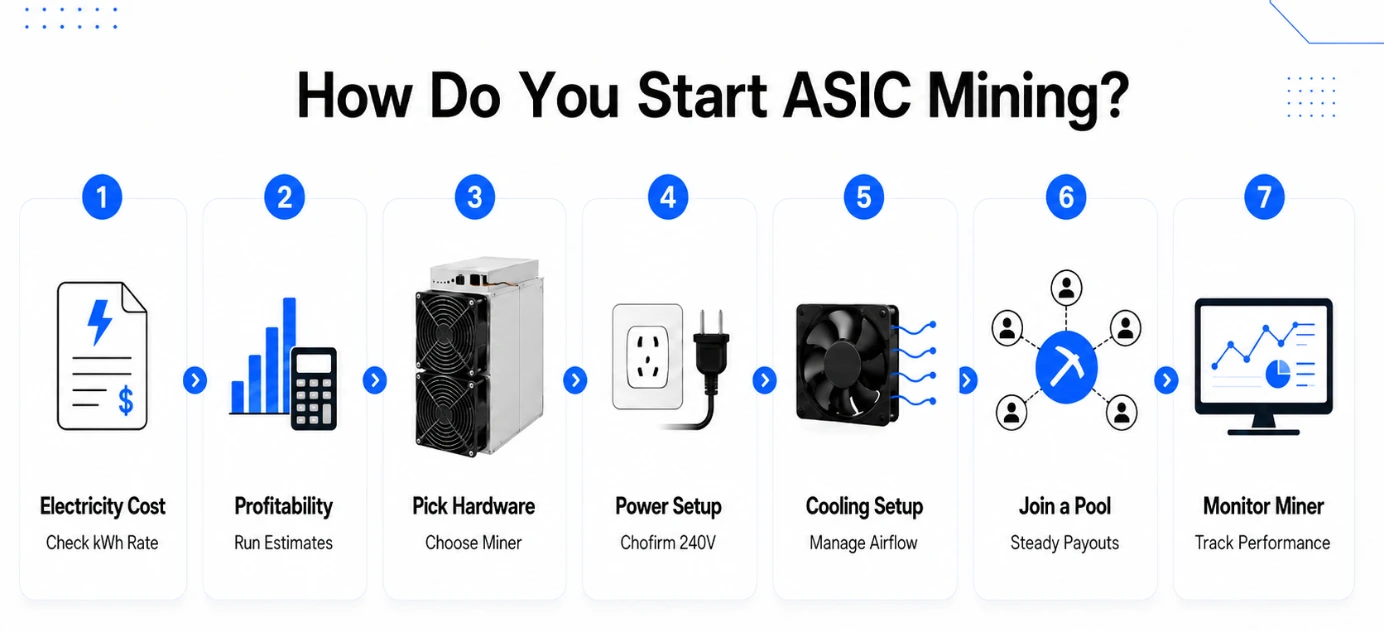
If you have decided that ASIC mining fits your goals, here is a practical starting roadmap:
- Calculate your electricity cost. Check your utility bill for the rate per kWh. This single number will determine whether any miner is profitable for you.
- Run profitability estimates. Use tools like WhatToMine or ASIC Miner Value with your electricity rate and current Bitcoin price to model real returns before buying.
- Pick your hardware. For most newbies, the Antminer S21 Pro feels like the best compromise between efficiency, price, and that practical dependability thing. If you’re going the budget route, the Canaan Avalon A1566 at roughly $3,100 is a decent starting point.
- Prepare your power setup. Most modern ASIC miners require a 240V outlet and draw 3,000W or more. Confirm your electrical infrastructure before the hardware arrives.
- Set up cooling and ventilation. ASICs run hot. A dedicated space with airflow management is not optional. Industrial fans and proper exhaust routing are minimum requirements.
- Try joining a mining pool. In solo mining, Bitcoin isn’t really realistic for lone individual miners. When you link up with a pool like Foundry USA or AntPool, you tend to get steadier, more predictable payouts that track your contributed hashrate pretty closely.
- Then monitor and keep things running. Use the miner’s web dashboard to watch temperature, hashrate, and uptime, all of that. Also, plan for periodic fan replacements and do firmware updates when they come around.
Conclusion
For anyone serious about Bitcoin mining, ASIC miners are the clear choice. They provide a greater hashrate and power efficiency than GPUs, which makes them more suitable to compete with Bitcoin. Bitcoin network. The gap in performance is too big in order for GPU miners to continue to be useful in Bitcoin mining.
GPU mining still has an important place in the market. It is a good option in ASIC-resistant altcoins, for experimental DePIN projects, as well as miners who prefer flexibility between different networks. But for consistent, reliable, long-term revenue from Proof-of-Work mining, the most efficient ASIC mining device coupled with low electric costs is the best option.
Selecting a reliable seller is as crucial as choosing the best mining equipment. A reputable seller should have verified inventory, precise specifications, clear warranty conditions, as well as dependable after-sales assistance. ASIC Marketplace is one option to search for new and used ASIC miners that are available in a variety of budgets and mining sizes. Always look at the models available, determine your operating costs, and pick a model that you can afford to run consistently.
Frequently Asked Questions
-
Is it worth GPU mining in 2026?
GPU mining in 2026 is only worth it for ASIC-resistant coins like Monero or Ravencoin, and even then, only if your electricity rate is under $0.07/kWh. For Bitcoin, GPUs cannot compete with ASIC hardware at any practical scale.
-
What is the best mining in 2026?
ASIC mining on the Bitcoin network is the most profitable and reliable form of mining in 2026, with top machines like the Antminer S21 Pro delivering 234 TH/s at 15.1 J/TH efficiency. Running an ASIC miner at low electricity rates with proper cooling gives you the best shot at consistent returns.
-
Is GPU mining more profitable than ASIC mining?
No, GPU mining is not more profitable than ASIC mining for Bitcoin or any SHA-256 coin in 2026. ASICs outperform GPUs by thousands of times in hashrate and energy efficiency on established Proof-of-Work networks.
-
Is mining still a thing in 2026?
Yes, mining is very much active in 2026, with Bitcoin’s network hashrate continuing to grow and new ASIC hardware pushing efficiency benchmarks higher. Profitability depends on your electricity cost, hardware choice, and Bitcoin price, but miners operating at low power rates are still generating solid daily returns.

Peter Davis
Peter Davis is an accomplished blockchain analyst and technical writer with over four years of experience in the cryptocurrency sector. His expertise spans blockchain infrastructure, ASIC mining hardware, and digital asset markets, where he is recognized for translating complex technical concepts into precise, insightful, and accessible analysis for a global audience.
With a strong foundation in technical research and market evaluation, Peter’s work focuses on bridging blockchain innovation with practical mining and investment strategies. His writing is defined by analytical depth, clarity, and a focus on data-backed insights that guide both professionals and enthusiasts through the evolving crypto landscape.
Driven by a deep passion for Web3 technology and decentralized systems, Peter continues to produce authoritative, research-driven content that enhances understanding of ASIC mining performance, blockchain efficiency, and the broader dynamics shaping the future of digital finance