Quick Summary
Bitcoin used to be the kind of cryptocurrency you bought once, put in your wallet, and then forgot about unless there was news about its value. That’s changed. Thousands of stores, travel sites, tech companies, and online shops now take BTC at checkout, not just as an investment to sit on. This guide covers how that happened, where BTC works as payment today, what it looks like to pay with crypto in real time, and a few things miners should consider before turning mined coins into a purchase.
BTC as payment makes Bitcoin more than an investment
For a long time, Bitcoin sat in the “digital gold” bucket. People bought it, parked it in a wallet, and waited for the price to go up. A lot of long-term holders still see it that way, and there’s nothing wrong with that approach. But it’s not the whole picture anymore. Between better payment processors, smarter point-of-sale setups, and the Lightning Network finally working the way it was supposed to, paying with BTC at checkout has gotten close to as easy as tapping a card.
A few things pushed that along. Lightning settlement cuts transaction costs down to a fraction of a cent for smaller purchases, which matters a lot if you’re buying coffee rather than a car. Processors like BitPay and Coinbase Commerce also gave merchants a way to accept crypto without ever touching a wallet themselves or learning how blockchain works under the hood. And mainstream brands, telecom companies, and airlines, among them, started noticing that customers simply wanted another way to pay.
None of this means Bitcoin has replaced cash or cards, and it probably won’t anytime soon. What it does mean is there’s now a real, working bridge between holding BTC and actually spending it, and that’s what the rest of this article gets into, one category at a time. Whether you’re covering a daily purchase or something bigger, the question is basically the same: does this merchant or platform let you pay directly in crypto, and if not, is there a workaround that gets you there anyway?
How Has Bitcoin Payment Acceptance Changed Over the Years?
A simple timeline view helps show how far Bitcoin payments have come, from a niche experiment to something thousands of retailers support in some form.
| Period | Typical Merchant Behavior | Common Payment Method |
| Early adoption era | A small handful of forward-thinking retailers tried out direct BTC wallets | Coin sent wallet to wallet, by hand |
| Growth stage | Larger brands began testing crypto through third-party processors | BitPay, Coinbase Commerce integrations |
| Present day | Retail, travel, and service businesses by the thousand now take BTC in one form or another | Lightning, crypto debit cards, and gift-card swaps |
There’s a pattern here worth noticing. Hardly any business starts by building its own crypto wallet system from the ground up. Instead, a processor steps in to handle the conversion, the compliance side, and the actual settlement, which takes most of the technical weight off the merchant’s shoulders. Handing that complexity to someone else is probably the single biggest reason adoption picked up speed.
What’s the Payoff for Merchants Who Accept Bitcoin?
Merchants don’t add crypto checkout out of novelty. There are concrete business reasons behind the decision, and they tend to show up consistently across industries.
- Lower processing costs. Card networks usually take somewhere between 1.5% and 3.5% per sale, while a Bitcoin payment routed through Lightning can end up costing a sliver of that.
- No chargeback risk. Once a Bitcoin transaction is confirmed, it can’t be reversed the way a card payment can be disputed, which removes a category of fraud that costs retailers heavily every year.
- Access to a new customer base. Shoppers who already live in crypto tend to seek out merchants that take BTC, so supporting it can set a business apart in a crowded market.
- Simpler cross-border settlement. International sales avoid currency conversion fees and multi-day bank transfer delays, since BTC settles the same way regardless of where the buyer or seller is located.
None of this means crypto checkout is free of friction for merchants, since price volatility between the sale and settlement is still a real consideration. Most processors get around this by converting BTC into local currency the instant a sale goes through, which shifts the exchange-rate risk onto the processor instead of the merchant.
What Kinds of Businesses Actually Take Bitcoin?
Bitcoin shows up in far more corners of the economy than most people assume, and it’s not only the crypto-native brands you’d expect. Here’s a look at the industries where BTC works as a payment option, whether that’s direct or routed through a processor.
Tech, telecom, and everyday subscriptions
Software subscriptions, VPN services, domain registration, mobile phone plans- this corner of the market got there early and never really looked back. Part of that’s just audience overlap: a customer base that already understands crypto is more likely to ask for it at checkout, so these companies had less convincing to do.
Retail, travel, and hospitality
Online electronics stores and general marketplaces have started plugging crypto checkout into their existing payment stack, often through a widget that takes minutes to install rather than a custom build. Travel follows a similar pattern. Booking platforms and some airlines now let you pay for flights, hotels, and cruises in BTC directly, and a fair number of traditional travel agencies have added the option too, usually through the same kind of payment partner.
Entertainment, food, and everyday spending
Streaming services, theater chains, and gaming platforms have added crypto as a supported rail alongside the usual card options. On the food side, it’s a smaller slice: some coffee shops, a few quick-service chains, a handful of delivery apps, but it’s growing, mostly thanks to Lightning making tiny transactions actually practical.
Big-ticket and niche categories
Several dealerships, including a few larger dealer groups, now take crypto toward full or partial vehicle purchases. Jewelry and watch boutiques do something similar for high-value items, usually through a private processor arrangement rather than their own wallet setup. Even nonprofits have joined in, since BTC donations can carry tax advantages for the giver and lower overhead for the organization collecting them.
Here’s how those categories stack up at a glance:
| Category | Typical Payment Method | Conversion Needed? | Availability |
| Retail & electronics | Direct BTC or processor checkout | Sometimes | Moderate |
| Travel & hospitality | Booking platform crypto checkout | Rarely | Growing fast |
| Everyday food & delivery | Crypto debit card | Usually instant | Wide (via cards) |
| Online marketplaces | Payment gateway at checkout | Sometimes | Moderate to wide |
| Real estate & luxury goods | Broker-assisted transfer | Often | Limited |
| Charitable giving | Direct wallet donation | Rarely | Growing |
If you want to browse a curated list of verified retailers rather than guessing, the merchants that accept Bitcoin directory is a practical starting point, since it’s organized by category and gets updated as new businesses come on board.
What Are the Best Real-World Places to Put Bitcoin as payment?
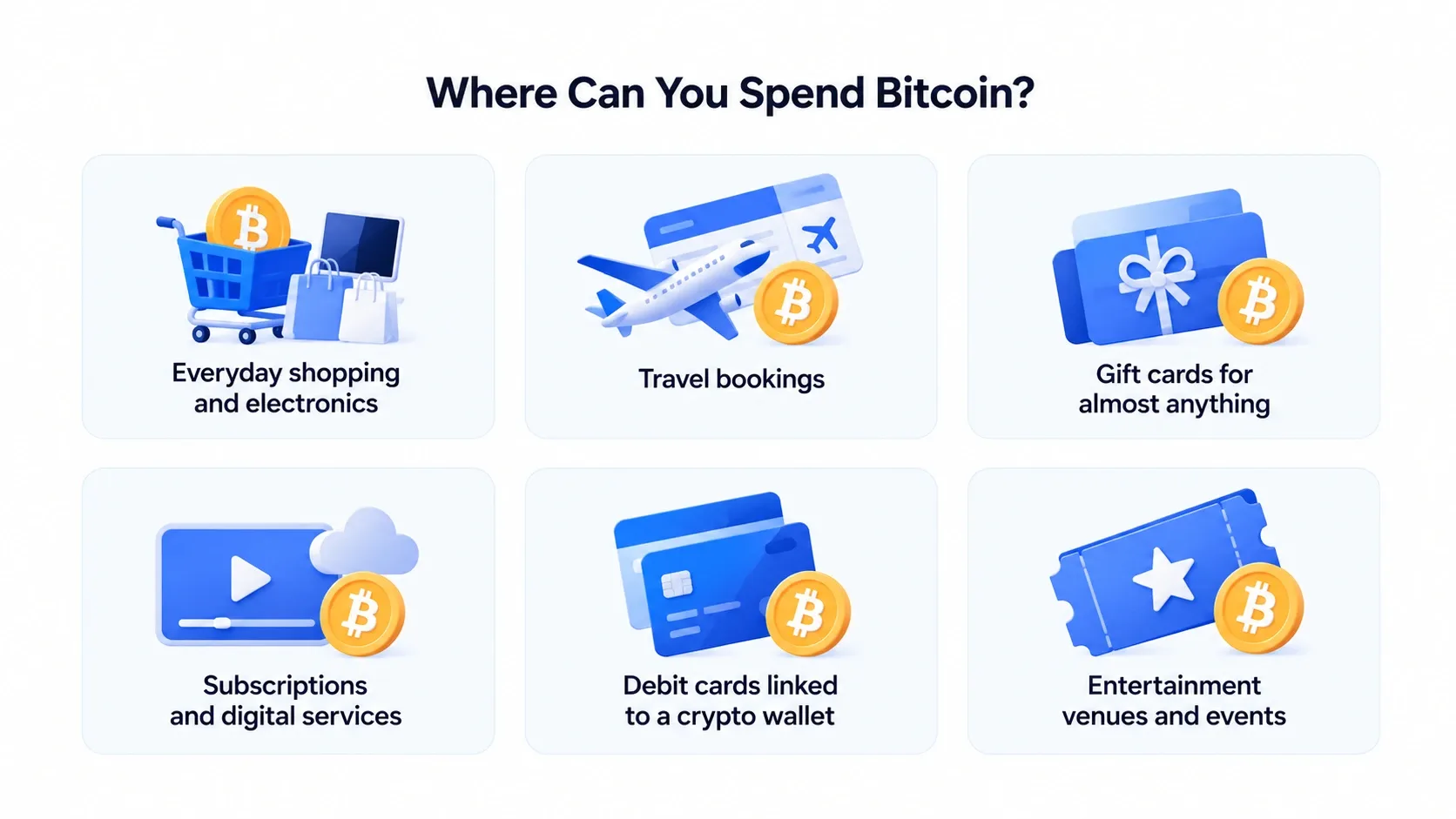
Once you know the categories, the real question is where your BTC actually goes furthest. Here’s a rundown by use case.
Everyday shopping and electronics
Several large electronics and general retail marketplaces take Bitcoin directly at checkout, and plenty more accept it indirectly through gift-card conversion. That makes routine stuff, laptops, components, home goods, genuinely payable in BTC, without selling coins on an exchange first and waiting on a bank transfer.
Travel bookings
Crypto-built booking platforms let you cover an entire trip, flights, hotels, even car rentals, in BTC. Traditional travel agencies have started adding similar support through payment partners too, so you’re not stuck browsing niche crypto-only sites anymore.
Gift cards for almost anything
This is arguably the widest door into spending Bitcoin. Gift-card conversion services let you turn BTC into a spendable balance at stores that don’t take crypto directly, which means you can effectively spend it at almost any major retail chain, a grocery store, a clothing brand, or a food delivery app, by routing it through a card first.
Subscriptions and digital services
Web hosting, VPNs, cloud storage, and various SaaS tools take crypto payments fairly often, and a few privacy-focused email providers have supported BTC for years now, mostly to appeal to users who’d rather not link a card to every service they sign up for.
Debit cards linked to a crypto wallet
Several providers issue debit cards that draw straight from your BTC balance and convert it at the point of sale automatically. This works anywhere a standard card network is accepted, which is about as close to universal Bitcoin spending as it gets right now, since you never have to check whether the specific merchant supports crypto.
Entertainment venues and events
The concept of using cryptocurrency for ticket sales and merchandise purchases has also been tried by a few theaters and professional sports franchises, and again, these have relied on a third-party platform that would covertly convert the cryptocurrency into fiat behind the scenes.
To get a sense of just how far this has spread, from fast food counters to global airlines, it’s worth seeing how businesses themselves describe the appeal. Anyone researching Bitcoin payments for businesses will find the appeal isn’t only customer convenience. Cheaper processing, fewer chargebacks, and smoother cross-border settlement get mentioned just as often.
Does Bitcoin Adoption Look the Same Everywhere?
Bitcoin transactions are not uniformly distributed across the map, and this very thing is precisely why using Bitcoin payments is a breeze in one country but almost out of the question next door.
North America
This region has the broadest mix of merchant categories, everything from telecom giants to entertainment chains, backed by a growing number of crypto-friendly banking partners and clearer regulatory guidance than a few years back.
Europe
Adoption runs strong among independent retailers and hospitality businesses, largely because tourists paying in BTC skip the cross-border card fees that come with converting currency twice.
Asia
While there are a few that have fully embraced mobile-based cryptocurrency payment mechanisms, some have remained stringent with their policies, so what one gets largely depends on which market they find themselves in.
Emerging and developing markets
This tends to be where everyday Bitcoin spending grows the fastest. BTC and stablecoins can offer more stability and fewer transfer restrictions than local currency in some of these economies, which gives people a real reason to use it beyond speculation.
Travelers pick up on these gaps quickly. One city might have BTC working at every cafe, hotel, and shop, while the country right next door barely has a single business that touches it, which is exactly why it’s worth glancing at a merchant directory before a trip if you spend crypto often. And none of this holds still for long. Regulations shift, new processor deals get signed, and consumer demand moves the needle, so a merchant sitting out today could easily be taking BTC within a few months once a competitor jumps in first.
Is Mining Equipment Payable in Bitcoin?
Bitcoin is not only something miners can hold or sell. It can also be used directly for purchases where merchants support crypto payments. This creates a practical, closed loop between mining rewards and real-world spending, since the coins a miner earns can go straight back into the equipment that produces them, without an extra conversion step in between.
ASIC Marketplace accepts cryptocurrency payments, including Bitcoin, alongside bank wire transfers. The final crypto amount is calculated at checkout using the current market rate, so a miner can potentially use BTC directly when purchasing a new Bitcoin miner instead of converting it to traditional currency first. This matters for anyone running a mining operation, because it removes a conversion step, a potential exchange fee, and the delay that comes with cashing out before reinvesting in new hardware.
This is worth pointing out because most conversations about crypto payments focus on coffee shops and airline tickets. For someone already active in ASIC mining, being able to reinvest mined coins into the next rig without leaving the crypto ecosystem is one of the more practical, everyday uses of Bitcoin as payment. It also means a mining operation can, at least in part, fund its own hardware upgrades directly from the coins it produces rather than routing everything through a bank account first.
A few habits make this easier in practice.
Before treating mined BTC as everyday spending money, or before putting it toward new equipment, it helps to build a couple of simple routines:
- Confirm your payout schedule with your pool. While some pools have daily payouts, others offer weekly payouts, and being able to know when the coins will be deposited in your wallet makes planning easier.
- Keep spendable BTC separate from long-term savings. A dedicated wallet for coins you’re willing to use, separate from coins you intend to hold, makes it far easier to decide what’s actually available to spend.
- Track your cost basis as you go. Since spending crypto is typically a taxable event, noting the value of each batch of coins when it arrives, whether from mining or a purchase, saves a lot of guesswork later.
- Reinvest deliberately, not automatically. Whether that means upgrading a rig, adding another unit, or simply covering other expenses, deciding on purpose rather than by default keeps a Bitcoin miner’s income working toward a clear goal.
Whether you’ve got one unit running at home or a small fleet to manage, these habits apply either way, and they take a lot of the stress out of moving from coins parked in a wallet to coins you’re actually spending, on Bitcoin mining gear or anything else.
What Actually Happens When You Pay With Bitcoin at Checkout?
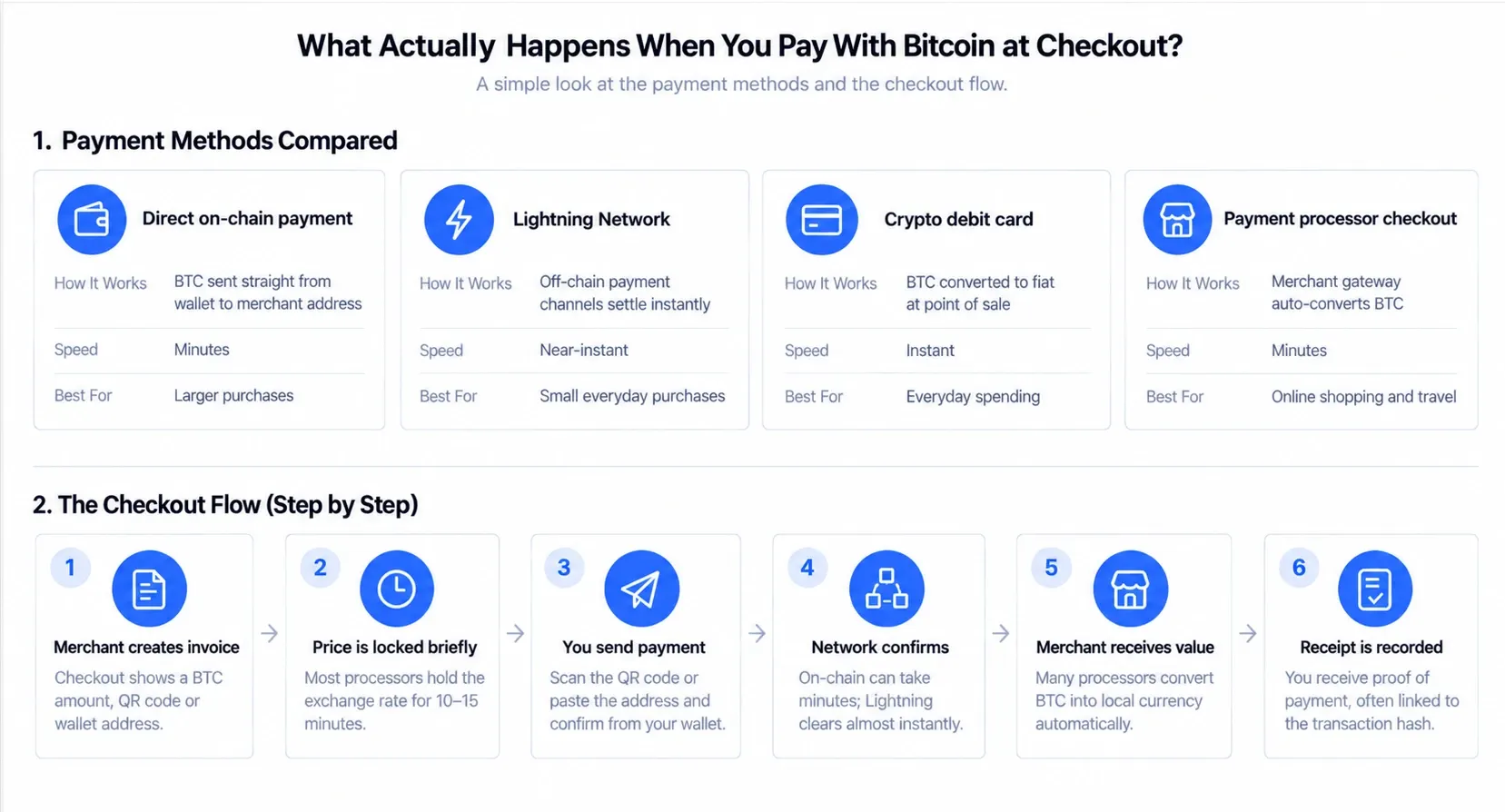
“Paying with Bitcoin” isn’t one single thing, either. There are a few distinct methods, and it helps to see them side by side before walking through the steps:
| Method | How It Works | Speed | Best For |
| Direct on-chain payment | BTC sent straight from wallet to merchant address | Minutes (depends on network congestion) | Larger purchases, fewer frequent transactions |
| Lightning Network | Off-chain payment channels settle instantly | Near-instant | Small, everyday purchases like coffee or food delivery |
| Crypto debit card | BTC converted to fiat at point of sale | Instant | Everyday spending anywhere cards are accepted |
| Payment processor checkout | Merchant uses a gateway that auto-converts BTC | Minutes | Online shopping, travel bookings |
Paying with Bitcoin doesn’t look like swiping a card, but it’s a lot simpler than most first-timers expect once you’ve seen it happen. Here’s roughly what unfolds, step by step.
- The merchant generates an invoice. At checkout, the store’s payment processor calculates the BTC amount owed based on the current exchange rate and displays it as a QR code or wallet address, along with a countdown timer in most cases.
- You confirm the price lock window. Most processors lock the exchange rate for a short window, often ten to fifteen minutes, to protect both sides from sudden price swings during the transaction, since Bitcoin’s price can move noticeably even in that short period.
- You send the payment from your wallet. Scan the QR code, or copy the address by hand, and you’re authorizing a transfer straight from your Bitcoin wallet, hardware device, mobile app, whatever you use, after double-checking the amount before it goes out.
- The network confirms the transaction. An on-chain payment usually needs at least one confirmation, sometimes more, while a Lightning payment clears almost the moment you hit send, which explains why so many small merchants have moved to Lightning for quick, everyday buys like coffee or a burger.
- The merchant receives value, often in fiat. Many processors automatically convert the BTC to the merchant’s local currency the moment the payment clears, which shields the business from holding volatile crypto on its books overnight.
- You get a receipt tied to the transaction hash. This serves as proof of payment and, in most jurisdictions, as a record you’ll want for tax purposes since spending crypto is usually treated as a taxable event, similar to selling it.
Understanding these steps matters because it explains why some purchases settle instantly while others take a few minutes, and why the price you see at the start of checkout is the price that actually gets locked in.
What Are the Pros and Cons of Paying With Bitcoin?
Like any payment method, spending BTC comes with real trade-offs. A side-by-side view makes the decision easier, and it’s worth reading both columns before assuming crypto checkout is automatically better or worse than a card.
| Advantage | Trade-off |
| Lower processing fees compared to card networks, especially on the Lightning Network | Not every merchant accepts BTC directly, so gift cards or debit cards are sometimes required |
| Fast settlement, particularly for Lightning-enabled purchases | On-chain confirmations can take longer during network congestion |
| No chargebacks, which protects merchants from payment fraud | Refunds are harder to process since transactions are generally irreversible |
| Works across borders without currency conversion fees from a bank | Price can move meaningfully between the time you lock a rate and complete the purchase |
| Growing merchant support across retail, travel, and digital services | Tax reporting requirements vary by country and add extra bookkeeping |
None of these trade-offs are dealbreakers, but they explain why Bitcoin spending sits alongside traditional payment methods rather than replacing them outright. The practical approach is using BTC where it clearly saves money or hassle, and falling back on a card elsewhere.
Is Bitcoin Price Volatility a Real Problem for Spenders?
Volatility is probably the single biggest hesitation people have about spending BTC instead of holding it. The concern is straightforward: if the price rises sharply after a purchase, that coffee or laptop ends up costing far more in hindsight than the sticker price suggested, and that regret sticks with people.
A few practical habits help manage this:
- Many spenders choose to use recently acquired Bitcoin for purchases rather than long-held coins, which limits the size of any unrealized gain being given up
- Crypto debit cards that auto-select which coins to spend can reduce the tax and opportunity-cost impact of a purchase by prioritizing lots with the smallest gain.
- Price-lock windows during checkout, usually just a few minutes, remove most of the short-term volatility risk during the transaction itself.
- Some spenders simply treat a portion of their BTC holdings as a “spending wallet,” separate from long-term savings, which makes the volatility question less stressful day-to-day.
- Keeping simple records of the cost basis for spent coins makes tax season considerably less painful, especially for anyone spending BTC regularly rather than occasionally
Volatility hasn’t gone away, but checkout tools, price locking, wallet segmentation, and automated conversion have made it manageable rather than prohibitive for everyday purchases.
How Can a Business Start Accepting Bitcoin as Payments?

For merchants on the other side of the transaction, getting started with crypto payments is far less technical than it used to be. The basic path looks like this:
- Choose a payment processor such as BitPay, Coinbase Commerce, or a similar platform that handles wallet infrastructure, compliance, and conversion on your behalf, so the business doesn’t need in-house blockchain expertise
- Decide on a settlement preference, meaning whether you want to hold received Bitcoin or have it automatically converted to local currency to avoid exposure to price swings.
- Integrate the checkout tool into an existing e-commerce platform, point-of-sale system, or invoicing software, which most processors support with plug-and-play widgets that take a few minutes to set up
- Set clear refund and dispute policies, since blockchain transactions can’t be reversed the way a card payment can, and customers should know that upfront.
- Train staff on the basics, particularly for in-person retail, so employees understand how a QR-code payment differs from a card swipe and what to do if a customer’s transaction is still confirming.
Businesses adopt this route for lower processing costs, a tech-forward customer base, and fewer chargeback disputes. Even businesses adjacent to the ASIC mining industry, hardware resellers and rig-hosting providers among them, have found that accepting BTC directly makes sense given how many of their customers already hold it from running their own equipment.
What Does the Future Hold for Bitcoin as a Payment Method?
A few trends point toward continued growth in BTC spending rather than a plateau:
- Lightning Network capacity has expanded significantly in recent years, making small, everyday purchases faster and cheaper than they were even a short time ago
- Point-of-sale integrations are becoming more automatic, with some payment networks rolling out crypto support to large numbers of small businesses without merchants needing to opt in manually.
- Crypto debit cards continue to close the gap between “places that accept Bitcoin as payment directly” and “places that accept Visa or Mastercard,” effectively making BTC spendable almost anywhere a standard card works.
- Regulatory clarity in several regions has reduced the uncertainty that once made larger businesses hesitant to add crypto checkout options.
- More mining-adjacent businesses, from hardware sellers to hosting providers, are accepting BTC directly, which shortens the distance between earning coins and using them.
None of this guarantees Bitcoin becomes a dominant everyday currency, and plenty of skepticism remains reasonable. But the direction is clear: the gap between holding Bitcoin and actually spending it keeps narrowing, purchase by purchase and merchant by merchant, in ordinary retail as much as in crypto-native corners of the economy.
How Does Mining Connect Back to Spending Bitcoin?
Bitcoin’s journey from a mined asset sitting in a wallet to a currency you can use at checkout reflects a broader maturity in how the crypto economy functions. Miners generate BTC through the Bitcoin mining process, running dedicated hardware around the clock to solve proof-of-work puzzles, and increasingly, that same BTC can move directly into travel bookings, tech subscriptions, retail purchases, or even the next piece of hardware for the mining setup itself. A miner earning rewards today isn’t just accumulating a speculative asset; they’re producing something with a growing number of practical uses the moment it lands in their wallet.
Understanding where you can actually spend Bitcoin turns a long-term holding into a genuinely usable currency, and that shift is exactly why the payment side of Bitcoin deserves as much attention as the mining side. Whether the coins came from an exchange purchase or from months of running a rig, the spending options are largely the same, and they keep expanding.
Conclusion
Bitcoin has clearly outgrown its reputation as a purely speculative asset. Between growing merchant support, faster settlement through the Lightning Network, and practical tools like crypto debit cards and gift-card conversions, spending BTC has become genuinely workable for everyday purchases and larger investments alike. For miners specifically, that includes the option to put mined coins straight back into new equipment, which is exactly the kind of closed loop that platforms like ASIC Marketplace make possible by accepting Bitcoin directly at checkout alongside traditional payment methods. Whether you’re mining, holding, or actively spending, the ecosystem around Bitcoin payments is more usable today than it has ever been, and it keeps getting easier from here.
Frequently Asked Questions
-
Can you actually buy things with Bitcoin?
Yes, thousands of merchants across retail, travel, and tech now take BTC directly or through a payment processor. Crypto debit cards also let you spend it almost anywhere a regular card works.
-
Where can I spend Bitcoin online?
Electronics retailers, travel booking sites, VPN and hosting services, and gift-card platforms are some of the easiest places to start. Most convert BTC to your local currency automatically at checkout, so there’s nothing extra to figure out.
-
Do any major stores accept Bitcoin?
A growing list of telecom companies, airlines, and online marketplaces supports BTC payments, usually through a processor like BitPay. Coverage still varies by region, so it’s worth checking a merchant directory before assuming a specific store takes it.

Peter Davis
Peter Davis is an accomplished blockchain analyst and technical writer with over four years of experience in the cryptocurrency sector. His expertise spans blockchain infrastructure, ASIC mining hardware, and digital asset markets, where he is recognized for translating complex technical concepts into precise, insightful, and accessible analysis for a global audience.
With a strong foundation in technical research and market evaluation, Peter’s work focuses on bridging blockchain innovation with practical mining and investment strategies. His writing is defined by analytical depth, clarity, and a focus on data-backed insights that guide both professionals and enthusiasts through the evolving crypto landscape.
Driven by a deep passion for Web3 technology and decentralized systems, Peter continues to produce authoritative, research-driven content that enhances understanding of ASIC mining performance, blockchain efficiency, and the broader dynamics shaping the future of digital finance