Resumen rápido
BTCB2 has brought fresh attention to mining hardware originally built for BLAKE2b and BLAKE2b-Sia workloads. The network moved away from SHA256d and now runs on BLAKE2b proof-of-work, which means the usual Bitcoin SHA-256 machines aren’t the hardware used on this chain. Instead, miners are looking at existing Sia-generation ASICs, including Goldshell and iBeLink models that already handle BLAKE2b-based work.
In this guide, we’ll look at how BTCB2 mining hardware compatibility works, why existing BLAKE2b-Sia machines are relevant, and what hashrate, power consumption, efficiency, firmware, pool support, and accepted shares tell you about a working setup. We’ll also compare the Goldshell HS Box II, the Goldshell SC5 Pro family, the Goldshell SC Box II, and the iBeLink BM-S3, before looking at how hardware connects with current mining data.
What Hardware Does BTCB2 Mining Use?
BTCB2 mining hardware is built around the BLAKE2b algoritmo de prueba de trabajo. The current BLAKE2b chain began using it from block 961,640, while block 961,639 was the final SHA256d block on that branch. The change is permanent, so hardware designed only for SHA256d can’t produce valid blocks on the current chain.
That distinction matters because an ASIC isn’t a general-purpose computer. Its chips are built to perform one hashing workload extremely fast. A SHA-256 ASIC might push out hundreds of terahashes per second on its own algorithm, but that doesn’t make it useful on BLAKE2b; it’s simply doing the wrong calculation.
BLAKE2b-Sia hardware is a different story. These machines were already designed for the same broader hashing function used by Sia-generation equipment, which is why they’ve become relevant to BTCB2. The official miner documentation says BLAKE2b and BLAKE2b-Sia miners are supported, naming Sia-style hardware such as the Goldshell SC5 Pro as an example. In short, existing BLAKE2b-Sia miners have a genuine technical connection to BTCB2 with no change to the underlying chips.
Why Are BLAKE2b-Sia Miners Relevant to BTCB2?
Several existing BLAKE2b-Sia miners are relevant to BTCB2 because they were already designed around the same mining-algorithm family. Before BTCB2 drew attention, much of this hardware was associated mainly with Siacoin mining; models like the SC5 Pro, the SC Box II, and the BM-S3 were already built around BLAKE2b-Sia workloads. The algorithm change simply created a second use case for some of it: rather than designing a whole new ASIC generation, the network can lean on machines that already know how to perform BLAKE2b-style hashing.
That doesn’t mean every machine marketed as a Sia miner is guaranteed to work, only that the hardware architecture is relevant. The gap between algorithm compatibility and working compatibility is worth understanding; a miner may support BLAKE2b at the chip level, but the full mining path also involves firmware, Stratum communication, pool difficulty, work formatting, and share validation. So existing Siacoin miners are a strong starting point, but the exact model still needs checking against current network or pool support.
How Are BTC and BTCB2 Different?
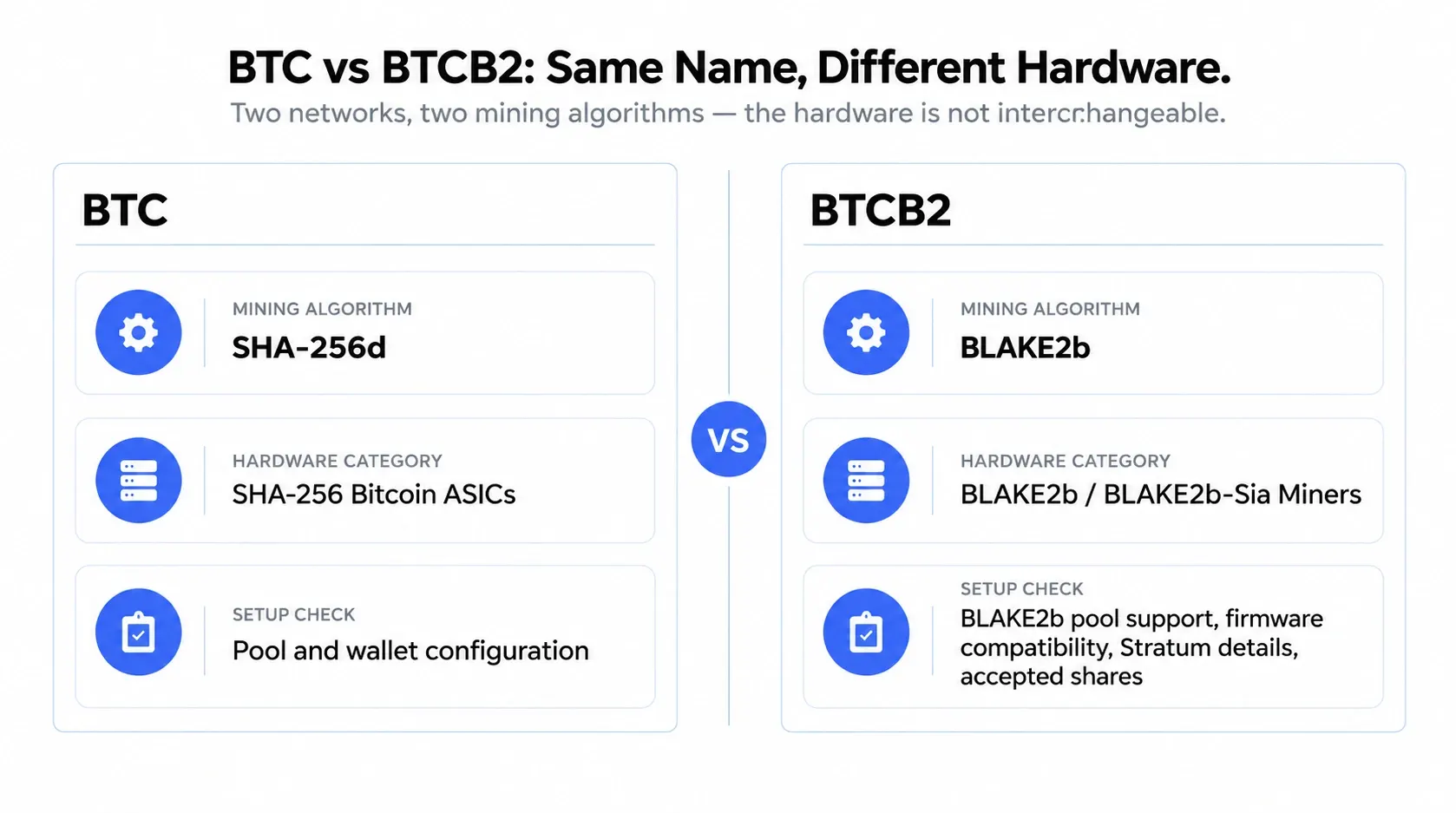
BTC and BTCB2 may look connected by name. Miners should not treat them as the same mining network. The main difference is the mining algorithm. That one change affects the hardware completely.
Bitcoin uses SHA-256d, so it needs SHA-256 Bitcoin ASICs. BTCB2 now uses BLAKE2b, which makes BLAKE2b and BLAKE2b-Sia machines the hardware category. A powerful Bitcoin ASIC may look stronger on paper. It cannot mine BTCB2 if it only supports SHA-256.
Here is the easier way to understand it:
- BTC mining uses SHA-256d hardware.
This includes Bitcoin-focused ASIC miners such as Antminer S19, Antminer S21, Avalon Bitcoin miners, and similar SHA-256 machines.
- BTCB2 mining uses BLAKE2b hardware.
This is where BLAKE2b or BLAKE2b-Sia miners become important, including models like GoldShell SC5 Pro, Goldshell SC Box II, and iBeLink BM-S3.
- A SHA-256 ASIC can mine Bitcoin. Not BTCB2.
Even if the hashrate looks high, that hashrate matters for the algorithm the machine was built for.
- For Bitcoin, the main setup check is pool and wallet configuration.
For BTCB2, miners also need to check BLAKE2b pool support, firmware compatibility, Stratum details, and accepted shares
- The common mistake is comparing hashrate.
A Bitcoin miner may show a higher hashrate number, but it is still the wrong machine for BTCB2 if it cannot process BLAKE2b work.
The simple takeaway is this: BTC and BTCB2 need mining hardware. For BTCB2, miners should focus on BLAKE2b compatibility, pool support, firmware support, and whether the machine is submitting accepted shares through a supported pool or gateway.
Does Every BLAKE2b ASIC Miner Work With BTCB2?
Not automatically. A compatible algorithm is the first requirement, but not the only one. A miner needs to receive work in a format it understands, calculate the correct proof of work, and return shares the pool or gateway accepts. A practical compatibility check usually involves:
- Confirming the machine actually processes BLAKE2b or BLAKE2b-Sia
- Checking whether the exact model and firmware can connect to your chosen BTCB2 pool or gateway
- Confirming shares are accepted, and the Stratum connection stays stable once the miner starts
It’s also worth noting that the DATUM software used with the network is still in public beta, and its node-based route needs a compatible BLAKE2b node and gateway. Pools make things simpler, though; B2Pool says BLAKE2b Sia-generation hardware can connect over standard Stratum, and identifies the iBeLink BM-S3 as hardware that can point at the pool without reflashing. The useful rule: an algorithm match means a miner is worth checking, while accepted shares mean the setup is actually working.
Which ASIC Miners Are Relevant for BTCB2 Mining?
The current picture runs from compact sub-kilowatt boxes to machines drawing more than 3 kW, which is why comparing Mineros ASIC by hashrate alone leaves out too much. BLAKE2b-Sia hardware currently associated with BTCB2 ranges from the 19 TH/s iBeLink BM-S3 down to lower-power Goldshell units like the SC Lite and SC Box II. Four families make useful examples here:
| Miner | BLAKE2b-Sia Hashrate | Potencia | Approx. Efficiency | Current BTCB2 Relevance |
| Goldshell HS Box II | 1.2 TH/s in SC mode | 325W | 270.83 J/TH | BLAKE2b-Sia capable; verify exact BTCB2 pool support |
| Goldshell SC5 Pro | 11 TH/s | 2820W | 256.36 J/TH | Explicitly named by BLAKE2b network documentation |
| Goldshell SC5 Pro II | 14 TH/s | 3300W | 235.71 J/TH | Listed by Mining Now for Bitcoin BLAKE2b |
| Goldshell SC Box II | 1,9 TH/s | 400W | 210.53 J/TH | Currently listed by Mining Now for Bitcoin BLAKE2b |
| iBeLink BM-S3 | 19 TH/s | 3100W | 163.16 J/TH | Identified by B2Pool and Mining Now |
Goldshell HS Box II
La Goldshell HS Box II stands apart from the larger miners because it supports more than one mode. For BLAKE2b-Sia work, the relevant figure is its Siacoin mode, around 1.2 TH/s at 325W, plus a lower-power SC mode of roughly 900 GH/s at 220W.
Its compact design makes one point clear: the largest hashrate isn’t always the only practical spec, since a 325W machine loads a room, circuit, and cooling setup very differently than a 3,000W-class ASIC. That said, current tracking mainly reflects its Handshake profile rather than BTCB2, so confirm exact pool acceptance before treating it as a fully verified BTCB2 worker.
Goldshell SC5 Pro 11 TH/s and SC5 Pro II 14 TH/s
La Goldshell SC5 Pro family sits between compact hardware and higher-hashrate units, and comes in 11 TH/s and 14 TH/s versions, a nice example of how hashrate and power vary within one family. The 11 TH/s draws 2820W (about 256.36 J/TH); the SC5 Pro II lifts output to 14 TH/s at 3300W, improving efficiency to roughly 235.71 J/TH.
The 11 TH/s model has particularly strong compatibility evidence, since the official Bitcoin BLAKE2b documentation names Goldshell SC5 Pro hardware among the supported Sia-style hashers, and current tracking lists both versions with Bitcoin BLAKE2b. The pair also shows how two related miners differ: the 14 TH/s machine delivers more hashrate but asks for another 480W, so the choice comes down to available power, efficiency targets, heat, and how much you value the extra output. For a closer walk-through, thisSC5 Pro mining guide covers the setup side in more detail.
Goldshell SC Box II
Compact Siacoin miners such as el Goldshell Caja SC II use the same BLAKE2b-Sia hardware category now being discussed around BTCB2. It runs at 1.9 TH/s and around 400W (roughly 210.53 J/TH), with a low-power mode of 1.45 TH/s at 260W.
Compared with the SC5 Pro family, that’s a much smaller electrical load and less hashrate, so the two belong to different setup categories rather than being direct swaps. Current tracking includes BTCB2, shown as Bitcoin BLAKE2b, among its mineable coins. It’s a good example of why efficiency and absolute power deserve separate attention: a miner can use far less electricity overall while still carrying a different efficiency ratio from a bigger machine.
iBeLink BM-S3
La iBeLink BM-S3 is the highest-hashrate model here, rated at 19 TH/s and 3100W, which gives an efficiency of around 163.16 J/TH. B2Pool specifically identifies the BM-S3 and BM-S3+ as BLAKE2b ASIC hardware that can connect to its BTC BLAKE2b pool, noting that Sia-generation machines can use their existing firmware and point at the pool through standard Stratum. Current tracking also shows the BM-S3 supporting Bitcoin BLAKE2b alongside Siacoin.
The BM-S3 illustrates the hashrate-efficiency relationship nicely. At 19 TH/s, it has the highest rated output here, yet its 3100W draw sits below the 3300W of the 14 TH/s SC5 Pro II, producing the lowest J/TH in the comparison. Even so, it shouldn’t automatically be called the standout choice, since a 3100W unit still needs suitable electrical infrastructure, strong airflow, and a location that can handle continuous ASIC noise and heat.
How Do Hashrate, Power, and Efficiency Affect BTCB2 Mining?
Specifications become far more useful when read together rather than one at a time.
Hashrate is how much hashing work a miner performs each second; within the same algorithm, more hashrate means more work contributed. A 19 TH/s BM-S3 does far more BLAKE2b work than a 1.9 TH/s SC Box II, though that doesn’t make it ten times more attractive to run once electricity, difficulty, and hardware cost are counted.
Power consumption is the electricity draw. A 3300W ASIC running continuously uses about 79.2 kWh a day; a 400W miner uses about 9.6 kWh. That gap affects more than the bill, since higher power means more heat to clear and may call for stronger circuits.
Efficiency, in joules per terahash, shows how much energy goes into each unit of hashrate, and lower is better on the same algorithm. Across these models, it runs from about 270.83 J/TH for the HS Box II to about 163.16 J/TH for the BM-S3, though it still needs context: a highly efficient 3 kW machine and a less efficient 300W machine suit completely different locations.
Why Do Pool and Firmware Support Matter?
Once the ASIC can do BLAKE2b work, the next question is how that work reaches the network. Pools talk to ASICs through Stratum: the pool sends a job, the ASIC hashes against it, and valid shares come back, which is how the pool measures a miner’s contribution. Use the wrong algorithm or work format, though, and a miner can look connected while quietly producing rejected shares.
That’s why pool-side data matters. B2Pool says its ASIC port supports BLAKE2b hardware over Stratum and adjusts worker difficulty once shares arrive, and notes stock Sia firmware works on compatible machines such as the BM-S3. The official route is more technical, pairing a Bitcoin Knots node with the BLAKE2b DATUM Gateway. The takeaway isn’t that one method beats the other; it’s that compatibility runs the whole path from ASIC to accepted work, not just the algorithm on a spec sheet.
How Do You Verify a BTCB2 Mining Setup?
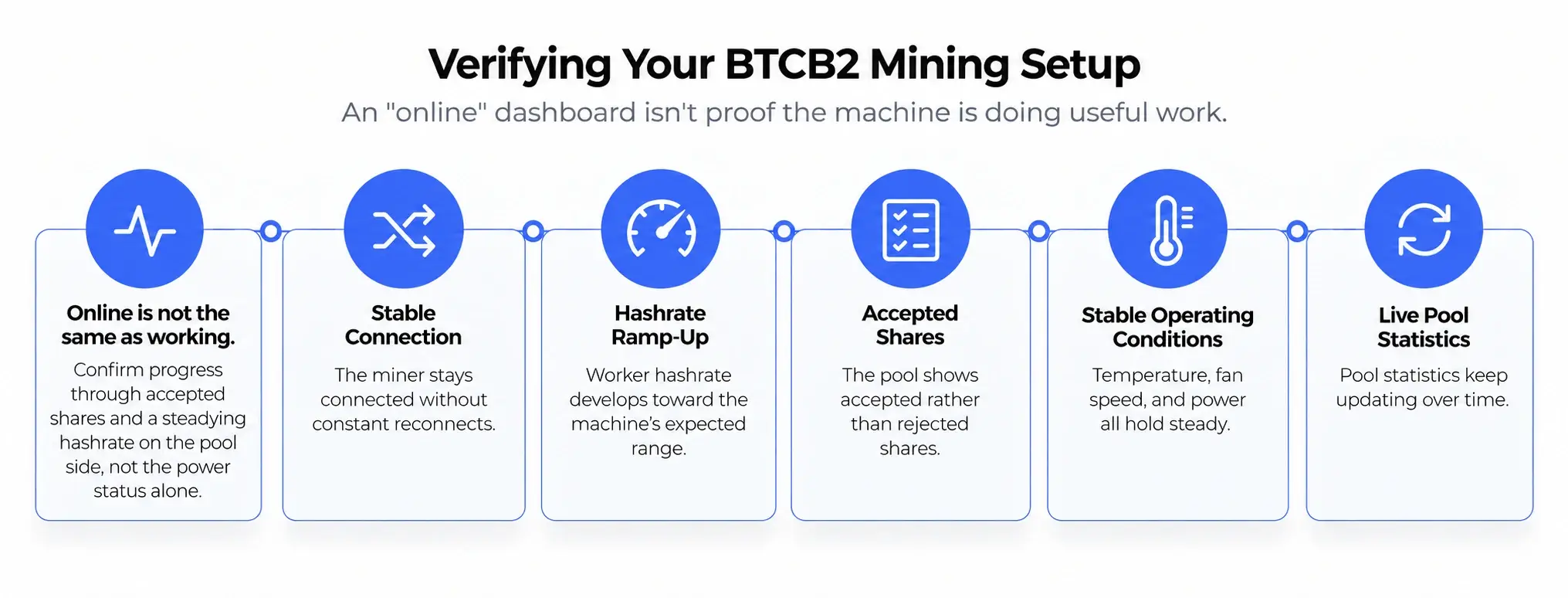
A dashboard reading “online” is a good start, but it doesn’t prove the machine is contributing useful work. After connecting compatible hardware, check the pool or gateway side too: accepted shares should start appearing, and the reported hashrate should steady as more shares are submitted. A practical check covers:
- The miner stays connected without constant reconnects
- The pool shows accepted rather than rejected shares
- Worker hashrate develops toward the machine’s expected range
- Temperatures, fan speed, and power all hold steady
- Wallet and payout details are entered correctly
- Pool statistics keep updating over time
Pool-measured hashrate can drift above or below the local figure over short windows, since it’s calculated from submitted shares, so compare over a longer period rather than judging a worker on a few minutes of data. A consistent gap, especially alongside rejected shares, is worth investigating.
How Does Hardware Choice Connect With Mining Profitability?
A miner’s specs give you the starting numbers for profitability, but they don’t decide the final result on their own:
| Factorar | What It Changes |
| Tasa de hash | Amount of mining work contributed |
| El consumo de energía | Daily electricity use |
| Eficacia | Energy required per unit of hashrate |
| Dificultad de la red | How much competition exists for rewards |
| Tarifas de pool | Amount deducted from mining rewards |
| BTCB2 market value | Estimated value of mined coins |
| Liquidity | How easily that value can be realized |
Current mining profitability can change even when a miner’s hashrate and power stay the same, since BTCB2 price, network conditions, electricity costs, and pool fees keep moving. When this data was checked, tracking pages for several BLAKE2b-Sia machines showed unusually high BTCB2 revenue estimates alongside warnings that BLAKE2b profitability was at record levels and could shift sharply. That’s the key part: BTCB2 market data moves quickly, so a fixed figure in an article goes stale fast, which is why live tools beat one daily return presented as if it will hold.
Why Does Market Liquidity Matter Alongside Hardware Performance?
Hardware tells you how fast a machine hashes and how much electricity it uses. What it can’t tell you is whether the market can actually absorb mined coins at the price a calculator shows, and that matters most for a newer, fast-moving market. A calculator’s maths can be perfectly correct while still resting on a price that shifts quickly, and liquidity adds one more question: if mined BTCB2 needs converting, is there enough real trading activity around that price to do it? So hardware performance and market data are best read together; a strong ASIC can hash exactly as expected while the estimated value of its output moves significantly from one day to the next.
Conclusión
BTCB2 has created a new use case for existing BLAKE2b and BLAKE2b-Sia mining hardware. Machines once associated mainly with Siacoin are relevant because the current chain runs on BLAKE2b proof-of-work, but exact compatibility should still be confirmed through firmware, pool support, and accepted shares rather than assumed.
The Goldshell HS Box II, SC5 Pro family, SC Box II, and iBeLink BM-S3 show just how wide the hardware range can be. Their hashrates, power needs, and efficiency figures differ substantially, so no single spec tells the whole story. ASIC Marketplace can be used to compare the technical specifications of these machines, while current network and profitability data should be checked separately before deciding what those specs mean in practice.
Preguntas frecuentes
-
Can Siacoin ASIC miners mine BTCB2?
Some can. BTCB2 uses BLAKE2b, and many Siacoin ASICs were built around BLAKE2b-Sia, so the hardware architecture is relevant. Even so, compatibility should be confirmed at the exact-model level through firmware and pool support, since not every Sia-branded machine is guaranteed to work.
-
Which algorithm does BTCB2 mining use?
BTCB2 uses BLAKE2b proof of work. The chain moved away from SHA256d, so hardware built only for SHA256d can’t produce valid blocks on it, while BLAKE2b and BLAKE2b-Sia machines are the relevant category.
-
Can Bitcoin SHA-256 ASIC miners mine BTCB2?
No. A SHA-256 ASIC is built for a different hashing workload and would be doing the wrong calculation for BLAKE2b, regardless of how high its terahash figure looks. BTCB2 needs hardware that supports BLAKE2b.
-
How can I check whether my BLAKE2b ASIC supports BTCB2?
Confirm the exact model and firmware against current pool or network documentation, connect it to a BTCB2 pool or gateway, and watch for accepted shares and a stable, developing hashrate. Accepted shares, rather than an “online” status alone, are what confirm the setup is genuinely working.

Peter Davis
Peter Davis es un consumado analista de blockchain y redactor técnico con más de cuatro años de experiencia en el sector de las criptomonedas. Su experiencia abarca la infraestructura blockchain, el hardware de minería ASIC y los mercados de activos digitales, donde es reconocido por traducir conceptos técnicos complejos en análisis precisos, perspicaces y accesibles para una audiencia global.
Con una sólida base en investigación técnica y evaluación de mercados, el trabajo de Peter se centra en vincular la innovación de blockchain con estrategias prácticas de minería e inversión. Sus escritos se caracterizan por la profundidad analítica, la claridad y el enfoque en las perspectivas respaldadas por datos que guían tanto a profesionales como a entusiastas a través del cambiante panorama de las criptomonedas.
Impulsado por una profunda pasión por la tecnología Web3 y los sistemas descentralizados, Peter sigue produciendo contenidos de autoridad, basados en la investigación, que mejoran la comprensión del rendimiento de la minería ASIC, la eficiencia de blockchain y la dinámica más amplia que da forma al futuro de las finanzas digitales.