Résumé rapide
Getting into Bitcoin mining in the United States is kind of more complicated in 2026 than it was a couple of years back. The equipment is better and more efficient, really, but new tariffs, weird shipping headaches, and profitability numbers that keep changing mean you can’t just tap “buy” and assume you will make money. This guide walks you through the real costs of bringing an Mineur ASIC into the country, what you’ll pay in duties, how shipping works, and whether the whole thing is actually worth it right now.
Let’s break it down a bit, so you kinda know exactly what you’re stepping into before you go spending thousands of dollars. As of today, Bitcoin is trading around $61,339, down sharply from the more recent highs, and the network hashrate is sitting near 920 EH/s, so honestly, the competition has never been this tight, and margins feel that squeeze.
Understanding the Hardware: What You’re Actually Buying
Before we talk about money, you kind of need to know what’s on the market. ASIC machines ( Application-Specific Integrated Circuit ) are built for one job only, mining Bitcoin, using the SHA-256 algorithm. Unlike a regular computer, they really do nothing else, and that is exactly why they are so good at it.
Here are the top machines miners are buying in 2026:
| Modèle | Hashrate | Efficacité | Consommation de courant | Meilleur pour |
| Antminer S21 XP | 270 TH/s | 13.5 J/TH | ~3,645W | Best air-cooled efficiency |
| Antminer S21 Pro | 234 TH/s | 15.0 J/TH | ~3,510W | Best all-around value |
| Antminer S21+ | 200 TH/s | ~17 J/TH | ~3,564W | Mid-size farms |
| Antminer S19 XP (Used) | 270 TH/s | ~21.5 J/TH | varies | Budget entry, cheap power |
A few things to keep in mind when picking your machine:
- Efficiency matters more than raw power. A difference of just 2–3 J/TH can mean tens of dollars per month per unit in electricity costs.
- The S21 XP is the air-cooled champ at 13.5 J/TH, while hydro-cooled versions push down to around 12 J/TH.
- Used machines like the S19 XP can run $800–$900 and still turn a profit if your electricity is under $0.06/kWh, but you’re gambling on chip wear with no warranty.
- 97% of all ASIC hardware comes from three Chinese-founded companies: Bitmain (82%), MicroBT (15%), and Canaan (2%).
That last point is the root of every problem we’re about to discuss. Because nearly all of this gear is made overseas, every machine that crosses the U.S. border gets taxed.
Import Duties: The Tariff Reality in 2026
This is where buying an ASIC miner in the USA gets expensive. Over the past two years, import taxes on mining hardware have climbed dramatically, and they stack on top of each other.
Here’s how the duties break down:
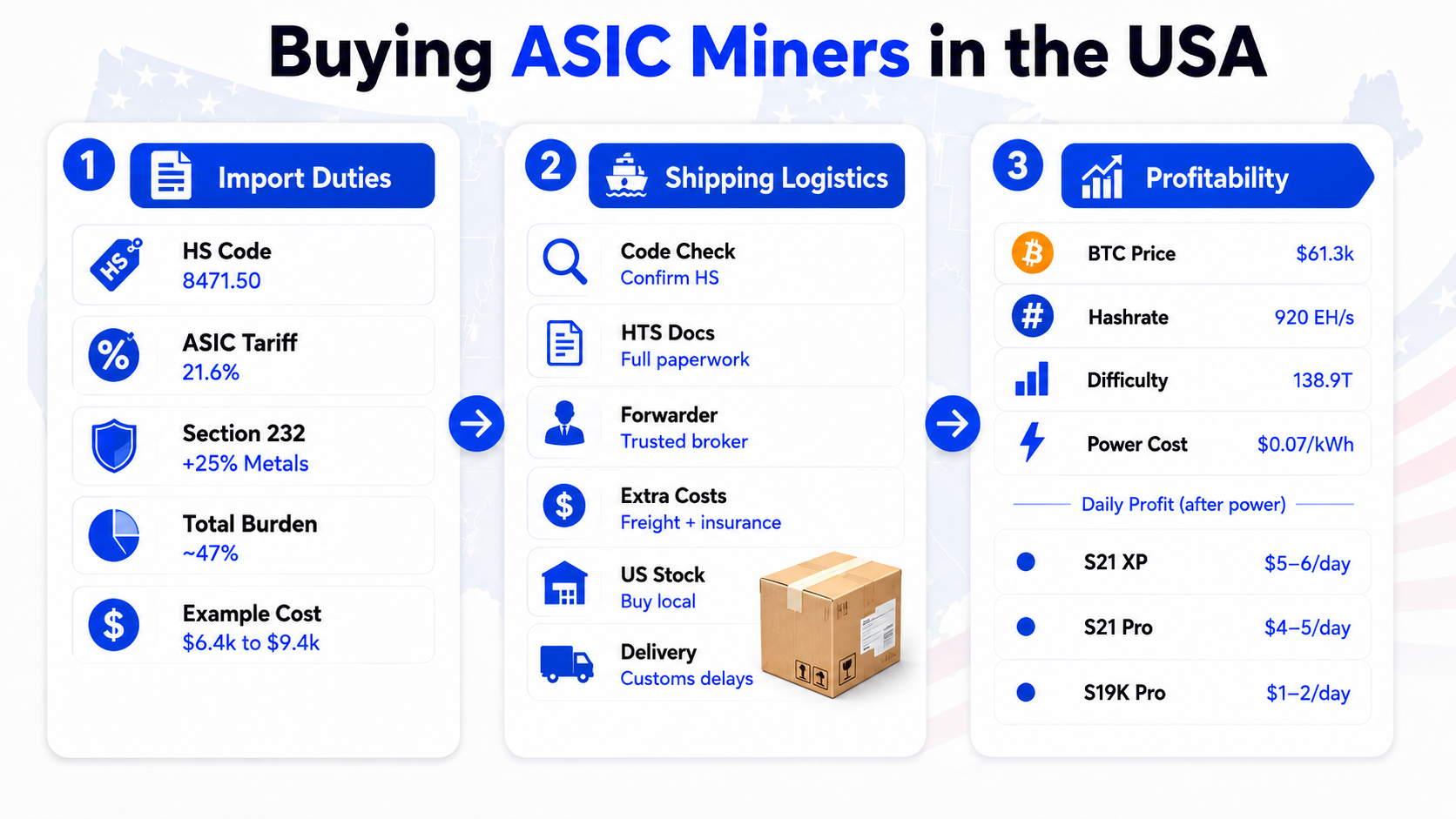
- ASIC miners are put in HS code 8471.50, as automatic data processing machines, you know the category.
- The base reciprocal tariff on machines coming from Southeast Asia, like Indonesia, Malaysia, and Thailand, went up from 2.6% to 21.6%.
- On top of that, the April 2026 Section 232 proclamation added 25% derivative tariffs on products containing significant steel, aluminum, and copper, which ASIC miners do.
Let’s look at a real example with a flagship machine:
| Cost Item | Amount |
| Antminer S21 XP base price | ~$6,400 |
| Section 232 metals tariff | ~$1,600 |
| Reciprocal ASIC tariff (21.6%) | ~$1,382 |
| Combined tariff burden | ~47% |
So this $6,400 machine can end up costing like $9,400 by the time it clears customs. That’s a brutal uplift in price, and it’s also why the all-in production costs for U.S. miners averaged around $74,600 per Bitcoin in early 2026, a figure that now sits above the current BTC price, leaving a lot of operators under pressure.
Some importers sometimes try to dodge duties by declaring a lower value than what they actually paid. That’s illegal; it can get your shipment seized at the port, and it may trigger serious penalties. Just don’t do it. Pay what you owe, and keep spotless records.
Shipping Logistics: Getting Your Machine Home
Once you’ve accepted the tariff math, you still have to get the hardware into your hands physically. Shipping ASIC miners isn’t like ordering a phone, and a few rules have changed recently.
Follow these steps to keep your shipment moving smoothly:
- Please confirm the HS code with your seller. Also, make sure, as much as possible, that everything lands under 8471.50 so customs doesn’t start flagging it.
- Get the full HTS paperwork ready. I mean, the U.S. de minimis exemption sort of ended in August 2025, so even those small parcels now need complete tariff documentation.
- Choose a reputable freight forwarder. A good Crypto miner supplier will handle customs brokerage, but verify they include duty estimates upfront.
- Budget for the extras. Beyond duties, expect freight charges, insurance, and a customs brokerage fee.
- Plan for power infrastructure separately. Mining containers (steel-and-copper units) also got hit with tariffs, adding $10,000–$25,000 to a $30,000–$80,000 container.
A few practical shipping tips from experienced miners:
- Purchase from sellers with U.S.-based warehouses whenever you can. Buying stock that’s cleared of customs will eliminate the hassle of importing; you’ll have to pay an additional charge that is added to the cost.
- Check delivery timelines carefully. Customs processing can add days or weeks.
- Ensure high-value shipments. A single S21 XP is worth thousands; don’t risk it over a small insurance fee.
Because of the tariff pressure, many U.S. buyers now shop the secondary market for machines already inside the country. It sidesteps the import duty entirely, which is a legitimate and increasingly popular strategy.
Profitability: Will You Actually Make Money?
Now the question everyone wants answered. Bitcoin is trading around $61,339, and the network hashrate is sitting near 920 EH/s, difficulty around 138.9T, and honestly, the mining margins are pretty tight right now. That recent pullback of something like 17% over a single week has put a lot of the higher cost operators right at the edge or even a bit under breakeven.
Use this standard profitability formula:
(Your Hashrate ÷ Network Hashrate) × Block Reward × BTC Price − (Power Draw × Electricity Rate)
Remember that after an April 2024 cut, the block reward will be halved to 3.125 BTC per block, which cuts down on the amount you can earn.
Here’s a rough daily view with $0.07/kWh electricity, based on the current network atmosphere and BTC around $61,339:
| Modèle | Gross Daily Revenue | Daily Profit (after power) |
| Antminer S21 XP | ~$12–$14 | ~$5–$6 |
| Antminer S21 Pro | ~$10–$12 | ~$4–$5 |
| Antminer S19K Pro | ~$4–$5 | ~$1–$2 |
The factors that decide whether you profit:
- Electricity cost is king. Below $0.05–$0.08/kWh, modern machines still generate returns. Above that, many units slip into the red at today’s price.
- ROI timelines have stretched. With BTC down near $61,000, even the best units like the S21 XP may need 18–24 months to recover their cost in favorable conditions; weaker machines may never break even.
- The difficulty keeps climbing. As more hashrate joins the network, your share of rewards drops, so today’s numbers won’t hold forever.
- BTC price volatility can swing your profitability overnight. Bitcoin recently broke below $60,000 for the first time since 2024 before clawing back.
The honest takeaway: at current prices, U.S. mining only works if you have access to genuinely cheap power and can buy hardware without paying the full 47% tariff stack. Otherwise, jurisdictions like Kazakhstan and Russia hold a real cost advantage right now.
Conclusion
Buying ASIC miners in the USA in 2026 means navigating steep import duties, careful shipping logistics, and, at today’s BTC price near $61,339, thinner-than-usual margins. The hardware is fantastic, but the current tariff and price environment demands that you do your homework before spending a dime. Run the numbers using your real electricity rate, then factor in the full landed cost, including duties, and also ask yourself if the secondary market actually makes more sense than new imports. Maybe it does, maybe it doesn’t.
If you’re ready to get going, start with a trusted supplier who is clear about pricing, customs duties, and warranty help. Asic Marketplace has a pretty strong selection of machines and the kind of direction you need to make a sensible buy, so you can spend less time pushing through customs paperwork. Doing the due diligence, locking in inexpensive power, and mining can still be a rewarding thing to do in the United States.
Questions fréquemment posées
-
Is Bitcoin mining illegal in the USA?
No, Bitcoin mining is completely legal in the USA. However, a few states have specific regulations or restrictions, so always check your local and state rules before setting up.
-
How much does it cost to mine 1 BTC in the USA?
As of 2026, the all-in cost to mine one Bitcoin in the USA averages around $74,600, including hardware, electricity, and tariffs. This figure varies widely based on your power rate, which is the single biggest factor.
-
Are ASIC miners still profitable?
Yes, but margins are tight at today’s BTC price near $61,339. Profitability depends heavily on cheap electricity (ideally under $0.07/kWh) and avoiding the full 47% import tariff stack.

Peter Davis
Peter Davis est un analyste accompli de la blockchain et un rédacteur technique avec plus de quatre ans d'expérience dans le secteur des crypto-monnaies. Son expertise couvre l'infrastructure de la blockchain, le matériel de minage ASIC et les marchés des actifs numériques, où il est reconnu pour traduire des concepts techniques complexes en analyses précises, perspicaces et accessibles pour un public mondial.
Avec une base solide dans la recherche technique et l'évaluation du marché, le travail de Peter se concentre sur le lien entre l'innovation de la blockchain et les stratégies pratiques d'exploitation minière et d'investissement. Ses écrits sont définis par la profondeur analytique, la clarté et l'accent mis sur les idées fondées sur des données qui guident à la fois les professionnels et les passionnés dans le paysage cryptographique en évolution.
Animé d'une profonde passion pour la technologie Web3 et les systèmes décentralisés, Peter continue de produire un contenu faisant autorité, axé sur la recherche, qui améliore la compréhension de la performance minière ASIC, de l'efficacité de la blockchain et de la dynamique plus large qui façonne l'avenir de la finance numérique