Home Bitcoin mining is still possible in 2026, and in some ways it’s easier to get into than it was a few years back, thanks to more efficient machines and a mature secondhand hardware market. That said, this isn’t the “plug in a machine and get rich” game some YouTube videos make it look like.
This guide walks through everything a beginner in the United States needs to know before buying a machine, plugging it in, and joining a mining pool, covering the real numbers, the real costs, and the real mistakes people make in their first few months.
Is Home Bitcoin Mining Still Worth It?
Here’s the truth about profitability: it depends on your electricity rate, the type of equipment you will use, and your risk perception.
Modern Bitcoin exploitations minières is mostly the work of large farms consisting of hundreds or even thousands of mining rigs, operating in locations where electricity prices are low. This is what you are competing against if you are planning on mining alone at home. However, it does not mean that home mining cannot be profitable anymore.
Here’s how the scenario of mining Bitcoin has improved:
- Network difficulty has been volatile this year, swinging both up and down as large-scale operators shift power capacity toward AI and high-performance computing workloads, which occasionally removes hashrate from the network and eases conditions for everyone else.
- Hashprice, the standard measure of daily mining revenue per unit of computing power, has bounced around the $28 to $35 per petahash per second range for much of the year, which is enough to keep efficient hardware profitable in low-cost power regions but tight almost everywhere else.
- Newer-generation ASIC miners are meaningfully more power-efficient than machines from just two or three years ago, which matters more than raw hash rate when you’re paying a residential electricity bill.
Home mining works best as a long-term accumulation strategy, not as a fast source of income. If your electricity costs under 12 cents per kWh and you buy efficient, well-maintained hardware, you can mine profitably. If you’re paying 20+ cents per kWh, you’ll likely need to treat mining more as a hobby or a hedge than a business.
Who Should Try Home Bitcoin Mining?
Home mining will make the most sense for:
- People with access to inexpensive energy sources (solar, off-peak, or inexpensive utility rates in your region).
- Individuals with a garage, basement, or outbuilding where there are no concerns about noise and heat.
- Someone familiar with basic networking and computers.
- who are long-term Bitcoin enthusiasts and interested in earning BTC rather than purchasing it on an exchange.
If you rent a small apartment with shared walls, have expensive electricity rates, or are looking for immediate returns on investment, then it’s probably not for you. Be realistic with yourself before dropping a couple of grand on mining hardware.
What is the Difference Between Home, Cloud, and Hosted Bitcoin Mining?
If you consider running mining hardware in your garage, you should know that mining at home is not the only way to earn Bitcoin by mining. In fact, three models coexist, and each has a different set of pros and cons:
- Home mining: You own the hardware and mine using it on your own. You retain full control over the device itself, its firmware, and its pool settings. Yet, you will also bear the full responsibility for all electricity costs, the noise, and other maintenance needs.
- Hosted mining: You own an ASIC miner and lease it to a third party to install it in their data center or mining facility, where they will take care of electricity, air conditioning, and uptime, which will cost you monthly service fees. You do not have the noise and heat issue to deal with anymore, but the hosting costs you money.
- Cloud mining: You have no hardware at all. You simply pay a certain firm for a mining contract based on their hash rate. It is the easiest way of mining, but also the one with the most scams around, so proceed with caution.
Home mining would still be the best way for an absolute beginner to learn the mining process, despite the presence of a little noise.
How Does Bitcoin Mining Actually Work?
It will be helpful for you to know about mining before purchasing any cryptocurrency mining device.
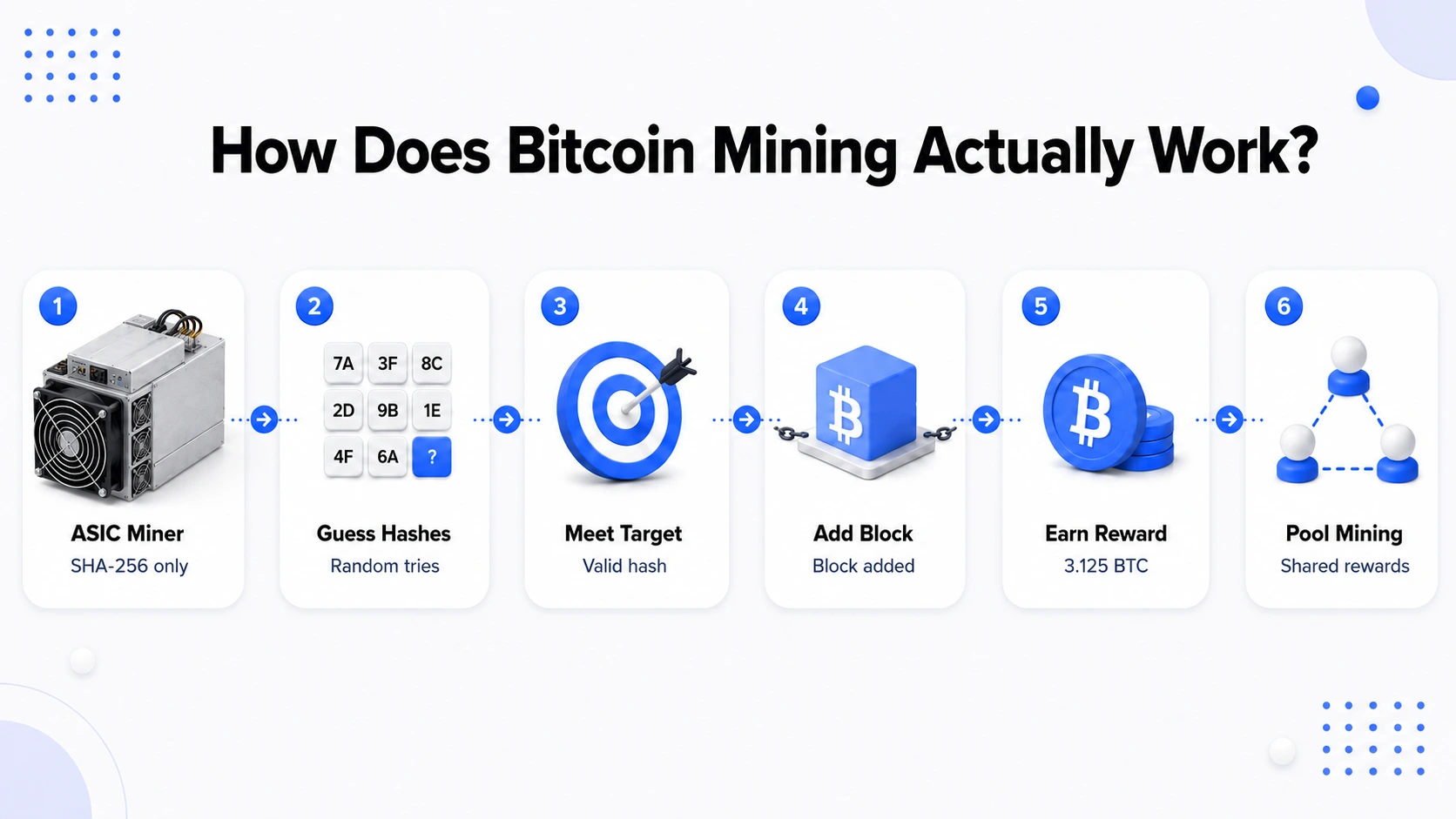
Mining bitcoin involves solving a mathematical equation by utilizing special computing power, which makes bitcoin secure. The miner who successfully solves this puzzle becomes entitled to append the next “block” of transactions into the blockchain system and gets paid in newly created bitcoin, together with transaction fees.
Here’s what the steps look like:
- The mining equipment that is used by miners is known as Mineurs ASIC (Application-Specific Integrated Circuit). The only function of these machines is to calculate SHA-256 hashes.
- Your computer keeps guessing random numbers, hoping to get a number that will satisfy the difficulty level of the entire network.
- The difficulty level changes automatically every 2,016 blocks (about every two weeks) to ensure that the average amount of time required to mine a block remains constant at 10 minutes regardless of the overall hash rate of the network.
- In case difficulty levels increase due to an increased number of miners joining the network, the chances of an individual miner discovering a block are decreased. When difficulty levels decrease, chances increase.
- Because a normal PC cannot discover a block at all, almost all home miners use mining pools, where thousands of miners join forces to mine a block together and distribute rewards accordingly.
What Is the Current Block Reward?
The Bitcoin récompense de bloc gets halved about every four years; the latest halving happened in April 2024, when the block reward was reduced to 3.125 BTC per block from 6.25 BTC. Still, this block reward sticks around and stays effective; it will continue being in force until the next halving, which is scheduled for 2028. Also, besides the block reward, the Bitcoin miners receive a few transaction fees that are folded into each block.
What Is the Bitcoin Network Difficulty?
Difficulty has been unusually choppy this year. It touched a high above 146 trillion in early January, then dropped sharply through the spring and summer as winter storms, seasonal Texas power curtailment programs, and the redeployment of mining facilities toward AI computing pulled hashrate off the network. By mid-June, difficulty had fallen to roughly 125 trillion, among the lowest readings of the year, before hashrate and difficulty started climbing back as conditions eased. The lesson for a beginner: don’t assume today’s difficulty is permanent. Build your profitability estimates around a range, not a single fixed number.
Network Hashrate alone has had its own narrative. The total hashrate of the network exceeded 1 zettahash per second (1,000 exahash per second) for the first time in January before dropping due to harsh weather conditions in Texas that made it imperative for some operators to cut down on energy consumption in order to prevent the collapse of the grid. This incident resulted in the loss of 12% of total hashrate in just a few days, which is the most significant drop since the Chinese mining ban in 2021. In June, another episode of curtailment in relation to ERCOT’s 4CP season caused the hashrate to drop from above 1,000 EH/s to 893 EH/s.
What does this mean for you as a beginner? It means the mining landscape you enter in month one may look meaningfully different by month six. Periods of falling difficulty and rising hash price, like the one seen in mid-year, are actually good news for smaller miners, since your machine needs less computational work to earn the same share of rewards. Periods of rising difficulty squeeze margins. Instead of timing the markets, the best home miners just plan for worst-case scenarios and take whatever upside as a bonus.
What equipment do you need to start home mining?
This is the aspect that most newcomers are most interested in, so we will take it apart step by step.
What Is an ASIC Miner and How Do You Choose One?
Choosing the right ASIC miner is one of the most important steps in Bitcoin exploitations minières. Unlike regular computers or graphics cards, modern Bitcoin mining works best with purpose-built hardware designed specifically for high-speed, efficient mining. A crypto miner in this category is usually judged by three key numbers:
- Hashrate is calculated in terahashes per second (TH/s). It basically tells you how quickly the device can perform calculations.
- Power draw is expressed in watts. It basically tells you how much energy the device uses.
- Efficiency is expressed in joules per terahash (J/TH). It basically tells you the amount of energy needed to generate each unit of hashing power. This figure is actually the one that really affects your profit margin.
Here’s a snapshot comparison of popular ASIC miner categories a beginner is likely to consider this year:
| Miner Category | Typical Hash Rate | Typical Power Draw | Efficacité (J/TH) | Meilleur pour |
| Entry-level / older generation | 60–100 TH/s | 3,200–3,400W | 30–34 J/TH | Hobbyists, very cheap power only |
| Mid-range current generation | 200–260 TH/s | 3,300–3,600W | 15–18 J/TH | Most home miners with average electricity rates |
| High-efficiency flagship models | 300–500+ TH/s | 5,500–7,000W | 9–13 J/TH | Serious home operations, low-cost power regions |
| Hydro-cooled models | 400–580+ TH/s | 5,500–7,000W | 8–11 J/TH | Noise-sensitive setups, higher upfront cost |
A smaller J/TH value is preferable. It indicates that the equipment generates greater processing capability for the energy you invest.
Should You Buy a New or Used ASIC Miner?
One of the initial major decisions a new miner encounters is deciding between purchasing a brand-new ASIC miner or a used one. Each option has its own benefits given how much money you have and how much risk you are willing to take.
- Brand-new devices are backed by a warranty from the manufacturer; they have stable performance and feature up-to-date efficiency figures. Still, they also have the highest initial cost and sometimes long waiting times if they are ordered directly from overseas manufacturers.
- Used machines, often sold by miners upgrading their fleet or by liquidating mining farms, can cost 30-60% less than new units. The tradeoff is that hashboards degrade over time, fans wear out, and older firmware may not be supported going forward. A used machine that’s three or four years old may also carry a much higher J/TH number, meaning it costs more to run per unit of hashing power, sometimes enough to erase any electricity cost advantage.
- Certified pre-owned machines from a trusted retailer are in the middle; they are usually tested and sometimes re-warrantied for a short period. They are priced lower than brand-new units but higher than random marketplace listings.
A refurbished computer from a specialist retailer for your first-time purchase can be a good compromise between price and comfort. This is because you may be sure that the hardware was tested before being shipped.
What Other Equipment Do You Need Besides the Miner?
Beyond the miner itself, budget for:
- Sufficient electrical circuit capacity: most ASIC miners need a dedicated 240V circuit, similar to what an electric dryer or EV charger uses.
- Power distribution unit (PDU) if running multiple machines.
- Ethernet cable and a stable internet connection; most miners don’t work reliably on WiFi.
- Ventilation or ducting to move hot exhaust air outside your living space.
- For basic noise reduction purposes, since the miner will be operating in proximity to residential zones, this machinery is extremely loud, typically generating 70-75 decibels of noise, equivalent to that of a vacuum cleaner running continuously.
How Much Does It Cost To Start Mining Bitcoin At Home?
Let’s discuss real numbers. Your upfront costs can be divided into four categories.
ASIC Miner Hardware Cost:
Depending on the tier you pick, you can expect to spend roughly $1,500 on an entry-level or used machine, then maybe as much as $6,000-$10,000+ for a current-generation, high-efficiency flagship unit. A lot of people, especially beginners, go for refurbished or slightly older hardware as a cost relief, but that usually comes with a tradeoff, like a higher J/TH efficiency figure, and so, thinner margins overall.
Electrical Setup Cost:
If your home doesn’t already have a 240V outlet near where you plan to place the miner, budget $300–$800 for an electrician to install one, depending on your region and how far the run is from your panel.
Noise and Heat Management Cost:
An external venting system and acoustic chamber could cost you anything from $100 for materials up to $1,000 or more for a specially-designed mining shed or insulated box.
Electricity Cost To Run a Miner:
This is your real, every-time cost of doing business. A single mid-range machine, drawing 3,400 watts and running 24/7, will chew through roughly 2,450 kWh per month. At the US average residential rate, say around 17 cents per kWh, that comes out to about $415 each month just for electricity. If you’re lucky enough to land a 10 cents per kWh price, then the same machine runs for about $245 a month.
What Is the First-Year Mining Budget?
| Article de Coût | Low-End Estimate | Higher-End Estimate |
| ASIC miner hardware | $1,500 | $8,000 |
| Electrical installation | $0 (if outlet exists) | $800 |
| Ventilation/noise control | $100 | $1,000 |
| Monthly electricity (x12) | $2,400 | $5,000 |
| Estimated Year 1 Total | $4,000 | $14,800 |
What Hidden Costs Should You Budget For?
Apart from the mentioned expenses, some small but regular expenses that many newcomers tend to miss are:
- Fan replacement: the miners’ fans operate at high RPM all the time and need replacement every 12-24 months, and it usually costs $15-$40 per fan.
- Dust filtering: if there is any pet, carpet, or construction activity near your house, there is more dust that can clog hashboards and obstruct the airflow, hence the need to install filters or to clean your system regularly using compressed air.
- Insurance: not every homeowner’s or tenant’s insurance includes coverage for expensive mining equipment, so you need to check whether any additional insurance is required for your costly device.
- Internet stability: in case of home Internet connection interruptions, the miner does not earn anything for its owner; thus, one needs to consider purchasing an alternative Internet connection.
How Do You Set Up Your First Bitcoin Miner?
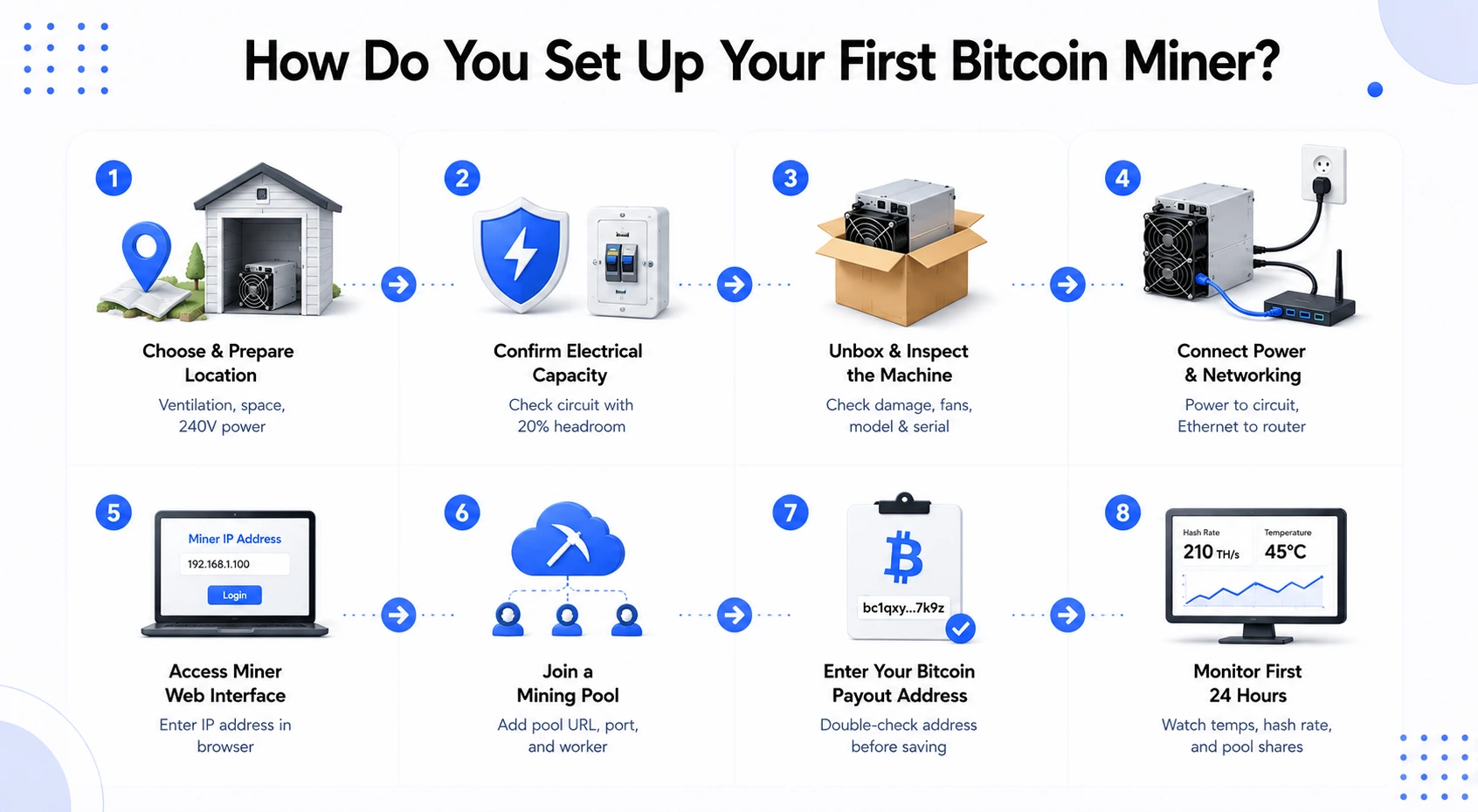
After the hardware comes in, installation will take only a couple of hours as long as you’re prepared. This is how it goes.
Step 1: Selecting and preparing the location. The selection must be done based on ventilation needs, as well as enough space around the unit for airflow and a 240V power supply. Most likely locations include garages, basements, and sheds.
Step 2: Confirm your electrical capacity. Check that your circuit can handle the miner’s full power draw with some headroom. Most miners recommend at least a 20% buffer above rated power draw. If you’re unsure, hire a licensed electrician rather than guessing.
Step 3: Unbox and inspect the machine. Check for shipping damage, confirm all fans spin freely, and verify the model and serial number match your invoice, especially important if you bought secondhand.
Step 4: Connect power and networking. Plug the miner into its dedicated circuit and connect an Ethernet cable directly to your router or a dedicated network switch.
Step 5: Access the miner’s web interface. Most ASIC miners host a local configuration page you reach by typing the machine’s IP address into a browser. Your router’s connected-devices list will show you this address.
Step 6: Join a mining pool. Create a free account with a mining pool, generate a worker name, and enter the pool’s connection details (URL, port, and worker credentials) into your miner’s configuration page.
Step 7: Enter your Bitcoin payout address. This is where the pool sends your mining rewards. Double- and triple-check this address before saving, since mistakes here can’t be undone.
Step 8: Monitor your first 24 hours closely. Watch temperatures, hash rate stability, and pool-reported shares to confirm everything is working as expected before you walk away and let it run.
How Do You Choose the Right Mining Pool?
Not all mining pools are built the same, and the one you choose affects both your payout consistency and your fees.
When comparing pools, look at:
- Fee structure: most reputable pools charge between 0% and 3%, often using either a PPS (Pay Per Share) model, which pays a fixed amount per valid share regardless of whether the pool finds a block, or a FPPS (Full Pay Per Share) model, which also distributes a share of transaction fees.
- Minimum payout threshold: some pools pay out daily once you cross a small BTC threshold, while others hold payouts until you reach a higher amount
- Server location: connecting to a pool server geographically closer to you can reduce latency and slightly improve your accepted-share rate
- Track record and transparency: established pools publish real-time statistics on hashrate, blocks found, and payout history, which is worth checking before you commit your machine’s hash power to them
Many beginners start with one of the larger, well-known pools simply for the stability and lower variance that comes with a bigger combined hash rate, then experiment with smaller or regional pools later once they’re comfortable with the basics.
Where Should You Buy an ASIC Miner in the US?
This is one of the most common questions beginners ask, and it deserves careful thought because the used ASIC market has its share of scams, misrepresented hardware, and hashrate-inflated listings.
Generally, you have three paths:
- Buying new directly from a manufacturer or authorized reseller: the safest option, but usually the most expensive and can involve long shipping timelines from overseas manufacturers
- Buying from a US-based specialized ASIC retailer: often a good middle ground, offering pre-tested hardware, faster domestic shipping, and support if something goes wrong.
- Buying secondhand through marketplaces or forums: the cheapest option, but the highest risk, with no guarantees around crypto miner hardware condition or hashboard health
If you’re weighing your options for ‘buying ASIC miners in the USA’, it’s worth understanding how import duties, shipping timelines, and profitability calculations factor into the total cost of ownership, since a machine’s sticker price is rarely the full story once taxes and logistics are added in. We’ve covered that full breakdown in detail, including how duties and freight costs affect your breakeven timeline.
Whichever route you choose, always verify seller reputation, ask for recent hash rate test results, and confirm what kind of return or dead-on-arrival policy applies before you pay.
How Do You Calculate Bitcoin Mining Profitability?
This is where a lot of beginners either get too excited or give up too early. Profitability depends on four variables you control (or partially control) and one you don’t.
Variables you influence:
- The efficiency (J/TH) of your machine
- Your electricity rate
- Your pool fee, typically 1-3%
- Your uptime: a machine sitting idle earns nothing
Variable you don’t control:
- Network difficulty and Bitcoin’s price, both of which shift your revenue up or down regardless of what you do
How Do You Estimate Monthly Mining Profit?
- Find your machine’s daily estimated revenue using a mining profitability calculator (most manufacturers and mining pools offer free ones)
- Multiply your machine’s power draw in kilowatts by 24 hours, then by your electricity rate, to get the daily electricity cost.
- Subtract the daily electricity cost from the daily estimated revenue.
- Multiply by 30 for a monthly estimate.
For example, a machine producing $9 per day in estimated revenue that costs $6.50 per day in electricity nets roughly $2.50 per day, or about $75 per month, before accounting for pool fees and any downtime. That may not sound exciting, but over a multi-year horizon, and combined with potential Bitcoin price appreciation on the coins you accumulate, it can add up to a meaningful position.
Important check: with hashprice fluctuating in the $28-$35 per PH/s range through much of this year, older or less efficient machines have frequently operated at breakeven or a loss in high-electricity-cost states. Always run your own numbers with current data before buying, not numbers from a YouTube video posted months ago.
How Does Bitcoin’s Price Affect Your Mining Returns?
It’s easy to focus only on hash rate and electricity costs, but Bitcoin’s market price is just as important to your bottom line, since your reward is paid in BTC, not dollars. A rising Bitcoin price increases the dollar value of every block reward and transaction fee you earn, even if your hash rate and difficulty stay the same. A falling price does the opposite.
This is part of why many long-term miners think of mining less as a way to generate steady monthly income and more as a method of accumulating Bitcoin at a production cost that may end up well below the market price over a multi-year holding period. If you believe in Bitcoin’s long-term value, this accumulation angle is often the strongest argument for mining over simply buying BTC on an exchange, since you’re converting electricity into an asset rather than converting cash directly.
That said, this cuts both ways. If Bitcoin’s price falls significantly and stays low for an extended period, your breakeven timeline stretches out. In a worst-case scenario, an inefficient machine could end up costing more in electricity than the Bitcoin it produces is worth. This is exactly the kind of margin pressure that pushed many industrial miners to power down machines during the low-hash-price periods seen earlier.
Is Home Bitcoin Mining Legal in the US, and What About Taxes?
Home Bitcoin Mining is legal in all fifty states. Still, a couple of practical and legal issues arise.
- Local rules and HOA regs might disallow loud noises or commercial-style machines in residential areas, so better check before you decide to set up, especially if you have neighbors or live in an area with an HOA.
- Rules of your utility company: sometimes describe rules about heavy-load residential equipment; in general, most residential mining rigs don’t cause problems, but still, give it a thought if you have several machines running.
- You have to pay taxes: per the IRS, mined Bitcoin is considered ordinary income based on its fair market value at the time you receive it. You will be liable to pay income tax on that amount. On top of that, if you later sell the Bitcoin at a higher price than that initial value, you will be required to pay capital gains tax on the difference. Make sure you keep accurate records of the date, amount, and USD value of each mining reward you obtain.
- Business status: On the off-chance that your mining activity is large and ongoing, then you might be able to write off equipment, electricity, and setup expenses as business costs. Consult a tax expert well-versed in cryptocurrency before you decide whether any deduction applies to your case, because rules differ and this guide is not a tax advisory.
What Mistakes Do Beginner Miners Commonly Make?
Learning from other people’s mistakes is a lot cheaper than making your own. Here are the most common ones:
- Ignoring electricity cost until after buying hardware: Always calculate your breakeven point before, not after, purchasing a crypto miner.
- Underestimating noise: Many beginners are shocked at how loud these machines run and end up needing to relocate or soundproof after the fact.
- Négliger la planification de la ventilation : A miner running in a poorly ventilated closet will overheat, throttle performance, and shorten the hardware’s lifespan.
- Buying secondhand without testing: Always ask for a live hashrate test or recent pool screenshot before paying for a used machine.
- Setting and forgetting: Miners need occasional firmware updates, dust cleaning, and monitoring. A neglected machine loses efficiency over time.
- Chasing the newest flagship machine on credit. Financing an expensive miner you can’t pay off comfortably turns a hobby into a financial risk.
- Not joining a pool. Solo mining with a single home machine has such low odds of finding a block that it’s essentially a lottery ticket, not a strategy.
- Placing the miner somewhere inaccessible. Beginners sometimes tuck their machine into a tight crawlspace or attic for noise reasons, then struggle to perform basic maintenance or troubleshoot issues later. Leave yourself room to work.
- Overlooking firmware security. ASIC miners connect to the internet and, like any networked device, can be targeted if left on default passwords or outdated firmware. Change default login credentials immediately and keep firmware updated.
- Failing to track receipts and warranty documentation. If you ever need to make a warranty claim or file mining-related tax deductions, having organized purchase records saves significant headaches later.
How Do You Keep a Home Mining Setup Running Smoothly Long-Term?
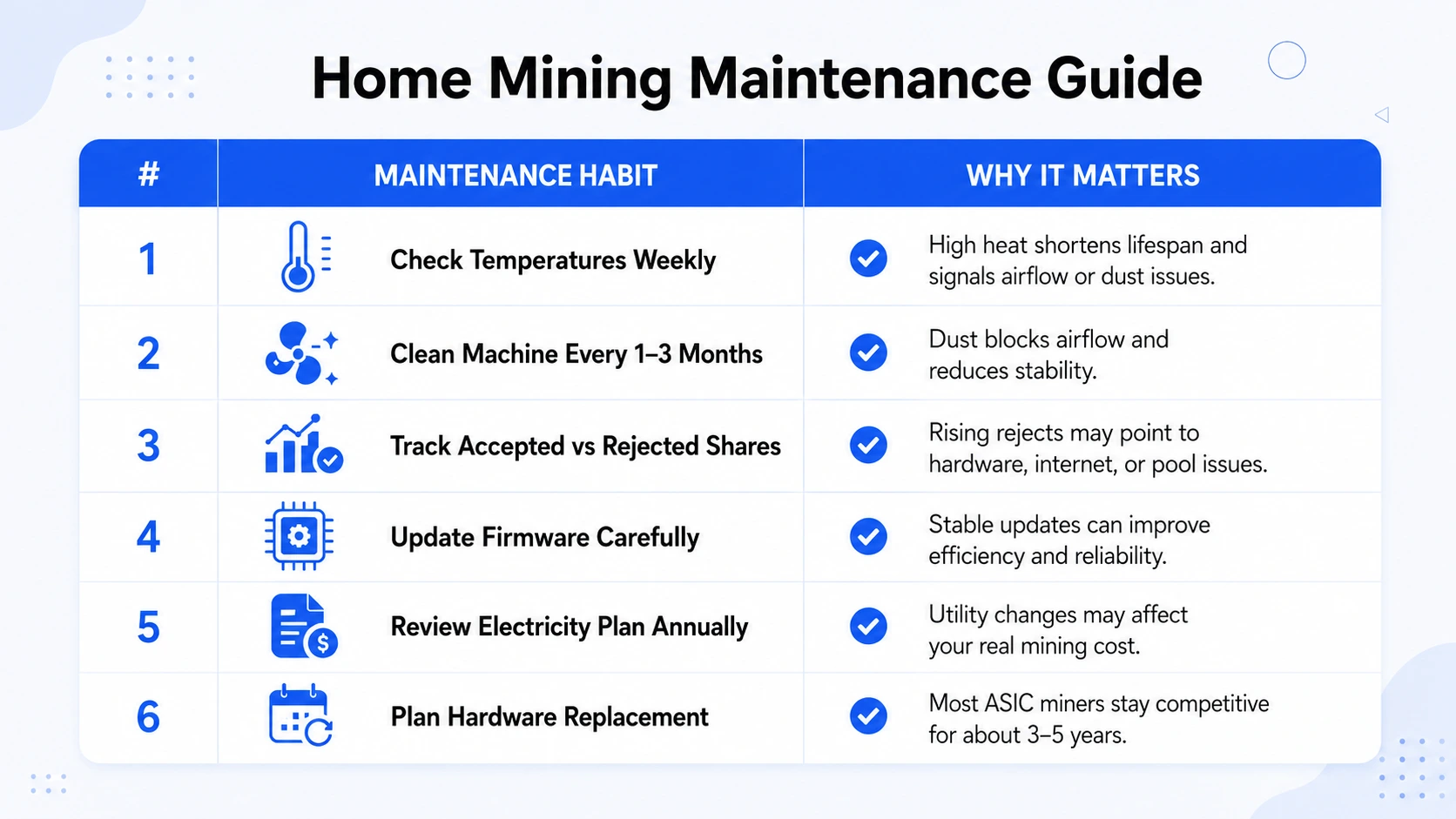
Getting your first ASIC miner online is only the beginning. Keeping it running efficiently for years requires a bit of ongoing attention. A few habits separate miners who get years of reliable service from those who see performance quietly decline:
- Check temperatures weekly. Most miners display chip and board temperatures in their web interface. Sustained high temperatures shorten hardware lifespan and often signal a dust or airflow problem.
- Clean the machine every 1-3 months. Compressed air and a soft brush are usually enough to clear dust buildup from fans and hashboards. Always power down before cleaning.
- Track your accepted vs. rejected share ratio. A rising rejection rate can indicate a failing hashboard, an unstable internet connection, or a pool server that’s too far away.
- Update firmware when new stable releases are available. Manufacturers periodically release efficiency or stability improvements, though it’s wise to wait for user feedback before updating on the day of release.
- Reassess your electricity plan annually. Utility rates change, and some regions offer time-of-use plans that could lower your effective mining cost if you’re able to shift usage patterns.
- Plan for eventual hardware replacement. ASIC miners typically have a useful, profitable life of three to five years before newer, more efficient machines make them obsolete for anything but the cheapest power markets. Budgeting for a future upgrade keeps your operation competitive.
Conclusion
Home Bitcoin mining in 2026 can still be a smart and practical option when planned properly. With affordable electricity, the right setup space, and realistic expectations, it gives miners a steady way to earn Bitcoin while building a deeper understanding of how the Bitcoin network works. Start with one good machine and learn as you go. A real miner will teach you more than just checking numbers on a spreadsheet. Watch your electricity cost, daily earnings, and pool performance, then review everything every few months as mining difficulty and hashprice change.
If you’re ready to take the next step and want help comparing specific machines, current pricing, and what it actually takes to import crypto miner hardware into the US, ASICmarketplace is a good place to continue your research before you buy.
Questions fréquemment posées
-
Le minage de Bitcoin sera-t-il toujours rentable en 2026 ?
It can be, but it depends heavily on your electricity rate and machine efficiency. Miners paying under 12 cents per kWh with efficient hardware are seeing solid margins, while high-cost regions often struggle to break even.
-
How to mine crypto in 2026?
Buy an efficient ASIC miner, set it up on a dedicated 240V circuit with good ventilation, and connect it to a mining pool using your Bitcoin payout address. From there, the pool handles the technical work of combining hash power and distributing rewards.
-
Is Bitcoin mining difficult?
The technical setup is fairly beginner-friendly once you understand the basics of ASIC miners and mining pools. The real challenge is managing electricity costs, noise, and heat well enough to stay profitable long-term.
-
How to make money with crypto in 2026?
Mining is one path, letting you accumulate Bitcoin directly through hardware rather than buying it on an exchange. Other common approaches include trading, staking eligible coins, or simply holding assets long-term.

Peter Davis
Peter Davis est un analyste accompli de la blockchain et un rédacteur technique avec plus de quatre ans d'expérience dans le secteur des crypto-monnaies. Son expertise couvre l'infrastructure de la blockchain, le matériel de minage ASIC et les marchés des actifs numériques, où il est reconnu pour traduire des concepts techniques complexes en analyses précises, perspicaces et accessibles pour un public mondial.
Avec une base solide dans la recherche technique et l'évaluation du marché, le travail de Peter se concentre sur le lien entre l'innovation de la blockchain et les stratégies pratiques d'exploitation minière et d'investissement. Ses écrits sont définis par la profondeur analytique, la clarté et l'accent mis sur les idées fondées sur des données qui guident à la fois les professionnels et les passionnés dans le paysage cryptographique en évolution.
Animé d'une profonde passion pour la technologie Web3 et les systèmes décentralisés, Peter continue de produire un contenu faisant autorité, axé sur la recherche, qui améliore la compréhension de la performance minière ASIC, de l'efficacité de la blockchain et de la dynamique plus large qui façonne l'avenir de la finance numérique