Résumé rapide
The siacoin is a cryptocurrency of the Sia platform, which is essentially a cloud-based data storage system built on the blockchain network. Its principal objective is to disrupt the traditional way of storing and sharing data. This coin attracts more investors as the demand for data storage increases daily, and cloud technology continues to advance.
The blog below provides in-depth information on siacoin, including its working mechanism and the necessary requirements to mine the cryptocurrency. Additionally, we highlight the Blake2b-Sia miners that you can purchase, along with their installation procedure, and guide you through the expected earnings as a siacoin miner.
Siacoin: A Quick Overview
Siacoin (SC) is the token of the Sia blockchain. Sia is a decentralized and shared cloud storage system, and it is open-source. With the Sia software, anyone on the platform can rent out the extra storage space they have to people who need it.
Sia is a peer-to-peer (P2P) decentralized network, so there is no place for a third party in it. Files stored on the network are divided into thirty pieces. Each piece is encrypted and saved on a different host. In this way, users can be sure that their data is secure. The low cost is another big benefit of this system compared to other cloud services.
Siacoin is also the coin that miners earn. The Sia blockchain runs on proof of work, so a crypto miner can add hashing power to the network and get paid in Siacoin for it. This is the part we focus on in this guide.
What is Siacoin (Sia)?
Siacoin is a fully decentralized cloud storage platform that is built on the blockchain. The platform divides your data, encrypts it, and then spreads it across its decentralized network. There is no central authority in the Sia network, and because of the P2P protocol, the whole system is run by its users from beginning to end.
Cloud storage on Siacoin, compared to conventional cloud storage options such as Google, is much safer and more affordable to use because the rental cost for storage is significantly lower.
The problem with current providers such as Apple and Google is that they offer limited options for people who want to rent space on their cloud storage services; however, they remain popular options for cloud storage. The Siacoin network aims to attract users to store their data safely and affordably while giving them the ability to control their data. Because there is no overall entity or third party involved, everyone who uses the network owns their data.
Siacoin network eliminates many issues associated with third-party cloud storage, such as high rent prices, hacking and stealing data, controlling and manipulating the data, and more.
Siacoin is the currency used to pay for transactions on the Sia network. All contracts are written in the form of Siacoins; therefore, having them is necessary if one wishes to use the Sia network. Anyone can gain access to Siacoin and spend it in various ways, such as when someone sends you coins, when you purchase them from the exchange, or when you mine them.
Historical Background
David Vorick and Luke Champine came up with the idea of Siacoin cloud storage at an MIT hackathon. They started Nebulous Inc., the parent company of Siacoin, in 2014. The beta network of Siacoin came out in 2015, and the Sia network marked its tenth anniversary on June 6, 2025.
The Nebulous Inc. and Siacoin project was partly funded with $750,000 from several sources. Since then, Vorick and Champine have raised around $6.4 million for the startup. The investors include Fenbushi Capital, Raptor Group, INBlockchain, and First Star Ventures.
The Sia development team also mined around 100 blocks before the mining algorithm was released to the public. That was about 30 million SC.
Vorick and Champine started as a duo, and as the network has grown, they have brought many developers onto their team. A network hard fork in Sia v1.5.4 also introduced the Sia Foundation. It is a non-profit that supports, develops, and promotes the Sia network, and it has been running a grants program since October 2022.
How does Siacoin work?
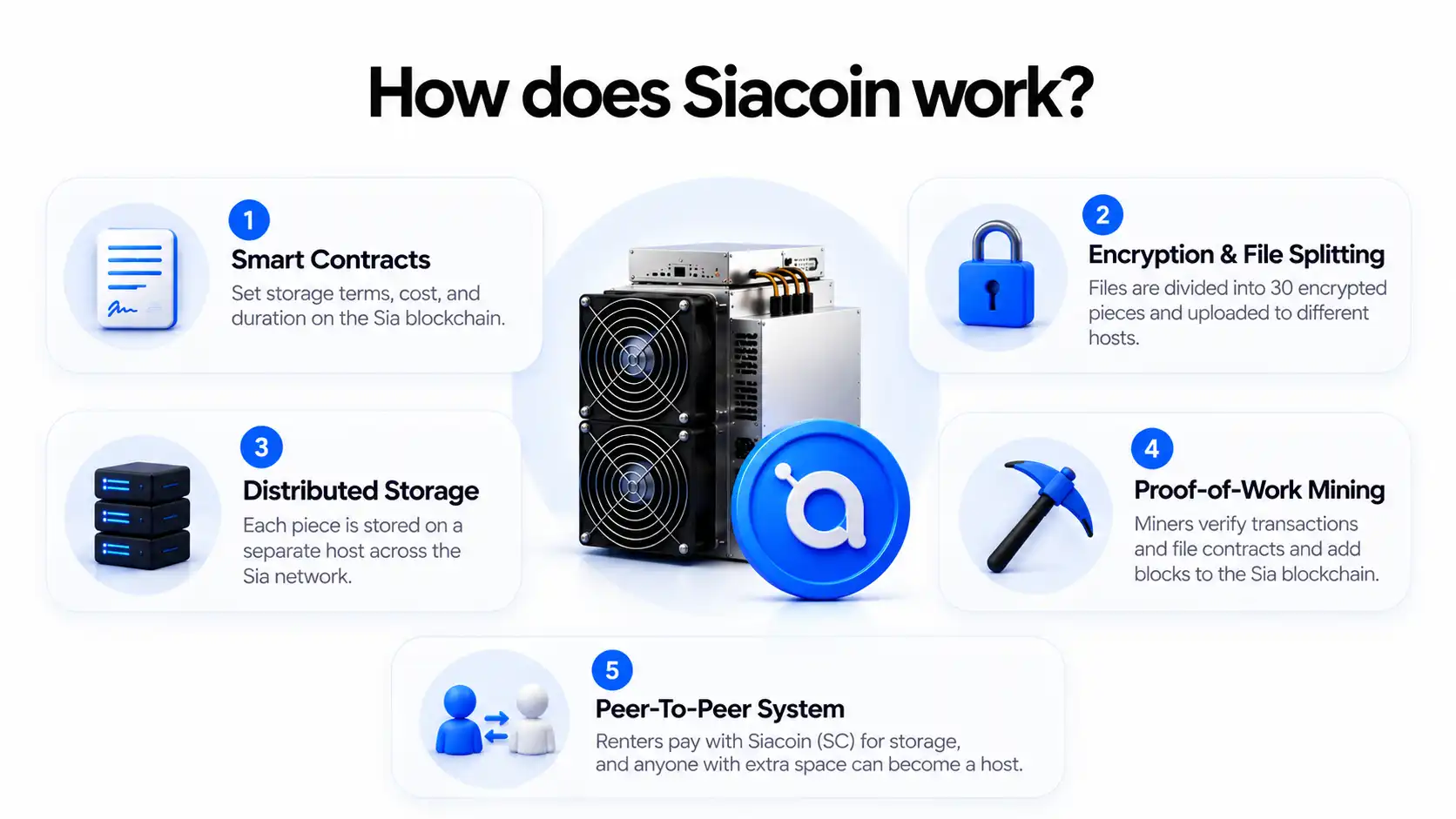
Smart contracts handle all the agreements and transactions on the platform. Siacoin (SC) is the means of exchange, and it is used to pay for storage on the network. The main aim of the project is to build an internet storage solution for the future.
The network divides each file into thirty encrypted pieces, and each piece is uploaded to a different host. Someone who wants to get the data would have to go after a lot of hosts and deal with the encryption. Even then, they would only maybe get the right data, and they would still have to figure out how to put it back together.
This is why Sia is considered one of the most secure and decentralized systems of its kind. There is also a way to earn on the other side. Anyone who has extra storage space can rent it out and receive Siacoin for it.
Contrats Intelligents : Siacoin uses smart contracts to create agreements between hosts and renters. A smart contract is a self-executing agreement. These contracts are kept on the Sia blockchain, and they set the conditions, the costs, and the length of the storage agreement.
Using smart contracts gives storage agreements reliability, security, and transparency.
The use of encryption: Data on the Sia network is divided into smaller segments and encrypted. The segments are then spread across several hosts on the network. This also gives redundancy, so it protects against data loss and outages.
Proof-of-Work Consensus Algorithm: Sia secures the network with a Proof-of-Work (PoW) consensus algorithm, which is similar to Bitcoin. Miners do the PoW calculations to approve transactions and add blocks to the network.
The Sia blockchain carries Siacoin transactions and also the file contracts between renters and hosts. So the miners are the ones who secure and verify both SC transactions and storage contracts. This is the reason a crypto miner is needed on Sia.
Peer-To-Peer System (P2P): Sia’s P2P system is made up of renters and hosts. Renters are the people who pay hosts in Siacoin for the storage they use. Hosts make their storage available to the network. You can take it literally as a storage locker.
Every storage relationship needs a file contract, which is a smart contract. It defines the relationship between a host and a renter. For each new storage opportunity, the renter has to start a file contract with a prepaid amount of Siacoin.
What changed with the Sia v2 hardfork?
The Sia network went through a big upgrade called the v2 hard fork. It activated on June 6, 2025, at block height 526,000. The upgrade changed Sia’s consensus code, the transaction formats, and the way renters and hosts work together.
After the hard fork, only v2 transactions are accepted. Anyone who did not update their software could no longer send or receive transactions, sync with the network, or form contracts. This also applied to miners and exchanges, so you should always check that your pool and your wallet support the current network.
The software changed as well. The original siad and Sia-UI were replaced by three separate apps. renterd is used for uploading files, hostd is used for providing storage, and walletd is used for wallets. We talk about walletd in the wallet section below.
How does Siacoin mining work?
Siacoin uses Proof of Work with the Blake2b algorithm, which is modified specifically for Sia. This is why the algorithm name you see on ASIC miners is Blake2b-sia. Your Siacoin Miner does the calculations, and when a block is solved, Siacoin is paid out to the miners who mined it.
When the Sia network launched, the block reward was 300,000 Siacoin. It went down by one with every block, until it reached 30,000 at block 270,000. Now every block has a reward of 30,000 Siacoin, and it stays there forever.
Unlike Bitcoin, the Sia block reward never stops. This means miners will always have a reason to be part of the network. Siacoin also has no maximum supply, and new coins are only made through proof-of-work mining. As of June 6, 2025, around 60.5 billion coins had been created.
The Sia Foundation also gets a block subsidy of 30,000 Siacoin per block. This is paid out every 4,380 blocks, and it is how the Foundation is funded.
Until January 2018, the Sia blockchain was mined almost exclusively with GPUs, which are the graphics cards inside a computer. Building a mining rig was easy at that time, and it could be done with parts from a local computer shop. Shortly after that, the first ASICs came into the Sia ecosystem.
An ASIC is a computer whose only job is to mine cryptocurrency. Because it does not have to do anything else, it can do that one job much better than a graphics card. Because of ASICs, GPU mining is not profitable anymore.
So today, if you want to mine Siacoin, you need an ASIC miner that is built for Blake2b-sia. Mining Siacoin with a CPU or a GPU is not efficient.
What is required to Mine Siacoin?
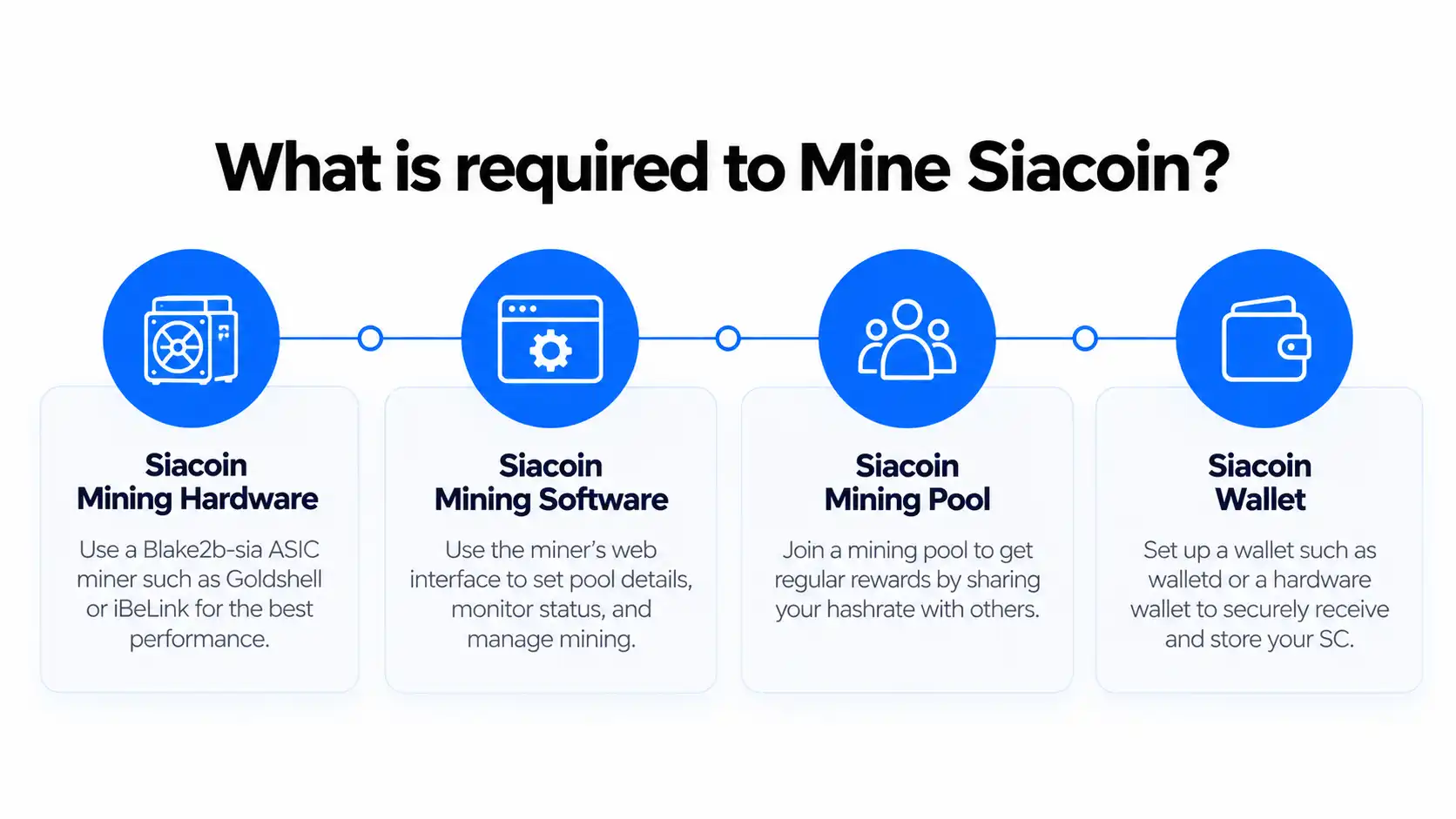
There are a few things you need to think about before you start to mine Siacoin, as with any other cryptocurrency. Below is the list of things that are required.
Siacoin Mining Hardware
Buying the hardware is the most important step in the Siacoin mining process. In the past, GPUs were used for Siacoin mining. However, just like Bitcoin and other cryptocurrencies, ASIC miners were also made for Siacoin. The Obelisk SC1 is one of the ASIC devices that was made for mining Siacoin.
Now, an ASIC built for Blake2b-sia is the only practical choice for a Siacoin Miner. On one reseller list of Siacoin miners, all the models come from two makers, Goldshell and iBeLink.
All of these use the same algorithm, so you can compare their hashrates directly. Hashrates are only comparable between miners that use the same algorithm.
Power use matters as much as hashrate. The Goldshell SC-BOX 2 has an efficiency of 0.211 J/Gh. The Goldshell SC5 Pro is at 0.256 J/Gh, and the iBeLink BM-S3 is at 0.163 J/Gh. A lower number means the miner uses less power for every unit of hashing.
Size and noise are also different from model to model. The Goldshell SC-BOX 2 was released in March 2023, and it is a small unit at 78 x 150 x 84 mm and 2000 g. Its noise level is 35 dB, which makes it one of the quietest Siacoin miners. The iBeLink BM-S3 was released in March 2024. It weighs 14000 g, has two fans, and its noise level is 75 dB.
So a smaller Siacoin Miner is easier to keep at home, while the bigger ones give you more hashrate but also use more power. Think about where you will keep your miner before you buy.
Siacoin Mining Software
As you probably know, the software you choose depends on the hardware you plan to use. A Siacoin ASIC miner has its own control panel that you open in a web browser. This is where you set the pool details, and it is also where you check the status of your miner.
The software connects your Siacoin mining hardware with the pool and the Siacoin blockchain network, and it manages the mining process. Once you have selected an Mineur ASIC, the next step is to check that the software works well with it.
Siacoin Mining Pool
The question comes up whether to mine alone or in a mining pool. Solo mining Siacoin is technically possible, but it is not practical for almost everyone. It is better to join a mining pool and share resources with other users. You will be rewarded for your participation according to the resources you have contributed.
There are many mining pools where you can mine Siacoin. The Sia documentation lists SiaMining, Luxor, DxPool, and F2Pool to get started. Back in September 2018, F2Pool and Siamining.com controlled nearly 80% of the network hash power. Because of this, some miners prefer to join pools that have a smaller amount of hash power.
F2Pool is a good example to look at. Its payout scheme is 3% PPS, and it pays out daily to every user who reaches the payout threshold of 100 SC. To mine on F2Pool, you need a Siacoin wallet address, because this is how you receive and track your payouts. The server address for Siacoin on F2Pool is stratum+tcp://sc.f2pool.com:7788.
Whichever pool you choose, think about the reward structure, the server locations, and the pool fees. Once done, create an account on the pool website if it is needed.
Siacoin Wallet
A wallet keeps your Siacoin safe. You need one to receive your SC after you get your mining payouts. The official wallet is walletd, which is made by the Sia Foundation, the developers of the Sia network. It replaced Sia-UI as the main wallet solution.
walletd is launched through the command line, but it also has a user interface that you open in your web browser. It lets you send and receive Siacoin and Siafunds, see your balance, and see your transaction history. It also works with Ledger hardware wallets. You can create your keys from a 12-word seed phrase, an older 28-word seed phrase, or a Ledger.
You should only download the software wallet from the official Sia website, sia.tech. The Sia team cannot guarantee that any other software wallet will store your Siacoin safely.
There is also a web wallet made by the community called Sia Central. It supports seed, Ledger, and watch modes. Sia Central is third-party software, so it is not made by the Sia Foundation.
Hardware wallets, also known as cold wallets, have offline storage and backup. The Ledger Nano S and Ledger Nano X both have an official Sia app. They are better for people with experience, because they cost more and they are harder to understand.
Software wallets are better for new users with a smaller amount of SC, because they are easier to use for transactions. However, they are less safe than hardware wallets. Lastly, there are hot wallets, which are digital wallets or exchanges that you access from a web browser. You have to trust a platform to handle your Siacoin, and they are the least safe of the three.
Step-by-Step Process to Mine Siacoin
Here is how you can start to mine Siacoin, along with the setup and the mining process.
Setup Process for Siacoin
First, connect the controller board and the hashing boards of the device with the cables that come from the PSU. After that, plug the power cord into the power outlet and the PSU. Now, connect the LAN cable from your internet router to the Ethernet port of the control board.
Next, decide which mining pool you want to join. Think about the reward structure, the server locations, and the mining pool fees when you choose. Once done, create an account on the pool website if it is needed. Some pools like F2Pool only need your wallet address.
Then find the IP address of the ASIC miner. You can do this from the admin interface of your internet router. You can also download the IP Reporter tool from the website of your ASIC miner maker. In the tool, select “Run” and click “Start.” After that, click the “IP Report” button on the control board of your ASIC miner, and the IP address will show up on your screen.
Once you have the IP address of the ASIC, open your web browser, type in the address, and press Enter. A pop-up box will come up, and you need to enter your username and password there.
When you are logged in, you can start to configure the miner. Go to General Settings or Miner Configuration. Here you have to enter the worker name, the password, and the pool URL address.
In the worker field, enter the address of your Siacoin wallet. The default value of the password field is 123, but you can also leave it blank. For the pool URL, use the one from the pool you selected. For example, F2Pool uses the stratum address we shared above.
You can also use the backup feature, which lets you enter more than one pool and worker. This helps if one of the pools is not working.
After a successful reset, you can check the status page for any mining activity. You can also track the mining process from your pool dashboard. On F2Pool, you select SC, put your wallet address in the search bar, and click Go to see your payout records.
Mining Process for Siacoin
The mining process for Siacoin is generally like any other proof-of-work cryptocurrency. Here are the steps to mine Siacoin.
Start by selecting your ASIC miner. Keep the requirements, the estimated profits, the power use, and the performance in view. Once done, buy the Siacoin Miner and set it up. Connect the power cable to supply the power it needs. You also need a stable Ethernet connection so that your mining hardware runs steadily and safely.
Once your miner is set up, the next step is to set up your Siacoin wallet. You need a wallet to keep your SC after you get a payout. Choose the wallet that suits you best, because it helps you send and receive Siacoin quickly.
Now, you need to check the mining software. Your miner uses it to connect to the pool, and it manages the mining process. Enter the pool address and your wallet address as we showed in the setup process.
After that, join a mining pool that works with your mining operation. A pool is the practical choice when you mine Siacoin with an ASIC miner, because when the members of a pool combine their hashing power, the pool is better able to solve blocks. You then get a share of the rewards according to the work you contributed.
Now, after all the steps above, you can start to mine Siacoin. Once configured, the miner needs monitoring instead of constant attention. You can keep an eye on your pool dashboard and the status page of the miner.
Your mining rig needs enough ventilation to keep it cool if you want it to work efficiently. You can install fans for extra cooling. This matters more with the bigger miners, because they use over 3000W and also make a lot of noise.
Can you make a profit when you mine Siacoin?
This is the part you need to look at before you buy anything. Mining Siacoin is ASIC-only, and most miners collect SC for the long term instead of treating it as daily income. It is not made for casual or short-term miners.
For most miners who pay average home electricity rates, mining Siacoin gives a small loss when you measure it in fiat money. The output in coin terms, however, is predictable.
Here is an example. On ASIC Miner Value, the Goldshell SC-BOX 2 shows a daily income of $0.38 and a daily electricity cost of $0.96. That is a loss of $0.58 a day. The electricity number matches a rate of $0.10 per kWh at 400W.
Your result depends on many things. The global hashrate, the network difficulty, the block reward, and the exchange rate of Siacoin all change the profit. Electricity cost is the biggest one, so always enter your own electricity rate in a profit tool before you decide. Higher electricity rates can reduce or even remove the profit.
For many people, buying Siacoin directly is simpler and often cheaper than mining it. Mining makes sense when your electricity is cheap and when you want to collect SC over time.
Advantages of Siacoin
You are in control of your money and your information. You are the only one in control of your files, so nobody outside can interfere, and you cannot be blocked or removed from platforms.
It gives a fair share of benefits and rewards. Renters pay for the resources they buy. Hosts earn money by renting out storage space for data. Miners get paid for producing blocks.
Smart contracts are used to store data, so SC can be given to another user or become a part of an agreement for network data storage.
The Proof-of-Work protocol is the basis of how the network operates, and it makes the network efficient and reliable. The block reward also never stops, so miners always have a reason to take part in the network.
Disadvantages of Siacoin
Before you start to mine Siacoin, you should know that mining takes time and makes the equipment heat up a lot. The bigger ASIC miners are also loud.
The machine needs a large amount of electricity to run all the time. At average home electricity rates, this can be more than what you earn.
Exchange services also send your data to the tax authorities if they ask for it when you convert Siacoin into fiat money.
Siacoin has no maximum supply, so new coins keep coming in with every block. This may stop the price from going up.
Future Analysis and Price
The Sia Foundation shares its plans and works on a grants program that keeps track of the ongoing projects, which you can follow. Post-hardfork v2, the team has been consistently working on further updates for hostd and renterd to improve the network’s stability. The Foundation has also announced that the new protocol will enable the creation of tools such as indexd, where management contracts could be delegated while maintaining decentralized and private uploads.
Siacoin is currently trading around $0.0005. Its all-time high was $0.111708, and it reached that on January 6, 2018. The price changes from day to day, and price predictions for Siacoin are different on every site. So we are not listing a price target in this guide.
If you plan to mine Siacoin, you should look at the price along with your electricity cost and the hardware you buy. These three things decide what you earn.
Conclusion
Among all the cryptocurrencies, Siacoin is one of the most useful but also underappreciated. It has changed internet data storage, and it has one of the best reputations for its marketplace of cloud services. Its supply has no limit, and this may keep the price from rising.
Finally, you understand how to mine siacoin cryptocurrency. You also need an ASIC miner for Blake2b-sia, a pool, and a wallet. After you have found the necessary tools, you must also pay attention to the maintenance process. You should know that mining is a long-term investment. That is why you are better off calculating the ratio between your electricity costs and the purchase of a Siacoin Miner.
By investing in ASIC mining machines and collecting information about the work of the SC network, you will be able to collect profits in the future. The value of the currency depends directly on the development of the network and the balance of supply and demand. ASICMarketplace can also help you find suitable ASIC mining machines when you are ready to start mining Siacoin.
Questions fréquemment posées
-
What do you need to mine Siacoin?
You need an ASIC miner built for Blake2b-sia, a mining pool, and a Siacoin wallet.
-
Can you mine Siacoin with a GPU?
No, GPU mining is not profitable anymore because of ASICs.
-
Is it profitable to mine Siacoin?
It depends on your electricity cost, and at average home electricity rates, most miners see a small loss in fiat terms.

Peter Davis
Peter Davis est un analyste accompli de la blockchain et un rédacteur technique avec plus de quatre ans d'expérience dans le secteur des crypto-monnaies. Son expertise couvre l'infrastructure de la blockchain, le matériel de minage ASIC et les marchés des actifs numériques, où il est reconnu pour traduire des concepts techniques complexes en analyses précises, perspicaces et accessibles pour un public mondial.
Avec une base solide dans la recherche technique et l'évaluation du marché, le travail de Peter se concentre sur le lien entre l'innovation de la blockchain et les stratégies pratiques d'exploitation minière et d'investissement. Ses écrits sont définis par la profondeur analytique, la clarté et l'accent mis sur les idées fondées sur des données qui guident à la fois les professionnels et les passionnés dans le paysage cryptographique en évolution.
Animé d'une profonde passion pour la technologie Web3 et les systèmes décentralisés, Peter continue de produire un contenu faisant autorité, axé sur la recherche, qui améliore la compréhension de la performance minière ASIC, de l'efficacité de la blockchain et de la dynamique plus large qui façonne l'avenir de la finance numérique