Résumé rapide
Merged mining allows one ASIC to earn additional cryptocurrency rewards from compatible blockchain networks without buying extra hardware or increasing its normal electricity consumption. Instead of splitting computing power, the miner uses the same proof-of-work results across multiple networks.
- One ASIC can simultaneously mine two or more cryptocurrencies that support compatible proof-of-work rules.
- Auxiliary Proof-of-Work (AuxPoW) allows parent and auxiliary blockchains to verify the same mining work.
- Litecoin (LTC) and Dogecoin (DOGE) are the best-known examples of this arrangement.
- Other supported Scrypt coins include Bellscoin, Pepecoin, Luckycoin, and Dingocoin.
- Additional rewards can improve total mining revenue, while electricity costs and network conditions still determine the final return.
What Is Merged Mining and How Does AuxPoW Work?
Traditional mining points an ASIC at one blockchain. The miner receives a job from a pool, calculates hashes, and submits valid shares. The pool tracks the work and pays miners under its stated payment method.
The phrase dual mining is sometimes used for setups that divide processing resources between two algorithms or mining tasks. In that arrangement, each coin may receive only part of the machine’s available computing power. Some sellers also use the term loosely, so the advertised feature needs checking. The label dual mining should not be treated as proof that a product supports shared block proofs.
With true shared proof-of-work, the ASIC does not split its work between two independent processes. It keeps hashing one compatible job while the pool checks qualifying results against more than one network target. That is the key difference from resource-splitting dual mining.
What Are the Parent Chain and Auxiliary Chain?
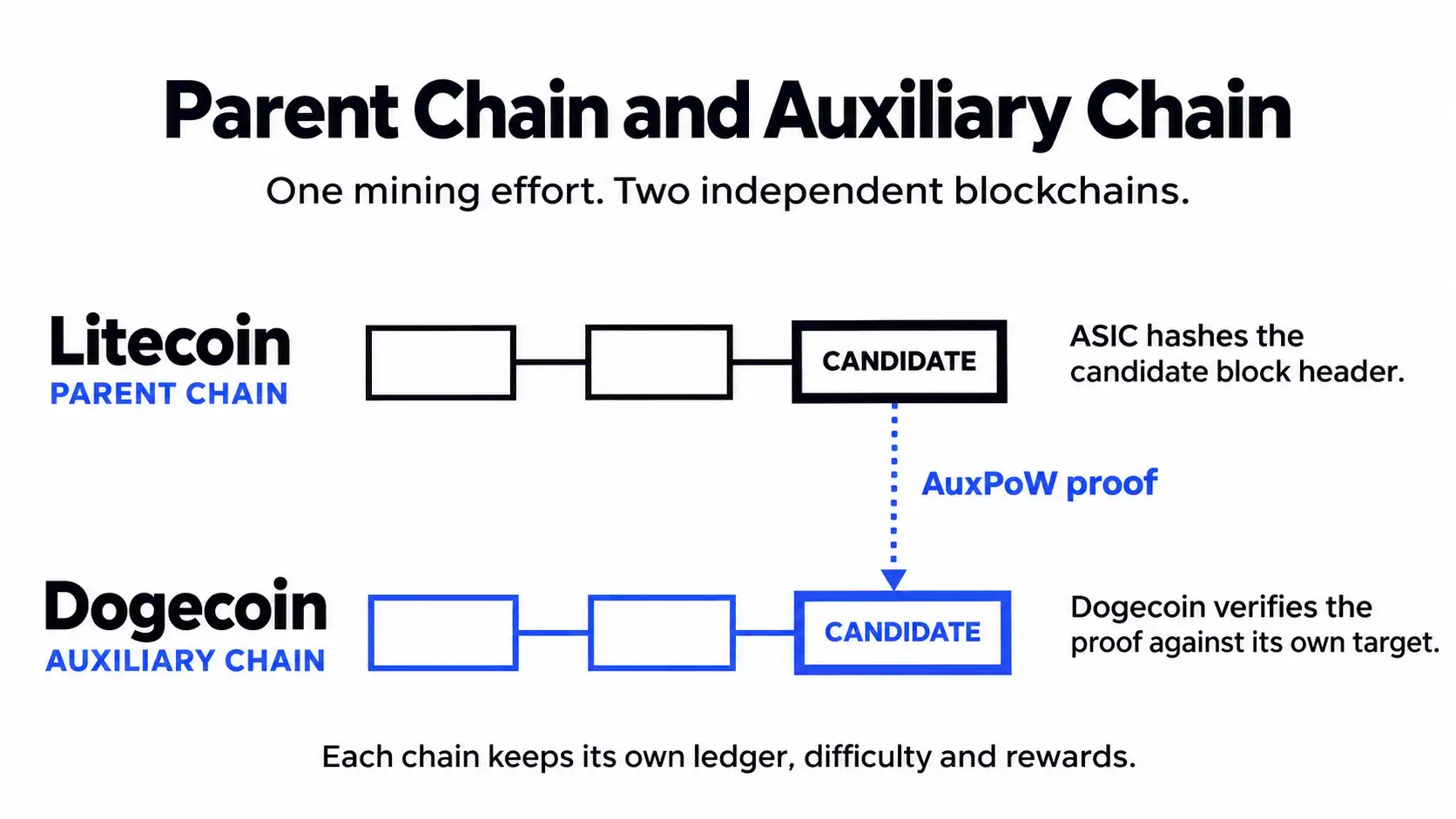
AuxPoW means Auxiliary Proof-of-Work. It allows an auxiliary blockchain to accept proof that a miner has already completed work for a parent blockchain.
The parent chain is the network whose block header the ASIC hashes. The auxiliary chain checks a cryptographic proof that connects its own candidate block to that parent-chain work.
In the Litecoin-Dogecoin example, Litecoin is the parent chain, and Dogecoin is the auxiliary chain. Each keeps its own transactions, block history, difficulty, wallets, and rewards.
Why Does This Method Not Increase Electricity Use?
The ASIC keeps doing its normal hashing work at its rated speed. The pool builds the extra block data and checks each qualifying result against the additional network target. The machine does not need another set of chips or a separate mining process.
For example, a 3,680 W ASIC still draws about 3,680 W when it works on a pool that checks both compatible networks. Its normal power draw does not rise just because the pool checks another compatible chain.
That can create another revenue stream from work already being done. The extra rewards are not cost-free in the wider business sense: hardware, electricity, cooling, maintenance, and pool fees still apply. The benefit is that the same machine can earn more than one block reward stream without an added mining rig.
The method only works when both networks support compatible proof rules, and the pool has implemented the required process. Sharing an algorithm by itself is not enough.
How Does AuxPoW Work Step by Step?
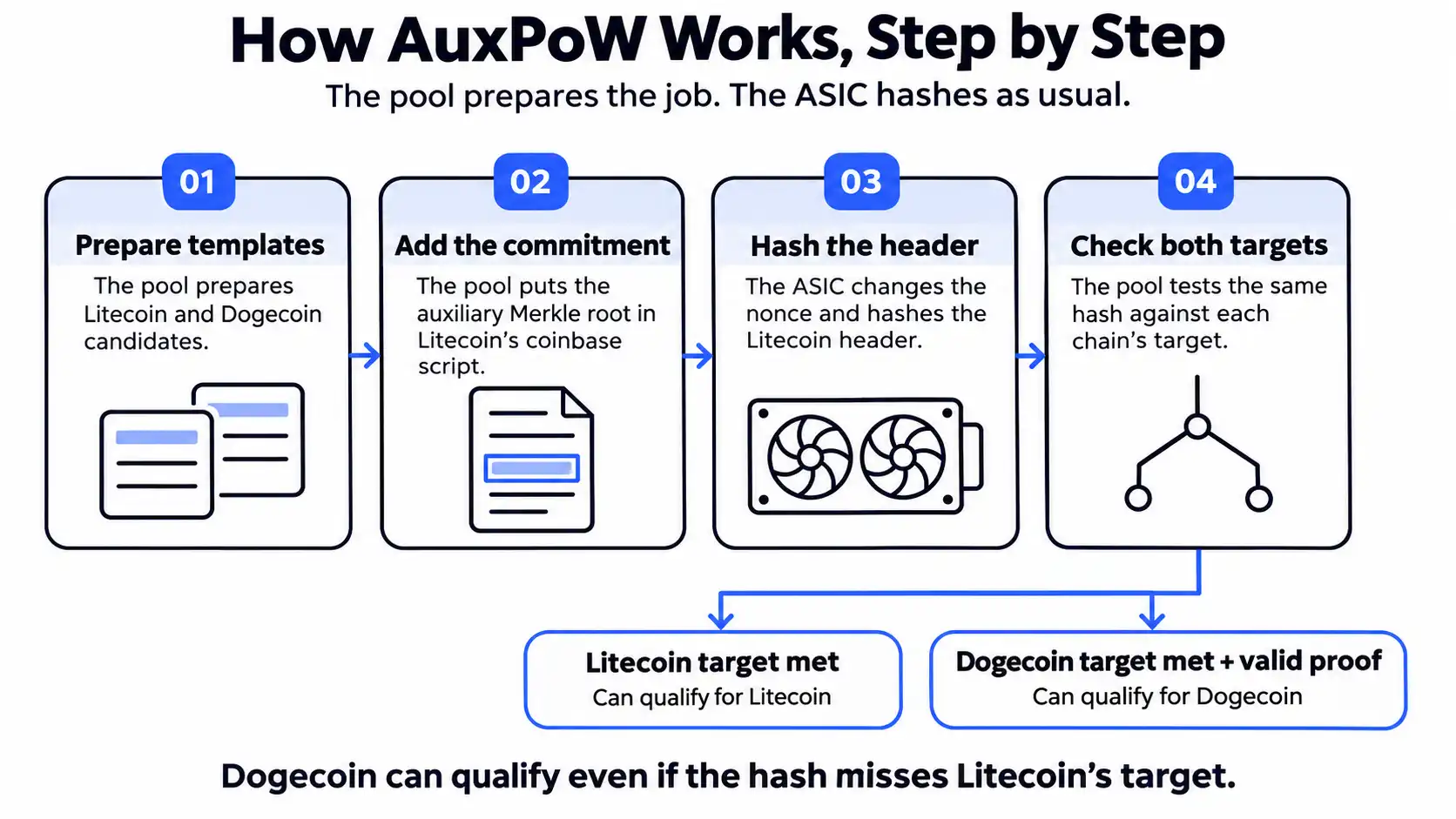
The pool manages most of the chain-specific work. The ASIC receives a mining job in a format its firmware supports and keeps hashing as usual.
Step 1: How Are Both Block Templates Prepared?
The pool builds a parent-chain block template and prepares separate information for the auxiliary chain. It connects the two candidates through a cryptographic commitment.
Step 2: How Is the Auxiliary Data Added to the Parent Block?
The pool places a commitment to the auxiliary block data inside the parent block’s coinbase script, often called the coinbase field or scriptSig. The commitment carries an auxiliary Merkle root.
The auxiliary network can use a Merkle proof to check that its block data was included in the parent-chain work. This commitment links the two candidate blocks.
Step 3: How Does the ASIC Search for a Valid Hash?
The pool sends the parent job to the ASIC. The machine changes the nonce and hashes the parent header at its normal speed. The pool handles the auxiliary block data and submission.
Step 4: How Are Both Difficulty Targets Checked?
The pool checks each qualifying result against the parent and auxiliary network targets. A result may meet the auxiliary target but not the parent target, so it can still qualify for an auxiliary block. A result that meets the parent target may also qualify for the auxiliary chain if its target is met and its proof is valid.
An auxiliary target is often easier to meet, but that is not guaranteed for every pairing. The same hash is tested against each network’s actual difficulty target; the hash rate is not divided between them.
How Does One Hash Reach Two Chains?
| Étape | Parent chain: Litecoin | Auxiliary chain: Dogecoin or Bellscoin |
|---|---|---|
| Template | Pool builds an LTC block candidate | Pool builds a separate auxiliary candidate |
| Commitment | Parent coinbase carries the auxiliary commitment | Merkle proof links the auxiliary block to the commitment |
| Hash search | ASIC hashes the parent header and changes the nonce | Pool checks the same results against the child target |
| Validation | Litecoin checks its own target and block rules | Auxiliary chain checks its target and AuxPoW proof |
| Submission | Valid LTC block is submitted to Litecoin | Valid auxiliary block and proof are submitted separately |
A pool share proves that a miner contributed work, but it is not automatically a full network block. The pool uses accepted shares, block results, and its payout method to calculate each miner’s balance. Dogecoin’s AuxPoW validation code shows how the parent commitment and proof are checked.
What Does a Mining Pool Show About Multi-Coin Rewards?
ViaBTC’s official X account announced support for Pepecoin merged rewards alongside Scrypt mining. Its PEP merged-mining announcement on X is linked from ViaBTC’s own Pepecoin mining article.
This is a practical example of a pool adding another payout option without asking miners to run a separate ASIC. Pool support and payout rules can change, so check the current coin list before connecting hardware.
Which Cryptocurrencies Support Shared Mining?
The long-running Litecoin and Dogecoin arrangement is the best-known Scrypt example. Dogecoin launched in December 2013 as a Litecoin-based fork. It adopted Auxiliary Proof-of-Work on September 11, 2014, allowing compatible Litecoin mining work to help secure its network.
Which Other Coins Can Be Paid Alongside LTC?
The pool determines which extra coins are available. A Scrypt miner does not automatically receive every coin that uses the same algorithm; the auxiliary network and pool must support the proof system.
F2Pool’s merged mining guide, updated November 11, 2026, lists DOGE, BELLS, PEP, LKY, JKC, DINGO, SHIC, TRMP, and CRC payouts with LTC. ViaBTC’s September 15, 2026 guide lists DOGE, BELLS, PEP, and DINGO.
| Piscine | Litecoin-related additional coins listed |
|---|---|
| F2Pool | DOGE, BELLS, PEP, LKY, JKC, DINGO, SHIC, TRMP, CRC |
| ViaBTC | DOGE, BELLS, PEP, DINGO |
Which Merged Mining Payout Rules Should You Check?
Each pool sets its own payout method, minimum balance, wallet requirements, and settlement schedule. F2Pool says its listed LTC auxiliary payouts use PPLNS, and it warns that miners who do not add the required payout address forfeit those rewards. Check the active settings before you start hashing.
Why Does DOGE Often Make Up a Large Part of Scrypt Revenue?
Dogecoin’s block subsidy is 10,000 DOGE, while Litecoin’s is 6.25 LTC. Market prices and network output determine how much each chain contributes to daily revenue.
Bitquery’s September 2026 review found that DOGE accounted for about 85% of Litecoin miners’ combined block pay that month: $36.4 million in DOGE versus $6.3 million in LTC. This is a historical result, not a fixed share. Smaller coins also have different market depth, exchange support, and withdrawal limits.
How Do Scrypt and SHA-256 Mining Compare?

The two ecosystems use different algorithms and hardware. Changing a pool address cannot turn a Bitcoin ASIC into a Scrypt machine.
| Comparaison | Scrypt setup | SHA-256 setup |
|---|---|---|
| Parent coin | Litecoin | Bitcoin |
| Auxiliary examples | DOGE, BELLS, PEP, LKY, DINGO | Namecoin, Fractal Bitcoin, Hathor, Elastos, NAT |
| Hardware type | Scrypt ASIC | Bitcoin ASIC |
| Main reward | LTC | BTC |
| Revenue impact | LTC plus DOGE and other supported Scrypt payouts | BTC plus supported auxiliary payouts |
F2Pool’s November 11 guide lists LTC with several Scrypt auxiliary coins and BTC with FB, HTR, NMC, NAT, and ELA. Other pools may support a different set. A Bitcoin ASIC cannot mine Scrypt coins because the chips are designed for a different hashing algorithm.
For miners, the useful comparison is not simply how many tickers appear in a pool menu. Coin prices, network difficulty, pool fees, withdrawal limits, and exchange access all affect the value of the extra payouts.
Litecoin network milestone: The Litecoin Foundation’s October 13, 2026 anniversary thread highlights the 2014 Litecoin-Dogecoin mining milestone. Its official X thread explains that the chains kept separate rules and block histories while reusing proof-of-work. See the Foundation’s milestone recap.
Which ASICs Can Earn Rewards From Multiple Networks?
A Scrypt ASIC supplies the work for the parent network. The following four models offer different output and power levels for miners comparing larger farm units with lower-power equipment.
The ratings below were checked against the product pages and available manufacturer information on November 16, 2026.
| ASIC model | Rated hash rate | Puissance absorbée | Efficacité |
|---|---|---|---|
| Bitmain Antminer L11 | 20 GH/s | 3 680 W | 184 J/GH |
| Bitmain Antminer L9 | 16 GH/s | 3,360 W | 210 J/GH |
| VolcMiner D1 Mini Pré | 2.2 GH/s | 500 W | 227.3 J/GH |
| Fluminer L2 | 1 GH/s | 230 W | 230 J/GH |
Efficiency is watts divided by GH/s; a lower J/GH figure means less energy per unit of work. The L11 and L9 draw over 3 kW, so plan circuit capacity, ventilation, heat removal, and noise. Smaller models use less power but contribute less work.
Where Can You View These ASIC Products?
The following product pages provide model details, rated specifications, and purchase information:
- Bitmain Antminer L11 Dogecoin Miner
- Bitmain Antminer L9 Dogecoin Miner
- VolcMiner D1 Mini Pre Dogecoin Miner
- Fluminer L2 Dogecoin Miner
Before ordering, confirm the batch, warranty, PSU inclusion, delivery terms, and local electrical requirements. For a Scrypt miner, also confirm that the selected pool supports the auxiliary coins you intend to receive. Confirm what a seller means by dual mining before ordering.
How Much Can These ASICs Earn After Electricity?
The following estimate uses market and network observations dated November 16, 2026. The network pages show rolling 24-hour block counts and separate UTC capture times, so treat them as dated reference inputs rather than one synchronized instant.
Network and market data as of November 16, 2026
| Entrée | Dogecoin | Litecoin |
|---|---|---|
| Coin price used | $0.05937 | $44.96 |
| Network hashrate | 2.8566 PH/s | 2.9263 PH/s |
| Difficulté du réseau | 41.32 million | 96.16 million |
| Blocks observed in 24 hours | 1,372 | 606 |
| Subvention par bloc | 10 000 DOGE | 6,25 LTC |
| Target block interval | 1 minute | 2.5 minutes |
How Is Daily Revenue Estimated Per GH/s?
The estimate divides the observed daily block subsidy by the network’s total hashing output, then applies the coin price.
Dogecoin
1,372 blocks × 10,000 DOGE = 13,720,000 DOGE in daily block subsidies.
13,720,000 DOGE ÷ 2,856,565 GH/s = approximately 4.803 DOGE per GH/s per day.
4.803 × $0.05937 = about $0.2852 per GH/s per day.
Litecoin
606 blocks × 6.25 LTC = 3,787.5 LTC in daily block subsidies.
3,787.5 LTC ÷ 2,926,264 GH/s = approximately 0.001294 LTC per GH/s per day.
0.001294 × $44.96 = about $0.0582 per GH/s per day.
The combined estimate is approximately $0.3433 per GH/s per day before pool fees. In this snapshot, DOGE contributes about 83% of the modeled LTC-plus-DOGE subsidy value. These figures exclude transaction fees and additional auxiliary coins.
What Could Each ASIC Earn at $0.07 per kWh?
The example uses an electricity price of $0.07 per kWh and assumes 24-hour operation at rated power.
Daily electricity cost = watts ÷ 1,000 × 24 × $0.07.
| ASIC | Estimated gross/day | Electricity use/day | Electricity cost/day | Balance before fees |
|---|---|---|---|---|
| Antminer L11 | $6.87 | 88.32 kWh | $6.18 | +$0.68 |
| Antminer L9 | $5.49 | 80.64 kWh | $5.64 | -$0.15 |
| D1 Mini Pré | $0.76 | 12.00 kWh | $0.84 | -$0.08 |
| Fluminer L2 | $0.34 | 5.52 kWh | $0.39 | -$0.04 |
These are estimates, not guaranteed payouts. They count LTC and DOGE subsidies only, excluding pool fees, auxiliary rewards, cooling, downtime, repairs, hardware cost, exchange charges, and taxes. Results change with coin prices, network difficulty, and electricity cost.
How Should You Check Mining Profitability?
Compare the pool’s live estimate with your own wall-power reading and electricity bill. A reliable mining profitability check should include the machine’s actual uptime, pool fee, withdrawal terms, and the cost of cooling. Recalculate when prices or network conditions change; the result can move even if the ASIC’s rated output stays the same.
Conclusion
Merged mining allows compatible ASICs to earn from more than one proof-of-work network using the same mining work. The Litecoin-Dogecoin pairing is the clearest example, and selected pools now add payouts for Bellscoin, Pepecoin, Luckycoin, and other Scrypt networks.
The extra rewards can improve the revenue side of a mining operation, but they do not remove electricity or hardware costs. Compare efficiency, pool rules, coin prices, and local power rates before buying. The calculation should always use current network data rather than a fixed earnings promise.
For miners comparing equipment, ASIC Marketplace offers verified global sourcing, direct manufacturer warranty options, competitive single-unit and bulk pricing, fast worldwide insured shipping, and pre-sale and post-sale support. Its team can also help buyers with hardware selection and multi-coin payout setup.
FAQ
-
Does this reduce the primary coin's mining output?
No. The ASIC continues its normal proof-of-work work. The pool checks qualifying results against additional network targets instead of taking a share of the machine’s output away from the parent chain.
-
Do I need special firmware or settings to enable AuxPoW?
Usually not when the pool builds the parent and auxiliary jobs. The ASIC needs compatible algorithm support and the correct pool connection. Some pools require auxiliary wallet addresses to be added in account settings, while others credit rewards to the pool account.
-
Can I use this with a quiet home ASIC?
Yes, if the machine and pool support the relevant networks. Check fan noise, heat output, power draw, and airflow before using an ASIC in a home. A lower-power model can be easier to place, but low wattage does not guarantee positive returns.
-
How many coins can I earn at once?
There is no fixed number for every setup. It depends on the parent network, compatible auxiliary chains, and the pool’s current support list. Read the payout rules for each coin before enabling it.
-
Is this the same as dual mining?
Not always. Some dual mining setups divide processing resources between two mining tasks. This arrangement reuses the same proof-of-work result, so the ASIC does not run a second independent algorithm.

Peter Davis
Peter Davis est un analyste accompli de la blockchain et un rédacteur technique avec plus de quatre ans d'expérience dans le secteur des crypto-monnaies. Son expertise couvre l'infrastructure de la blockchain, le matériel de minage ASIC et les marchés des actifs numériques, où il est reconnu pour traduire des concepts techniques complexes en analyses précises, perspicaces et accessibles pour un public mondial.
Avec une base solide dans la recherche technique et l'évaluation du marché, le travail de Peter se concentre sur le lien entre l'innovation de la blockchain et les stratégies pratiques d'exploitation minière et d'investissement. Ses écrits sont définis par la profondeur analytique, la clarté et l'accent mis sur les idées fondées sur des données qui guident à la fois les professionnels et les passionnés dans le paysage cryptographique en évolution.
Animé d'une profonde passion pour la technologie Web3 et les systèmes décentralisés, Peter continue de produire un contenu faisant autorité, axé sur la recherche, qui améliore la compréhension de la performance minière ASIC, de l'efficacité de la blockchain et de la dynamique plus large qui façonne l'avenir de la finance numérique