Quick Summary
Some storage tools stay connected to the internet, while others keep your private keys fully offline. The online type is fast and easy for daily use, and the offline type lowers your exposure to remote attacks. Neither is fully safe, since lost recovery phrases, phishing, and careless approvals can still cause losses. Many people use a mix of both, and anyone receiving payouts should check coin support, payout rules, and fees first.
Why Does Choosing Between Hot Wallet vs Cold Wallet Matter?
A Hot Wallet is a crypto wallet that keeps your private keys on a device connected to the internet, like your phone, laptop, or a browser extension. A Cold Wallet keeps those same keys offline, usually on a small hardware device or a written backup. Here is the part many beginners miss: your coins never sit inside either one. They stay on the blockchain, and the wallet only holds the keys that let you move them.
So the real question is where your keys live and how often you need them. This guide explains the hot vs cold choice, covers security honestly, and shows how miners can use both.
What Is the Main Difference Between Online and Offline Crypto Storage?
A private key is a long secret code. Whoever holds it controls the coins tied to it, which is why its location matters so much.
- Online storage: The keys live on a connected phone, computer, or app. Sending a payment takes a few taps.
- Offline storage: The keys stay on a device that never exposes them to the internet. The device signs the payment internally, and only the signed result leaves it.
Think of cash. The money in your pocket is easy to spend but easy to lose. The money in a safe is harder to reach but better protected.
Hot wallet vs Cold wallet: How Do the Two Types Compare Side by Side?
| Feature | Online Storage (Hot) | Offline Storage (Cold) |
|---|---|---|
| Security | Keys sit on a connected device, so malware and phishing are bigger concerns | Keys stay offline, which lowers remote attack exposure |
| Convenience | Very high, with instant access from phone or desktop | Lower, since you need the device in hand |
| Cost | Usually free to install | Hardware devices cost money, and DIY setups cost time and care |
| Transaction signing | Signed on the connected device | Signed on the offline device, then broadcast through a connected app |
| Backup | Recovery phrase written down at setup | Recovery phrase written down at setup, plus the device kept safe |
| Everyday use | Frequent payments, trading, mining payouts | Long-term holdings and larger balances |
Notice that backup looks almost the same in both columns. The recovery phrase is the real lifeline either way.
How Safe Is Each Option, Really?
Offline storage reduces your exposure to online attacks, and that benefit is real. But “safer” is not the same as “safe.” Both types carry risks, and no setup is completely risk-free.
What Are the Risks of Keeping Keys Online?
- Malware and keyloggers that read what you type
- Phishing links and fake apps that copy real ones
- Clipboard malware that swaps the address you paste
- Phone theft or account takeover when security is weak
What Are the Risks of Keeping Keys Offline?
- A lost, damaged, or poorly hidden recovery phrase, which can mean permanent loss
- Phishing that targets the phrase, such as fake support chats or fake firmware pages
- Physical theft, fire, or water damage
- Signing a malicious transaction, because the device signs whatever you approve
- Tampered devices bought from unofficial resellers
Read the details on your device screen, check the address and amount, and never type your recovery phrase into a website. No tool can protect you from approving something you did not read.
When Should You Use Each Type?
A Hot Wallet fits money you spend, trade, or receive often, like a small float for daily use or quick mining payouts. A Cold Wallet fits coins you plan to hold for months or years and rarely touch.
| Situation | Better Fit |
|---|---|
| Paying a friend today | Online |
| Receiving frequent small payouts | Online |
| Trying a new app | Online, with a small amount |
| Holding a larger balance for a long time | Offline |
| Moving funds only a few times a year | Offline |
This is about storage habits, not advice on what to buy or hold.
Can You Use Both Together?
Yes, and plenty of people do. It works like a checking account and a savings account. Here is a simple setup:
- Decide how much you want available for spending. Keep that amount online and the rest offline.
- Buy an offline device directly from the maker, check that the packaging is sealed, and set it up yourself.
- Write the recovery phrase on paper or metal. Do not photograph it or save it in cloud notes.
- Set up your online app with its own recovery phrase. The two setups should never share one.
- Send a small test amount between them before moving anything large.
- Review the split every few months and adjust it.
How Does a Crypto Miner Receive Mining Rewards?
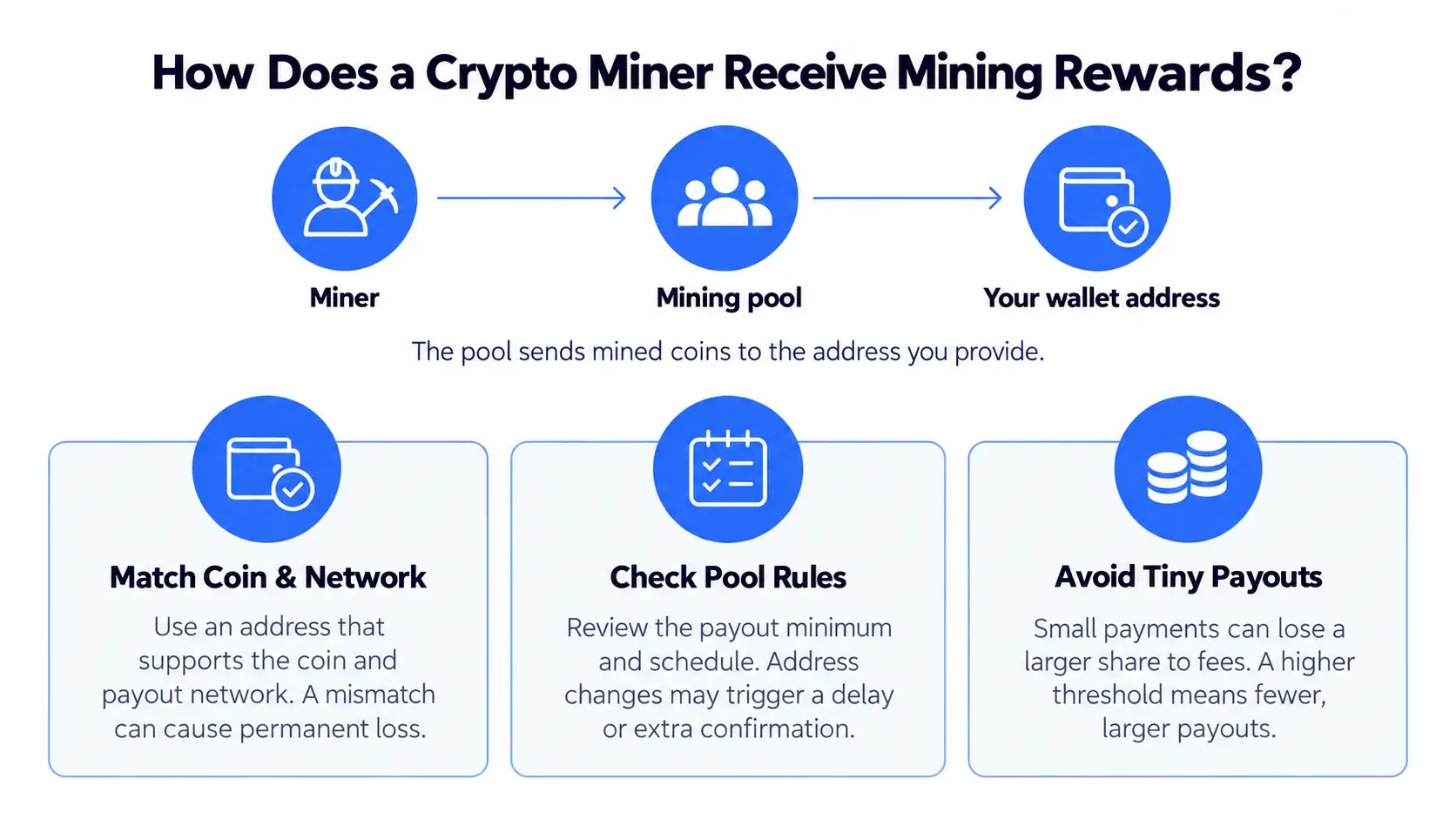
A crypto miner usually gets paid by a mining pool, and the pool sends coins to an address you provide. Three things deserve a close look before you save that address.
- Coin and network compatibility: The address must match the coin and the network. A Bitcoin address works for Bitcoin only. Sending to the wrong network can mean permanent loss, so confirm that your storage app supports the coin you mine.
- Pool payout rules: Pools set a minimum payout threshold and a payout schedule. Many also add a delay or an extra confirmation when you change the withdrawal address, so read the rules first.
- Fees from small payouts: Each on-chain payment pays a network fee, and that fee depends on transaction size, not on how much you send. Frequent tiny payouts can lose a bigger share of your reward to fees. A higher threshold means fewer, larger payments.
Many miners point payouts to an online address for flexibility, then move larger balances offline on a schedule.
What Practical Steps Should Miners Follow Before Setting a Payout Address?
- Confirm the coin and network your miner is working on.
- Create the receiving address in your own app or device and verify it on the screen.
- Paste it into the pool dashboard and compare it character by character.
- Run a small test payout before relying on it.
- Set a threshold that balances fees against waiting time.
- Turn on two-factor authentication for the pool account.
- Move larger balances offline on a routine.
What Do Mining Rewards Look Like in Practice?
Some current context helps. Bitcoin mining uses the SHA-256 algorithm, aims for one block about every 10 minutes, and pays 3.125 BTC per block since the April 2024 halving. Network hashrate sat near 950 EH/s in early October, difficulty was around 140.58T, and Bitcoin traded near $83,500 in late September. At 144 blocks a day, that is about 450 BTC for the whole network.
Here is what that means at three example hashrates:
| Hashrate | Est. Daily (BTC) | Est. Daily (USD) | Est. 30 Days (USD) | Days to Reach 0.001 BTC |
|---|---|---|---|---|
| 100 TH/s | 0.0000474 | $3.95 | $118.60 | About 21 |
| 200 TH/s | 0.0000947 | $7.91 | $237.30 | About 10.5 |
| 500 TH/s | 0.000237 | $19.77 | $593.10 | About 4.2 |
These are gross estimates before pool fees, transaction fees, and electricity, and they shift with price and difficulty. The 0.001 BTC threshold is only an example, since each pool sets its own. At these levels, ASIC mining income arrives in small pieces, which is why payout settings and fees matter.
Conclusion
Online and offline storage solve different problems. One gives you speed, the other gives you distance from remote attacks, and both can fail if the recovery phrase is handled badly. A small spending balance online with longer-term holdings offline works for many people, and plenty keep two wallets for that reason.
If you are active in ASIC mining, set up your payout address carefully, test it, and move larger balances offline on a routine. ASIC Marketplace has more mining guides if you want to keep learning. This article is for education only and is not investment advice.
Faqs
-
Can I Receive Funds While My Device Is Offline?
Yes, because the coins are recorded on the blockchain and the sender only needs your public address. You will see the balance once your device reconnects and syncs, or you can check the address on a block explorer.
-
Is It Safe to Share My Receiving Address?
Yes, a receiving address only lets others send you funds and gives them no control over your coins. Never share your recovery phrase or private key with anyone, and check each new address on your device screen before using it.
-
How Do I Transfer Funds Between Wallets?
Copy the receiving address from the destination, verify it on screen, and send a small test amount first. Then send the rest and confirm it arrived, keeping in mind that network fees apply.
-
How Do I Recover Access After Losing a Device?
Your funds remain on the blockchain, and you can restore access by entering your recovery phrase into a compatible app or a new device. Without that phrase, nobody can restore it, so store it safely and apart from the device.

Peter Davis
Peter Davis is an accomplished blockchain analyst and technical writer with over four years of experience in the cryptocurrency sector. His expertise spans blockchain infrastructure, ASIC mining hardware, and digital asset markets, where he is recognized for translating complex technical concepts into precise, insightful, and accessible analysis for a global audience.
With a strong foundation in technical research and market evaluation, Peter’s work focuses on bridging blockchain innovation with practical mining and investment strategies. His writing is defined by analytical depth, clarity, and a focus on data-backed insights that guide both professionals and enthusiasts through the evolving crypto landscape.
Driven by a deep passion for Web3 technology and decentralized systems, Peter continues to produce authoritative, research-driven content that enhances understanding of ASIC mining performance, blockchain efficiency, and the broader dynamics shaping the future of digital finance