Résumé rapide
More miners are moving to water cooling these days, and this machine is a big part of why. Pulling 5522W at 251 TH/s puts it around 22 J/TH, which is a real relief if you’re sick of a wall of loud fans taking over your garage. Below you’ll find the full spec sheet, what daily and yearly earnings look like right now, and how long it actually takes to earn back the purchase price.
What Is the S19e XP Hydro?
Antminer S19e XP Hydro features Bitmain’s SHA-256 series, but rather than having fans, the miner is made specifically for hydro-cooling systems. The role of air that would normally go through cooling plates now belongs to water, making heat transfer much more efficient while also lowering noise and temperature levels. This one came out in May 2024, and people who already had liquid cooling setups running (or wanted a reason to build one) kept it on their shortlist.
It’s not something you unbox and plug in right away, since a hydro unit needs a water loop, a pump, and a radiator working before it does anything useful. That tradeoff is the whole point, though, since hydro cooling lets Bitmain push more hash rate out of the same chip design without the fan noise or dust problems that come with air cooling.

What Are the Full Specifications of the S19e XP Hydro?
Here’s the full spec sheet, straight from the data sheet, no guesswork involved.
| Spécification | Détail |
| Fabricant | Bitmain |
| Modèle | S19e XP Hydro (251TH) |
| Algorithme | SHA-256 |
| Taux de hachage | 251 TH/s |
| Consommation électrique | 5522W |
| Efficacité | ~22 J/TH |
| Dimensions (without hydro box) | 410 x 170 x 209mm |
| Dimensions (with hydro box) | 570 x 316 x 430 mm |
| Poids net | 12 800 g |
| Mise en réseau | Ethernet RJ45 10/100M |
| Type de refroidissement | Hydro-cooling |
| Water Flow Rate | 8.0 – 10.0 L/min |
| pH liquide | 8.5 – 9.5 |
| Pression d'eau | ≤3.5 bar |
| Température de fonctionnement | 20°C – 50°C |
| Humidité de fonctionnement | 10% – 90% |
| Température de stockage | -20°C to 70°C |
| Garantie | 365 jours |
There are a few items worth mentioning here. Firstly, the flow window (8.0 to 10.0 L/min) is not an option; going lower than this window could deprive the chips of proper cooling even if you have normal ambient room temperature. Liquid pH is another one: acidic or alkaline water could accelerate the corrosion process in the cooling plates, and keeping it at 8.5 to 9.5 would actually prolong your equipment’s life.
Why Does Mining Hardware Even Need Hydro Cooling?
Air-cooling systems work perfectly well in small-scale systems, but when dealing with many or hundreds of ASIC mining rigs in one room, heat will be the limiting factor. The hydro-cooling system addresses this issue by transferring heat from air to water through:
- Lets each unit run at a higher sustained hash rate without thermal throttling
- Cuts noise dramatically compared to fan-cooled rigs
- Reduces dust buildup since there’s no constant airflow pulling debris through the chips
- Makes it easier to manage heat across large mining farms, since water loops can be centralized
The catch is upfront cost and complexity. You’re not just buying a miner; you’re buying into a cooling ecosystem. If you already run hydro or immersion infrastructure, adding this unit is straightforward. If you don’t, budget for the loop setup on top of the machine price.
How Much Can You Earn With the S19e XP Hydro?
And here we go with the good stuff everybody wants to hear. This is how your 251 TH/s mining power converts based on present mining difficulty and Bitcoin value:
| Métrique | Bitcoin (BTC) |
| Revenu quotidien | $3.1584 |
| Monthly Revenue | $94.7518 |
| Yearly Revenue | $1,152.8131 |
Remember that all numbers are influenced by two factors: the price of Bitcoin and its difficulty. The higher the price, the higher your profits will be. If the difficulty goes up, which is very common, you will see that your daily earnings will be lower in dollars unless the price increase surpasses it. That’s why those numbers must be updated constantly.
Another thing that must be mentioned is that this mining unit isn’t tied only to Bitcoin. As it supports the SHA-256 algorithm, it can mine other currencies that use the same algorithm, such as Bitcoin Cash or Fractal Bitcoin, or go through a mining pool such as NiceHash.
What’s the Real ROI Timeline on This Miner?
At $999 for the unit and $3.1584 in daily revenue before electricity costs, the raw payback period sits around 316 days, so just under 11 months, if daily earnings stayed perfectly flat. In practice, they won’t stay flat, since difficulty adjustments and price swings shift that number up or down throughout the year.
Here’s a rough breakdown of how the math plays out at different stages:
| Période | Estimated Revenue (before electricity) |
| 1 Month | $94.75 |
| 3 Months | $284.26 |
| 6 Months | $568.51 |
| 12 Months | $1,152.81 |
None of this accounts for your power bill, which is the single biggest variable in ASIC miner profitability. At 5522W running continuously, your electricity rate does more to determine your actual take-home profit than almost anything else on this page. A miner paying $0.05/kWh will see a very different bottom line than one paying $0.12/kWh, even with identical hash rate and identical Bitcoin price.
How Do You Calculate Your Own Mining Earnings?
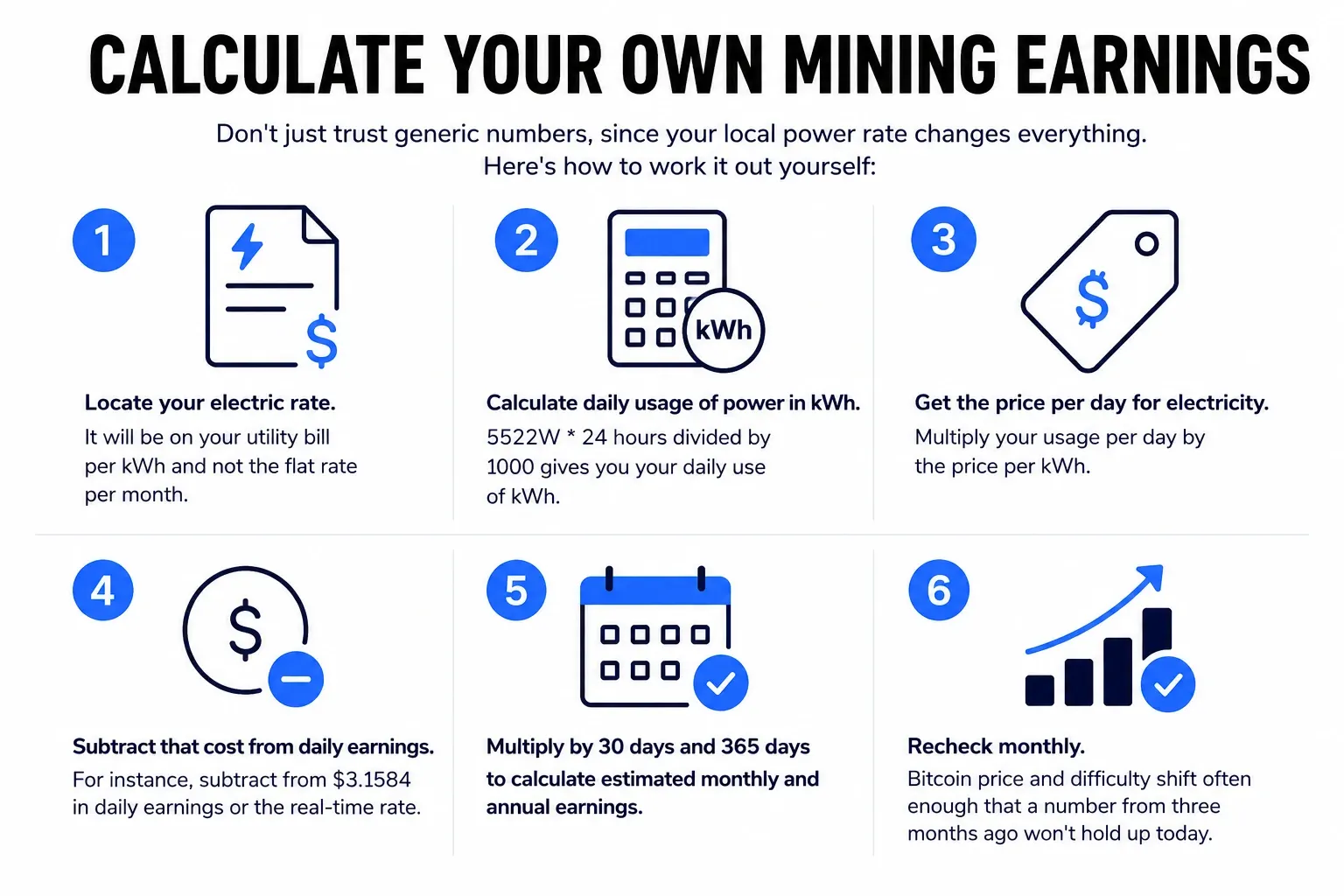
Don’t just trust generic numbers, since your local power rate changes everything. Here’s how to work it out yourself:
- Locate your electric rate. It will be on your utility bill per kWh and not the flat rate per month.
- Calculate daily usage of power in kWh. 5522W * 24 hours divided by 1000 gives you your daily use of kWh.
- Get the price per day for electricity. Multiply your usage per day by the price per kWh.
- Subtract that cost from daily earnings. For instance, subtract from $3.1584 in daily earnings or the real-time rate.
- Multiply by 30 days and 365 days to calculate estimated monthly and annual earnings.
- Recheck monthly. Bitcoin price and difficulty shift often enough that a number from three months ago won’t hold up today.
This gives you a personalized profitability figure instead of relying on a blanket estimate that assumes everyone pays the same power rate, which almost nobody does.
What Should You Check Before Buying the S19e XP Hydro?
Before purchasing a cryptocurrency miner, particularly one cooled using hydro, make sure you consider the following:
- Have you got the hydro cooling loop set up? If not, be sure to take this cost into account along with the $999.
- What is your rate for electricity? One figure will tell you if you’ll make money or break even.
- Can your space handle 5522W continuous draw? Confirm your electrical circuit and any facility limits before ordering.
- Do you have space for the full hydro box dimensions? The unit measures 570 x 316 x 430mm with the box attached, noticeably bigger than the bare unit.
- Are you comfortable maintaining water flow, pH, and pressure specs? Neglecting these shortens the lifespan of the cooling plates.
How Does the S19e XP Hydro Stack Up Against Air-Cooled Miners?
| Factoriser | S19e XP Hydro | Typical Air-Cooled ASIC |
| Méthode de refroidissement | Refroidissement par eau | Fan-based |
| Niveau sonore | Significantly lower | High, often 75dB+ |
| Complexité de configuration | Requires water loop | Plug-and-play with power |
| Dust Sensitivity | Bas | Haut |
| Ideal Environment | Mining farms, home setups with cooling infrastructure | Standalone or small-scale setups |
| Coût initial | Machine + cooling infrastructure | Machine only |
If you’re running a single unit in a spare room without any existing cooling setup, air-cooled machines are simpler to get started with. If you’re scaling up or already have hydro infrastructure in place, this unit’s efficiency and noise profile make it worth the extra setup work.
How Do You Set Up the S19e XP Hydro for Mining?
Setting up this machine involves a few more steps than a fan-cooled mineur de crypto, but the process is straightforward when you follow each step in order.
Here’s the general process most buyers follow:
- Build your water loop first, if needed. Have your radiator, pump, and tubing all set up prior to the miner coming in, so you aren’t trying to solve two problems at once.
- Test the loop without the miner. Run the pump and check for leaks, bubbles, and poor flow without attaching the mining unit, to be sure nothing goes wrong while you test something expensive.
- Verify flow rate and pH. Ensure that the water falls within the 8.0-10.0 L/min and 8.5-9.5 pH limits by using a flow meter and pH test kit before installing the miner.
- Mount the miner and hook up the hydro box. Get the inlet and outlet pipes attached and make sure every connection is fitted tightly before you power anything on.
- Power up and connect to a network. Power it up with the provided PSU and connect via Ethernet to your router or switch because it requires a wired connection using an RJ45 10/100M.
- Configure your IP and mining pool details. Connect to the miner’s control panel through a web browser and set the IP and pool address; also specify your wallet ID.
- Monitor the miner for a day. Check for a stable hash rate and temperature, and check the error codes displayed on the dashboard.
Most of the setup process is done once only. After the loop testing and getting your miner connected to the pool, you won’t be doing anything else very often.
What Maintenance Keeps a Hydro-Cooled Miner Running Long-Term?
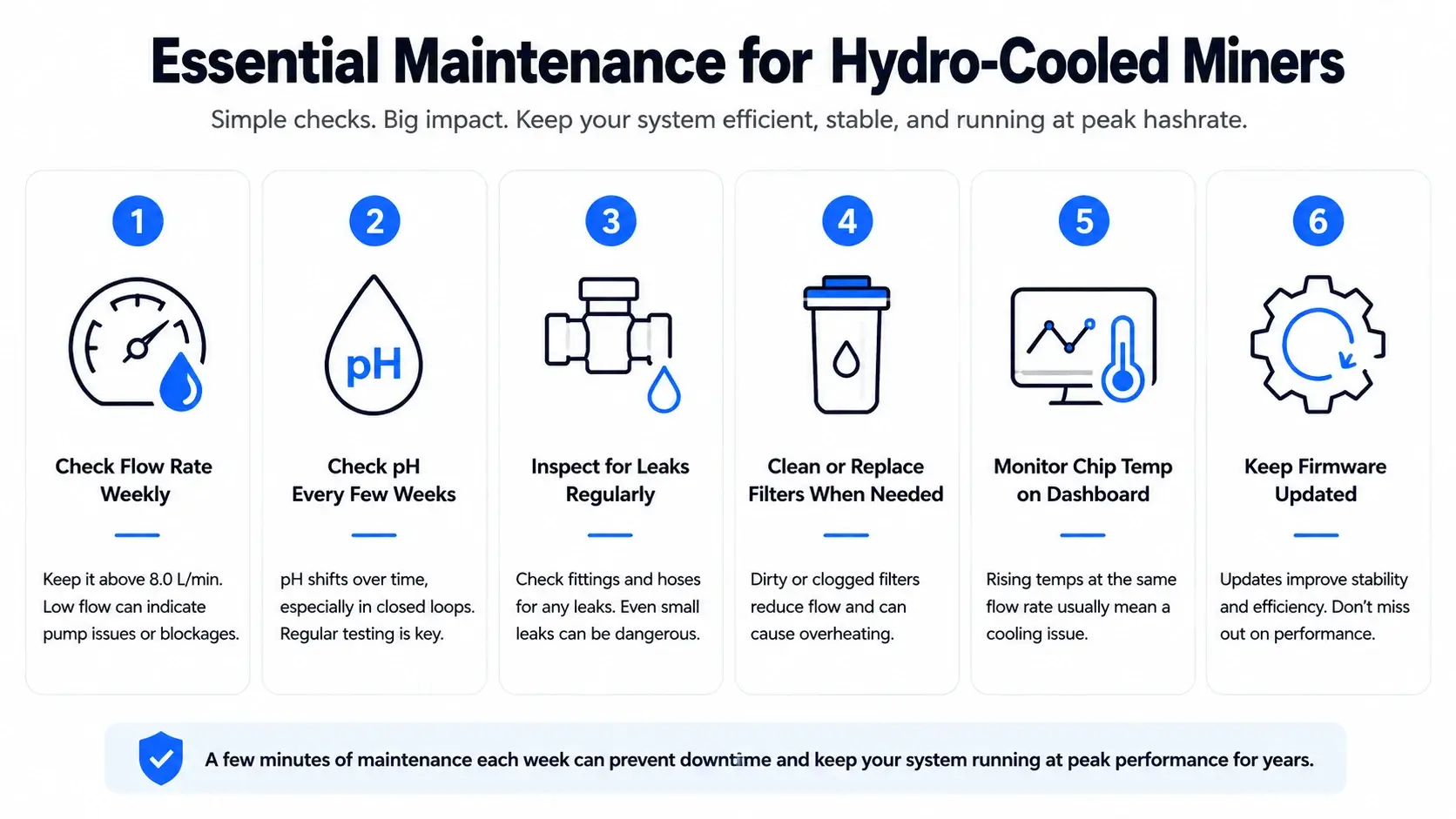
Hydro-cooling reduces issues of dust, but it adds its own maintenance procedure. Avoiding this can ensure that your machine dies the quickest, even though it is highly durable.
- Check the flow rate once a week. If the pump starts to get slower or if there’s a partial blockage, then you may see flow rates that are below 8.0 L/min without any visible indications.
- Check the pH value every few weeks. The pH changes with time, especially if you’re dealing with a closed loop that works non-stop, so it’s necessary to do this test.
- Check for any leaks around the fittings and hoses. Even a tiny leak close to the electric components may be dangerous, so you shouldn’t forget about this simple check.
- Clean or change the filter if required. Accumulation of sediment decreases the flow rate, but more often, a blocked filter will cause overheating of the system.
- Monitor chip temperature through the dashboard. Rising temps at the same flow rate usually point to a cooling issue rather than a chip problem, so catch it early.
- Keep firmware updated. Bitmain periodically releases updates that improve stability and efficiency, and running outdated firmware can leave performance on the table.
Each of these steps doesn’t take too much time to accomplish, but not accomplishing them on a monthly basis results in buyers getting machines that aren’t performing at their optimal hash rate.
Who Should Actually Buy the S19e XP Hydro?
This machine isn’t the right fit for everyone, and being honest about that upfront saves people money. It makes the most sense for a specific type of buyer.
- Farm operators scaling past a handful of units. Once you’re running many rigs in one space, the noise reduction and centralized heat management of hydro cooling start paying for themselves in ways a single unit never will.
- Anyone already invested in liquid cooling infrastructure. If you’ve got a loop, radiators, and pumps in place from a previous hydro or immersion setup, adding this unit is a natural next step rather than a new project.
- Home miners in noise-sensitive locations. Garages attached to living spaces or apartments with shared walls benefit from how much quieter a hydro loop runs compared to a wall of fans.
- Buyers who can commit to routine upkeep. Hydro cooling rewards people who check flow rate and water chemistry on a schedule, and it punishes people who set it up once and forget about it.
However, someone who is just dipping their toes into using one unit without any previous cooling system will probably find it much easier and more affordable to install an air-cooled system. The advantages of hydro cooling come into play when the project is larger in scale, and the environment is suitable.
How Does the S19e XP Hydro Compare on Cost Per TH?
Price per terahash is one of the clearest ways to judge whether a mining rig is worth its sticker price relative to output. At $999 for 251 TH/s, this unit works out to roughly $3.98 per TH/s of hash power.
| Price Point | Taux de hachage | Cost per TH/s |
| $999 | 251 TH/s | ~$3.98 |
That figure matters most when you’re comparing this unit against other SHA-256 machines on the market. A lower cost per TH generally means faster payback, assuming efficiency and power costs are similar. Since this model also runs at roughly 22 J/TH, it pairs a competitive price per TH with efficiency numbers that hold up well against other current-generation ASIC hardware, which is part of why it keeps showing up on buyer shortlists despite the added complexity of hydro cooling.
Conclusion
It would definitely make the cut for anyone interested in Bitcoin mining who is not afraid of the water-cooled system, since the S19e XP Hydro packs 251 TH/s hash rate and around 22 J/TH energy consumption. The figures indicate that the return on investment period could be less than a year, depending on electricity prices, Bitcoin price, and the difficulty level of the network. Run your own calculations with your local power rate before buying, since that’s the variable that actually decides whether this machine pays for itself on schedule or takes longer. If you’re ready to move forward, Asic Marketplace carries this unit in stock with a 365-day warranty and a PSU included, so it’s a straightforward next step once your cooling setup is in place.
Questions fréquemment posées
-
Will the S19e XP Hydro actually make money mining Bitcoin?
It’s still turning a profit for most operators, as long as power costs stay under about $0.10/kWh. That number swings a lot, though, so plug in your own rate before you commit.
-
How many watts does the S19e XP Hydro pull when it's running?
Full load sits at 5522W for 251 TH/s of hashing, roughly 22 J/TH once you do the math. Plan for a dedicated circuit, since that draw isn’t something a regular outlet handles well.
-
Does the S19e XP Hydro work without hooking up to water cooling?
Not really; this thing was designed around a hydro loop and needs one to function at all. Skip the pump, flow, or radiator setup, and you’re looking at overheating that can wreck the chips for good.

Peter Davis
Peter Davis est un analyste accompli de la blockchain et un rédacteur technique avec plus de quatre ans d'expérience dans le secteur des crypto-monnaies. Son expertise couvre l'infrastructure de la blockchain, le matériel de minage ASIC et les marchés des actifs numériques, où il est reconnu pour traduire des concepts techniques complexes en analyses précises, perspicaces et accessibles pour un public mondial.
Avec une base solide dans la recherche technique et l'évaluation du marché, le travail de Peter se concentre sur le lien entre l'innovation de la blockchain et les stratégies pratiques d'exploitation minière et d'investissement. Ses écrits sont définis par la profondeur analytique, la clarté et l'accent mis sur les idées fondées sur des données qui guident à la fois les professionnels et les passionnés dans le paysage cryptographique en évolution.
Animé d'une profonde passion pour la technologie Web3 et les systèmes décentralisés, Peter continue de produire un contenu faisant autorité, axé sur la recherche, qui améliore la compréhension de la performance minière ASIC, de l'efficacité de la blockchain et de la dynamique plus large qui façonne l'avenir de la finance numérique