Résumé rapide
Looking for a dedicated Equihash rig that can actually pull its weight on the ZEC network? This guide breaks down every spec sheet number, walks through real-world hashrate and power draw figures, and shows you how the profit math works out once electricity costs come into play. You’ll also get a setup walkthrough, a side-by-side comparison against other Bitmain gear, and honest pros and cons so you know exactly what you’re buying before you spend a dollar. Whether you’re a first-time buyer or adding a rack to an existing farm, this article has the numbers you need in one place.
Bitmain Antminer Z15K Equihash Miner Built to Do?
Bitmain Antminer Z15K is an Equihash mining rig that has been designed solely for mining Zcash in an efficient and uneventful manner. Bitmain has long been synonymous with specialized mining hardware, and this device continues that tradition by focusing on a single algorithm rather than being a general-purpose mining machine.
Unlike GPU rigs that can be repointed at dozens of different coins, this machine is an application-specific integrated circuit device, meaning the chips inside are hardwired to solve Equihash puzzles and nothing else. That specialization is exactly why it outperforms general-purpose hardware on hashrate per watt. You lose flexibility, but you gain raw speed and lower running costs per unit of work done.
Caractéristique clé
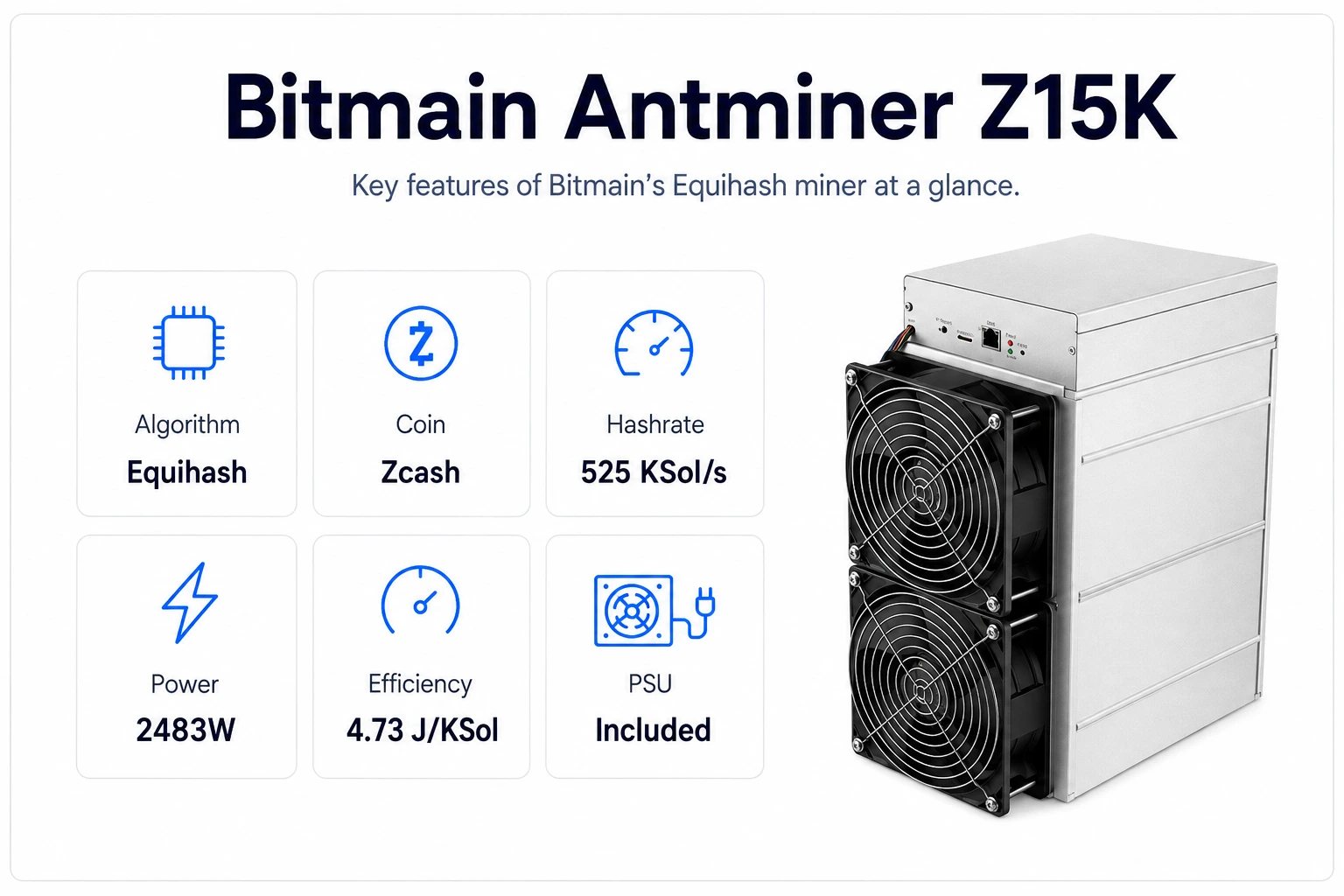
Here’s a quick view of what makes this hardware stand out:
- Engineered exclusively for Zcash mining via the Equihash algorithm
- Standard performance of 525 KSol/s right out of the box
- Operational power draw of 2483W, landing in the mid-to-high tier for this category
- Efficiency rating of 4.73 J/KSol, representing a reliable metric for current hardware
- Bundled with a dedicated power supply, eliminating any extra hardware expenses
- Highly compact 133 x 245 x 290mm build compared to larger multi-board units
For anyone who has run older Zcash-focused hardware, the jump in raw solutions-per-second is noticeable. Older generation boxes struggled to break past 200-300 KSol/s while pulling similar or even higher wattage, so the efficiency curve has genuinely moved forward here.
Who Does This Hardware Actually Suit?
It’s also worth noting who this machine suits best. This isn’t really a “hobbyist plugs it into a bedroom outlet” device; the noise output and power draw mean it’s built for garages, dedicated mining sheds, warehouses, or colocation facilities where airflow and electrical capacity are already sorted out. If you’re weighing this against building a custom GPU farm, the trade-off comes down to simplicity and efficiency versus flexibility. A GPU rig can switch coins on a whim; this hardware mines one thing, and it does that one thing well.
There’s also a maintenance angle worth mentioning early. Because this hardware runs continuously and generates real heat, treating it like a “set it and forget it” appliance is a mistake many first-time buyers make. A quick weekly glance at your pool dashboard, a monthly dust check, and keeping an eye on ambient room temperature go a long way toward protecting your investment and keeping output close to the rated figures over the life of the machine.
What Are the Full Technical Specs of This Miner?
Before making a purchase decision, it is helpful to view all the numbers in a single table rather than scattered across a product page.
Here’s the complete spec:
| Spécification | Détail |
| Fabricant | Bitmain |
| Modèle | Antminer Z15K |
| Algorithme | Equihash |
| Hashrate | 525 KSol/s |
| Consommation électrique | 2483W |
| Efficacité énergétique | 4.73 J/KSol |
| Dimensions | 133 x 245 x 290mm |
| Poids | 9kg |
| Niveau sonore | 72dB |
| Cooling Fans | 2 |
| Voltage Requirement | 200–240V |
| Network Interface | Ethernet |
| Température de fonctionnement | 5°C to 45°C |
| Humidité de fonctionnement | 5% to 95% |
What Do These Numbers Mean for Your Setup?
A few things jump out when you study this table closely. The power supply is bundled in the box, which isn’t always the case with ASIC hardware. Some manufacturers sell the miner and PSU separately, adding a few hundred dollars to your real cost. Here, that expense is already baked into the price.
The 200–240V voltage requirement means this is not a standard North American 120V wall-outlet device. You’ll need a 240V circuit, which is common in mining setups but something apartment or home miners often overlook until delivery day. If you’re setting up a single unit at home, budget for an electrician visit unless you already have a 240V line available.
The 72dB noise rating is roughly comparable to a running vacuum cleaner or a loud conversation. With two fans working to keep the hashboards cool, this is not a quiet appliance placement away from living spaces is a must.
The temperature and humidity tolerances (5–45°C, 5–95% humidity) are fairly generous, giving you flexibility on where you site the unit, though performance and longevity are always best in a clean, temperature-controlled environment rather than pushed to the edges of that range.
Yet another point that many buyers tend to overlook is that, owing to its 9kg weight and small dimensions, this product is not too difficult to install and move around in the mining area compared to previous, more cumbersome models. In case of multiple units being installed, this means that the design of the shelf will not be as complicated as in the case of heavy previous-generation boxes.
How Fast Does It Actually Hash Breaking Down Mining Performance
Several statistics displayed on a specification page are only meaningful with translating them into actual outputs. With 525 KSol/s, this device is approximately submitting 525,000 Equihash solutions every second to the network. This number gives your portion of the block reward directly compared to the overall network hashrate.
Here’s how that performance stacks up in practical terms:
- Hash rate: 525 KSol/s under usual working conditions.
- Efficacité 4.73 J/KSol; thus, fewer resources are wasted per unit of computing power produced.
- Reliability: ASIC miners meant for a specific algorithm are likely to maintain their specified hash rate more consistently compared to GPU clusters.
In terms of efficiency, miners belonging to the previous generation have been noted to work at an efficiency higher than 6-8 J/KSol, and even much more. A lower value of joules per KSol means that more computational power is being achieved with every watt of electricity. It is the most crucial figure when talking about expenses incurred while using equipment.
What Affects Real-World Hashrate?
Mining performance isn’t static, though. A few real-world factors affect how close you get to the rated 525 KSol/s figure:
| Factoriser | Impact on Performance |
| Ambient room temperature | High heat can trigger automatic throttling to protect chips |
| Power supply stability | Voltage fluctuations can reduce effective hashrate |
| Firmware version | Bitmain periodically releases updates that tune performance |
| Difficulté du réseau | Doesn’t change your hashrate, but changes your share of rewards |
| Pool overhead/fees | Pool cut reduces payout, not raw hashing output |
One thing worth flagging: your actual daily solutions submitted can dip a few percentage points below the rated figure simply due to normal thermal cycling, especially in warmer climates or poorly ventilated rooms. Budgeting for something closer to 95-98% of rated performance in real-world conditions is a sensible, conservative approach rather than assuming perfect lab-condition output every single day of the year.
Even if you have more than one unit, slight differences in performance among individual units are not unusual, because even ASIC chips undergo what is known as the “silicon lottery,” and that applies to CPUs and GPUs as well.
It is also important that you monitor your statistics over time instead of just taking a look at them once and ignoring them. Most pool dashboards and farm monitors will keep records for hourly or daily average statistics. This helps in identifying a slow loss in productivity long before it gets serious. An abrupt change would be indicative of fan damage or any loose connections, whereas a gradual change would be due to any dust accumulation or software problems.
Which Coins Can You Actually Mine With This Hardware?
This is where the answer is refreshingly simple compared to multi-algorithm rigs. This hardware is built exclusively around the Equihash algorithm, and its primary and effectively only practical target is Zcash (ZEC).
Zcash mining has been consistently popular over time due to the fact that the cryptocurrency has an active community associated with its shielded transactions, and Proof of Work mining is still performed using hardware similar to the one shown above based on the Equihash algorithm. This is not the case with cryptocurrencies that have switched to Proof of Stake.
What Should You Know About Coin Selection?
A few points worth understanding about coin selection with this device:
- Main coin: Zcash (ZEC). This is what the miner is designed and optimized for.
- Algorithm dependency: Chipsets with the Equihash algorithm can’t be used for mining SHA-256 (Bitcoin), Scrypt (Litecoin/Dogecoin), or other algorithms
- Merge mining/alternative coins: There are some other coins that use an Equihash algorithm variation, but their liquidity, exchange, and security are much worse compared to Zcash, and thus they are not practical for most miners.
- Pool support: All major pools that accept Equihash (Zcash) will work with this miner without any changes.
If your long-term plan involves mining multiple different coins or reacting to price swings across various algorithms, this isn’t the right hardware category for you because flexibility belongs to GPU rigs. But if you’ve already decided ZEC is the coin you want exposure to, and you’d rather mine it directly than buy it on an exchange, dedicated Equihash hardware like this remains one of the more efficient ways to accumulate it, assuming your electricity costs are favorable.
It’s also worth pointing out that mining directly gives you a dollar-cost-averaging effect into ZEC without needing to time the market, since you’re earning coins continuously regardless of daily price swings (though your profitability in dollar terms absolutely still depends on price).
How Much Power Does It Consume and How Efficient Is It?
Running any ASIC miner is fundamentally an electricity business wrapped around a piece of hardware, so it’s worth spending real time on power numbers before you buy.
At 2483W, this unit draws roughly the same power as two or three space heaters running simultaneously, 24 hours a day, 365 days a year if you run it continuously. That’s the reality of ASIC hardware. The hashrate is impressive, but so is the electric bill if you’re not paying attention to your rate.
Here’s a simple breakdown of what that power draw translates to over different time periods:
| Time Period | Energy Consumed (kWh) |
| Per Hour | 2.483 kWh |
| Per Day | ~59.6 kWh |
| Per Month (30 days) | ~1,788 kWh |
| Per Year | ~21,760 kWh |
Use your own electricity price per kilowatt-hour and multiply it by the figures above to calculate the exact cost of mining. For instance, with a price of $0.08 per kWh, which is quite affordable for an industrial consumer, you will need to spend $143 per month on electricity alone. However, with $0.15 per kWh, which is closer to the average residential price, you will have to pay about $268 per month for the electricity.
How Can You Keep Efficiency Close to Rated Spec?
The 4.73 J/KSol efficiency rating matters because it directly determines how much of your electricity spent converts into useful hashing output versus wasted heat.
Some tips to maintain maximum efficiency:
- Keep ambient room temperature below 30°C where possible.
- Ensure clean, unobstructed airflow; don’t stack units too tightly together.
- Use a stable power source; avoid cheap, unregulated power strips or long extension cords.
- Clean dust from fans and heatsinks every few months to prevent thermal buildup.
- Monitor firmware updates from Bitmain, which occasionally improve efficiency curves.
Pour minage de cryptomonnaies, ASIC hardware gives you a more focused setup when you already know which algorithm you want to mine. It usually needs less day-to-day handling than a multi-GPU rig and can deliver strong performance without adding as much extra cooling or maintenance. GPU mining still gives you more flexibility, while ASICs are a better fit when efficiency and steady output on one algorithm matter more.
Is This Machine Actually Profitable to Run?
This is the question everyone actually cares about, so let’s get into real numbers. Profitability for any ASIC always comes down to three variables: coin price, network difficulty, and your electricity rate. Change any one of those and the math shifts.
Using current calculator estimates published for this hardware based on 2483W power draw, 525 KSol/s hashrate, and an electricity rate of $0.05/kWh, here’s what typical net output looks like:
| Period | Estimated Net Profit | Estimated ZEC Earned |
| Daily | ~$19.28 | ~0.02443 ZEC |
| Monthly | ~$578.43 | ~0.73279 ZEC |
| Yearly | ~$7,037.55 | ~8.9156 ZEC |
The numbers above take into account that electricity costs $0.05 per kilowatt-hour and are in flux based on the price of ZEC and network difficulty, so consider them to be current but not a definite figure. If you pay more or less than $0.05 per kilowatt-hour for electricity, your actual profit will change accordingly.
How Do You Work Out Your Net Profit?
To see how your own electricity rate changes the picture, start from the gross daily revenue of roughly $22.26 and subtract your actual power cost. Using our earlier figure of roughly 59.6 kWh per day, here’s how net profit shifts at different rates:
| Tarif d'électricité | Coût d'énergie quotidien | Net Profit per Day |
| 1 TP 22 T 0,05/kWh | $2.98 | $19.28 |
| 1 TP 22 T 0,08/kWh | $4.77 | $17.49 |
| 1 TP pour 22 T par 0,12 kWh | $7.15 | $15.11 |
| $0.18/kWh | $10.73 | $11.53 |
At the unit’s listed price of around $5,059, a rough break-even calculation (before accounting for difficulty increases, which are almost certain to happen over time) puts payback somewhere in the range of 8.5 to 15 months, depending heavily on your electricity rate and where ZEC’s price sits during that window.
A few realistic factors that will move these numbers over time:
- Network difficulty tends to climb as more hashrate joins the Zcash network, gradually reducing your share of rewards unless price appreciation offsets it
- ZEC price volatility can swing daily revenue substantially in either direction
- Frais de piscine typically range from 0.5% to 2%, a small but real deduction
- Hardware depreciation and eventual resale value should factor into your long-term math, not just month-one profit
The hardware has the potential to make you money if you have inexpensive electricity and good ZEC prices, but it does not guarantee you returns. Consider the online profitability calculator to be a guideline that you should update monthly.
How Does This Unit Compare to Other Zcash Miners?
There are several Equihash options available from Bitmain, and having some insight into how this device compares to its counterparts enables one to make a decision on whether or not it is the best choice for you.
| Modèle | Hashrate | Puissance | Efficacité | Approx. Price |
| Antminer Z15K | 525 KSol/s | 2483W | 4.73 J/KSol | ~$5,059 |
| Antminer Z15 Pro | 840 KSol/s | 2780W | ~3.31 J/KSol | ~$3,989 |
Looking at this side by side, the Z15 Pro actually delivers higher raw hashrate and better joules-per-KSol efficiency at a lower listed price, which tells you pricing in the ASIC secondhand and pre-order market doesn’t always track linearly with performance. Stock availability, batch timing, demand spikes, and warranty terms all factor into what a given unit sells for at any moment.
What Matters Beyond the Spec Sheet?
That said, price and specs aren’t the only consideration:
- Availability: one model may be in stock while another sits on a waitlist, and delivery timing affects how quickly you start earning
- Warranty coverage: check whether the specific batch you’re buying includes 180 days or a full year of coverage
- Physical footprint: smaller dimensions can matter if you’re working with limited rack or shelf space
- Noise tolerance of your site: both units run loud, so this rarely differentiates a purchase decision
If you’re purely optimizing for hashrate-per-dollar and efficiency, it’s worth comparing current listings for both models before finalizing an order, since ASIC pricing shifts fairly often based on chip supply and secondhand market conditions. If this specific unit is temporarily out of stock, joining a waitlist for the next delivery batch is often faster than hunting for an inferior alternative just to buy something today.
How Do You Set Up and Install Antminer Z15K Miner?

Getting a new ASIC miner from the box to earn coins isn’t complicated, but skipping steps causes most of the “my miner won’t connect” support tickets. Here’s a clean walkthrough:
- Prepare your electrical setup first. Confirm you have access to a 200–240V circuit rated to handle roughly 2500W continuous draw. Don’t plug this into a standard 120V household outlet; it simply won’t work, and forcing it risks damaging the unit or your wiring.
- Choose your physical location. Pick a space with good airflow, away from living or sleeping areas due to the 72dB noise level, and with ambient temperatures ideally under 30°C. Garages, sheds, and dedicated mining rooms work well.
- Unbox carefully and inspect. Check the unit for shipping damage, confirm the included power supply unit is present, and verify all cables and mounting hardware arrived intact.
- Connect the power supply to the hashboard unit. Following the manufacturer’s cable diagram exactly; mismatched connections are one of the most common causes of early-life failures.
- Connect via Ethernet. This device uses a wired Ethernet connection rather than Wi-Fi, so you’ll need a network cable run to wherever the unit is placed, connected to your router or a dedicated mining switch.
- Power on and locate the IP address. Most setups use an IP scanner tool or your router’s connected-devices list to find the miner on your local network.
- Access the web-based configuration panel. Log into the miner’s dashboard through a browser using its IP address, then set your mining pool address, worker name, and password.
- Choose and configure a mining pool. Pick an Equihash-compatible pool with good uptime and reasonable fees, then enter those pool details into the miner’s settings.
- Monitor initial performance. Watch the dashboard for the first 24-48 hours to confirm the unit is hitting close to its rated 525 KSol/s and that temperatures stay within a safe range.
- Set up remote monitoring (optional but recommended). Many miners use farm management software or apps to track multiple units remotely, alerting you if one goes offline or underperforms.
What Are Some Practical Setup Tips?
Label your Ethernet cables and power connections if you’re running multiple units, since troubleshooting a rack of identical-looking machines without labels wastes hours. Also, keep the original packaging for at least the first few months in case you need to ship the unit back for warranty service.
What Operating Conditions Keep This Hardware Running Well?
ASIC hardware is generally built tough, but longevity and consistent output depend heavily on the environment you place it in. This unit is rated for 5°C to 45°C operating temperature and 5% to 95% humidity, which gives you a workable range, but “workable” and “optimal” aren’t the same thing.
Best practices for a healthy mining environment:
- Keep temperatures in the lower-middle of the rated range; running consistently near 45°C shortens component lifespan, even if it doesn’t cause immediate failure
- Manage humidity carefully: condensation forming inside the unit from rapid temperature swings is a real risk, especially in basements or unheated sheds during seasonal changes
- Filter incoming air if your space is dusty; accumulated dust on heatsinks is one of the most common causes of gradual performance decline
- Avoid direct exposure to rain, snow, or excessive moisture; even though the unit tolerates humidity, this isn’t a fully weatherproof outdoor device
- Space units apart if running multiple machines, so exhaust heat from one unit doesn’t become intake air for the next
| Condition | Rated Range | Recommended Practical Range |
| Température | 5°C – 45°C | 15°C – 30°C |
| Humidité | 5% – 95% | 30% – 60% |
| Airflow | Not specified | Continuous, unobstructed |
| Dust exposure | Not specified | Minimal, filtered if possible |
How Should You Plan Around the Seasons?
Seasonal planning matters too. Summer heat in uncooled spaces can push ambient temperatures well past comfortable operating levels, triggering automatic throttling that reduces your effective hashrate, meaning you lose earnings exactly when electricity demand (and sometimes cost) is highest. Winter, by contrast, often improves cooling efficiency naturally, though you’ll want to watch for condensation risk if a cold unit is moved into a warm, humid room too quickly.
If you’re scaling beyond a single unit, investing in proper ventilation, exhaust fans, or even a basic HVAC solution for your mining space pays for itself through more consistent output and fewer thermal-related slowdowns over the machine’s working life.
What Are the Pros and Cons of Bitmain Antminer Z15K Miner?
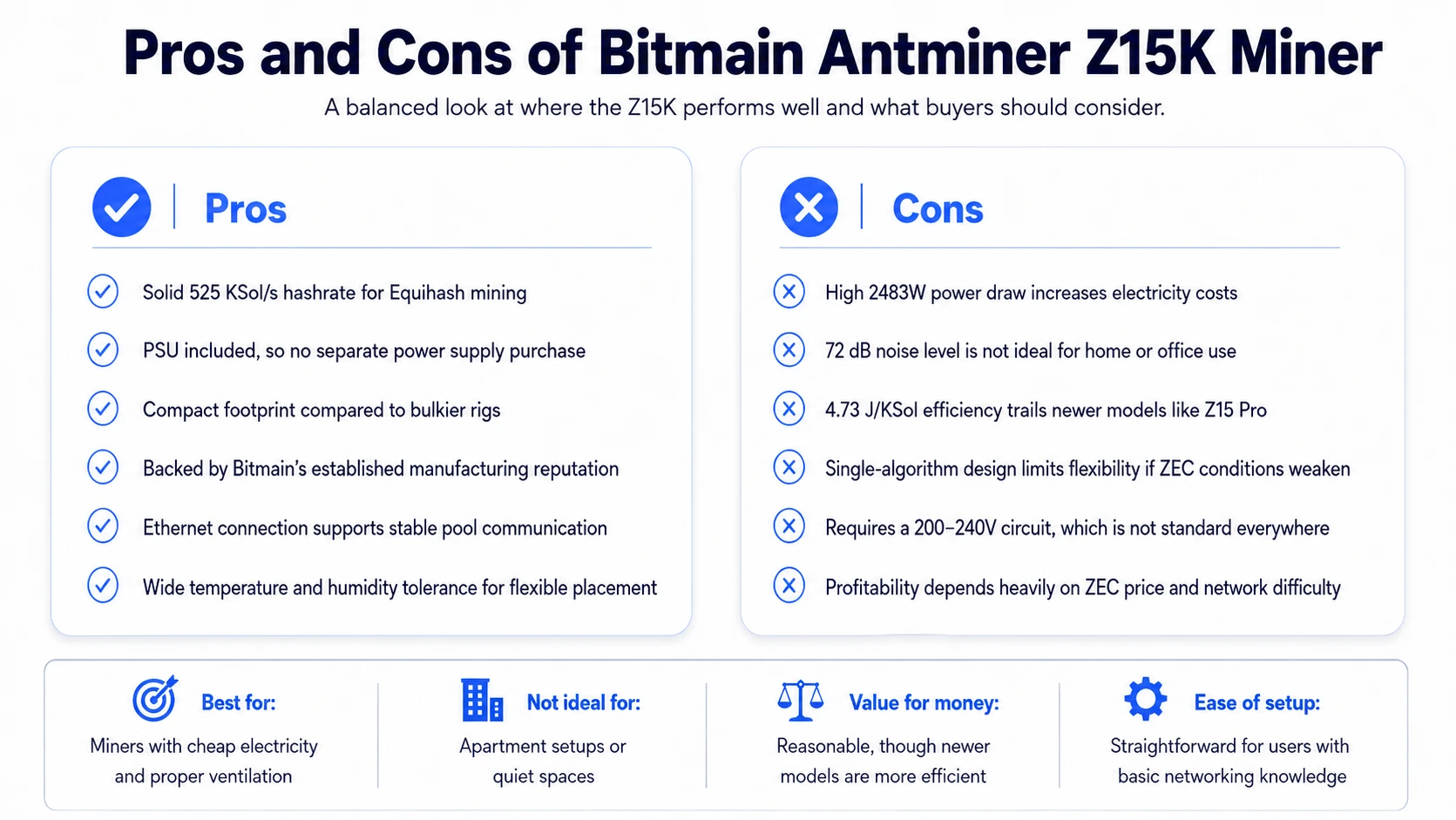
No piece of hardware is perfect for every situation, so here’s a balanced look at where this unit shines and where it falls short.
Pour :
- Solid 525 KSol/s hashrate dedicated entirely to Equihash mining
- Power supply unit included, avoiding a separate purchase
- Reasonably compact footprint compared to bulkier multi-board rigs
- Backed by Bitmain’s manufacturing reputation and established supply chain
- Ethernet connectivity for stable, low-latency pool communication
- Wide operating temperature and humidity tolerance for flexible siting
Cons :
- High power draw (2483W) means electricity cost dominates your profit margin
- 72dB noise level rules out home or office placement near living spaces
- Efficiency (4.73 J/KSol) trails newer models like the Z15 Pro
- Single-algorithm design offers zero flexibility if Zcash market conditions turn unfavorable
- Requires a 200–240V circuit, which isn’t standard in every home setup
- Profitability is highly sensitive to ZEC price swings and rising network difficulty
| Catégorie | Result |
| Meilleur pour | Miners with access to cheap electricity and proper ventilation |
| Not ideal for | Apartment dwellers or anyone needing a quiet, low-power setup |
| Value for money | Reasonable, though newer models offer better efficiency per dollar |
| Ease of setup | Straightforward for anyone comfortable with basic networking |
What’s the Resale Value?
If you already believe in Zcash as a long-term hold and you have access to affordable power, this hardware gets the job done reliably. If your electricity rates are high or you’re hoping for a flexible, multi-coin setup, you may want to look elsewhere or budget more carefully before committing.
One more angle worth weighing before you decide: resale value. ASIC hardware, like any specialized computing equipment, loses value over time as newer, more efficient models come to market. Buyers who plan to run a unit for a full multi-year cycle care less about this, but if you’re the type who upgrades every 12-18 months, factor in a realistic resale estimate rather than assuming you’ll recover a large share of your original purchase price down the line.
Where Can You Buy This Hardware and What Should You Know Before Ordering?
Once you’ve decided this is the right fit, a few practical buying considerations will save you headaches down the line.
- Pricing: Listed around $5,059, though ASIC prices shift with market demand and chip availability; always check current listings before finalizing a decision.
- Stock status: Popular batches sell out quickly; joining a waitlist for the next delivery round is common and usually faster than searching for the same unit elsewhere at inflated prices
- Expédition: Units typically ship from Hong Kong-based warehouses within 48-72 hours of order confirmation for in-stock inventory, with express delivery worldwide taking roughly 5-7 days
- Warranty: Look for coverage in the 180-365 day range from the manufacturer, and confirm whether technical support is available for troubleshooting after delivery
- Payment options: Most sellers accept wire transfer and major cryptocurrencies, giving flexibility depending on how you prefer to pay
- Import duties: If you’re ordering internationally, ask whether delivery-duty-paid service is available so customs and taxes are handled upfront rather than surprising you later
What Should Be on Your Pre-Purchase Checklist?
A quick pre-purchase checklist:
- Confirm your electrical setup can handle 200-240V and roughly 2500W continuous draw
- Calculate your local electricity rate against the profitability estimates above
- Decide on ventilation and noise placement before the unit arrives, not after
- Choose a reputable Equihash mining pool in advance
- Verify warranty terms and return policy with your chosen seller
- Factor shipping time into your break-even timeline, since idle days between purchase and setup don’t earn anything
Buying refurbished or secondhand units can lower the upfront cost, but they often come with limited or no warranty coverage, so the lower price needs to be weighed against the added risk. As with any minage de cryptomonnaies hardware purchase, good post-sale support and a clear return policy can matter more over time than saving a little on the initial price.
Conclusion
Choosing dedicated ASIC hardware for Zcash mining comes down to a fairly simple trade-off: you give up flexibility in exchange for solid, predictable hashing performance on a single algorithm. This unit delivers respectable numbers across the board, a competitive hashrate, an included power supply, and reasonable build quality backed by an established manufacturer, but its profitability still hinges heavily on your electricity cost and where ZEC’s price sits when you’re running it.
If you’ve done the math, secured affordable power, and have a properly ventilated space ready to go, this hardware is a reasonable pick for anyone serious about mining ZEC directly rather than buying it on an exchange. Just remember to revisit your profitability numbers regularly, since difficulty and price both move constantly. For current stock availability, pricing, and delivery batch details, Asic Marketplace is a good place to check before placing an order.
Questions fréquemment posées
-
What is the price of the Bitmain Antminer Z15K?
The Bitmain Antminer Z15K is priced at around $5,059, though prices can shift based on market demand and availability. Always check current listings before purchasing, since crypto hardware pricing changes often.
-
Is the Bitmain Antminer Z15K profitable in 2026?
Yes, at a low electricity rate like $0.05/kWh, it can generate roughly $19 a day and nearly $578 a month by mining Zcash. Profitability drops as your power rate rises, so run the current numbers before buying.
-
How much noise does the Antminer Z15K make while mining?
The Z15K runs at about 72 dB, similar to a vacuum cleaner, and it operates continuously around the clock. Because of this, it’s best placed in a garage, shed, or dedicated mining room rather than a living space.

Peter Davis
Peter Davis est un analyste accompli de la blockchain et un rédacteur technique avec plus de quatre ans d'expérience dans le secteur des crypto-monnaies. Son expertise couvre l'infrastructure de la blockchain, le matériel de minage ASIC et les marchés des actifs numériques, où il est reconnu pour traduire des concepts techniques complexes en analyses précises, perspicaces et accessibles pour un public mondial.
Avec une base solide dans la recherche technique et l'évaluation du marché, le travail de Peter se concentre sur le lien entre l'innovation de la blockchain et les stratégies pratiques d'exploitation minière et d'investissement. Ses écrits sont définis par la profondeur analytique, la clarté et l'accent mis sur les idées fondées sur des données qui guident à la fois les professionnels et les passionnés dans le paysage cryptographique en évolution.
Animé d'une profonde passion pour la technologie Web3 et les systèmes décentralisés, Peter continue de produire un contenu faisant autorité, axé sur la recherche, qui améliore la compréhension de la performance minière ASIC, de l'efficacité de la blockchain et de la dynamique plus large qui façonne l'avenir de la finance numérique