Solo Bitcoin mining is actually a fantasy for many people. You don’t have to pay any pool fees, you don’t have to share rewards with strangers, and if you get lucky, you will have the entire récompense de bloc for yourself. But is that kind of fantasy even possible realistically in 2026, when the network hashrate is around 1 ZH/s, and difficulty is at a level near its historical highs?
This guide will explain in detail what solo mining is, how it actually operates at a deeper level, what types of equipment are suitable, and whether or not it is financially viable for someone who is mining at home or has a small setup in the United States. We will not complicate the matter; we will refer to the actual figures whenever possible, and we will provide you with an accurate view so that you can figure it out on your own.
What Is Solo Bitcoin Mining and How Is It Different From Pool Mining?
Minage de Bitcoin en Solo means you are going head-to-head with the entire Bitcoin network on your own, only using your own hardware and without becoming a member of a mining pool. If your computer discovers a legitimate block, you shall become the sole proprietor of the entire block reward and transaction fees, at present 3. 125 BTC per block (after the 2024 halving), with no one else receiving a share.
This is the complete opposite of pool mining, where thousands of miners join their processing power, share the possibility of finding a block, and divide the reward based on the amount of work each individual has done. Pool mining results in small, regular payouts. Solo mining results in either a gigantic payout or absolutely nothing for a very long period.
Here is a simple way to think about it:
- Minage en pool is similar to purchasing a single lottery ticket every day and constantly winning small sums, as your earnings will be split proportionally with all the other people in the pool.
- Minage en solo is like purchasing a lottery ticket every single day but only winning the entire jackpot, and the chances of hitting that jackpot are really low unless you have significant hashpower backing you.
Both approaches use the same underlying technology and the same ASIC miner hardware. The only thing that changes is how the reward is distributed once a block is actually found. This distinction matters a lot when you’re deciding how to configure your equipment and what kind of financial outcome to expect.
Why Would Anyone Choose Solo Mining Over a Pool?
A few reasons people still try solo mining:
- They want full control and full rewards with zero pool fees
- They enjoy the technical challenge and want to run their own node
- They have accumulated a large amount of hashpower and the math starts making sense
- They like the “lottery” excitement of potentially hitting a full block reward
- They value privacy and don’t want to share hashpower data with a pool operator
- They want to support Bitcoin’s decentralization by running independent infrastructure rather than relying on a handful of large pools that currently dominate global hashrate
But, for most beginners with a couple of machines and not many others to split the work with, it is really just a hobby experiment rather than an actual means of making money. Major mining pools today control much of the overall hashrate (Foundry USA, AntPool, F2Pool, and so on), and these days it’s really this itself which encourages some got-up-in-hobbies to give solo mining a try; they prefer to join the decentralised minority than to spend resources helping to support the already largest pools.
How Does Solo Bitcoin Mining Actually Work Behind the Scenes?
By grasping the concept of solo mining, the initial effort should be to comprehend the mining process itself, which is the foundation. It is well known that every ASIC miner performs its function mainly by the continuous guessing of random numbers (which are called nonces) and then running these numbers through the SHA-256 hashing algorithm, in the hope of generating a hash that is less than the current difficulty target of the network. This is exactly what people refer to when they talk about a “hashrate”, which is an amount of power and is generally expressed in terahashes per second (TH/s) or petahashes per second (PH/s).
Here is the step-by-step process for solo mining:
- Your ASIC miner will get connected to a Bitcoin full node, be it your own node or a public solo mining pool endpoint.
- The node provides the miner with a block template consisting of the pending transactions and the hash of the previous block.
- Your miner begins to hash, guessing through billions or even trillions of hashes per second to get the required difficulty level hash.
- Should you succeed in obtaining a good hash faster than others on the network, you broadcast the block, and it is added to the blockchain.
- You receive the total block reward of 3.125 BTC plus any transaction fees present in the block.
The problem is steps 3 and 4. Since Bitcoin’s network hashrate is almost 1 ZH/s (that is 1, 000, 000, 000 TH/s), a single home miner, for example, with 200 TH/s of hash power, is a really very small fraction of the overall network. The chance that you discover a block on any given day is almost statistically zero.
It’s good to know that mining is a random and memoryless task. Every hash that is calculated by your computer has the identical infinitesimal chance of being a successful hash, irrespective of how many hashes you’ve already calculated. This implies there’s no warming up or getting closer to winning. You might be very fortunate and win on the first day of your mining, or never win even after mining for decades. This is why solo mining is often likened to a lottery and not to work.
Do You Need to Run Your Own Bitcoin Node to Solo Mine?
Technically, no. Several services now offer “solo mining pools” where you point your ASIC miner at their server, and if a block is found using your hashpower, you get the full reward minus a small fee (usually under 2%). This is much easier than running Bitcoin Core yourself, downloading the full blockchain, and managing your own node infrastructure. Popular solo pool options include Solo CKPool and similar services, which let you connect a miner in minutes without any server maintenance on your end.
Having your own node gives you greater control and no third parties to rely on, but then comes the problem of upgrading software, taking care of storage (since the blockchain is already more than 600GB in size), and fixing connectivity problems. Most home miners opt for solo mining pool services as a good compromise.
There’s also a hybrid option worth knowing about: some pools let you toggle between solo mode and regular pool mode on the same account, so you can switch back and forth depending on how you’re feeling about the odds that week. This feature is appealing to those hobbyists who would like to sometimes “roll the dice” without having to dedicate their hardware fully to running in solo mode.
What Hardware Do You Need for Solo Bitcoin Mining?
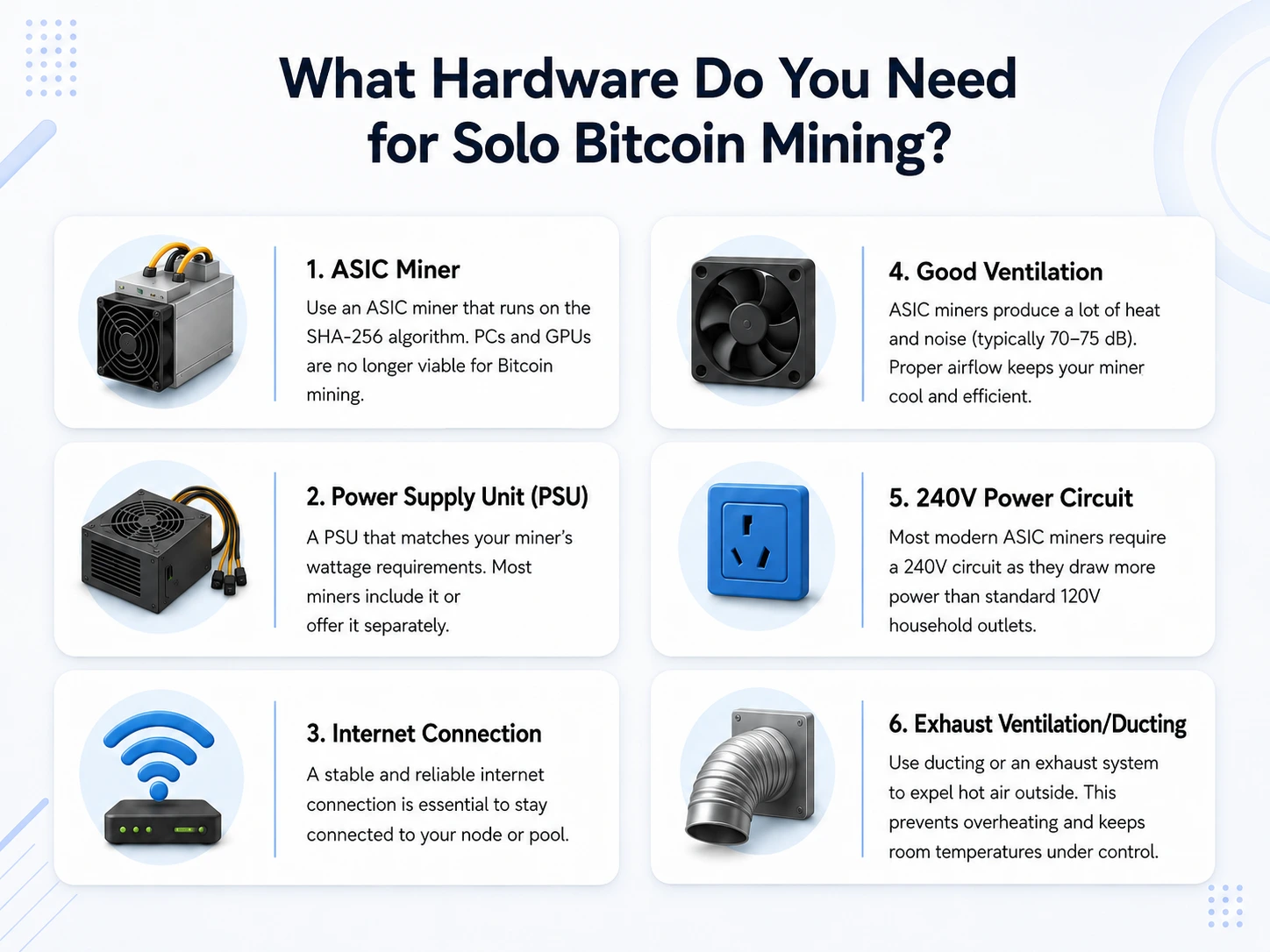
The hardware requirements for solo mining are the same as pool mining. Your odds of finding a block don’t change based on whether you’re solo or pooled; only your reward structure changes. What matters is having efficient, powerful hardware.
This is what you will require:
- The ASIC Miner uses the SHA-256 hash function for its operation. Mining of Bitcoins using PCs and graphics cards is no longer possible because of the increased performance of the ASIC mining rigs.
- A suitable power supply unit (PSU), which matches the wattage of your machine. Most miners either include this with the machine itself or sell it separately.
- An active internet connection for staying connected to your pool or node.
- Good ventilation because the ASIC mining hardware produces a lot of heat and makes quite a bit of noise (most work between 70-75 dB, comparable to a vacuum cleaner).
- An appropriate 240V circuit for your machine, since the majority of current ASIC machines consume more energy than a typical household socket that operates on 120V.
- A ventilation mechanism, ducting, for instance, to get rid of the hot exhaust air into the outdoor environment, as otherwise, you will be forced to deal with a significant increase in the room temperature after running your machine for several hours.
Which ASIC Miner Models Work Best for Home Solo Setups?
| Modèle de mineur | Hashrate | Consommation de courant | Efficacité (J/TH) | Approx. Noise |
| Antminer S21 XP | 270 TH/s | 3,645W | 13,5 J/TH | 75 dB |
| Antminer S21+ | 235 TH/s | 3564 Ouest | 16.5 J/TH | 76 dB |
| Whatsminer M60S | 186 TH/s | 3 441W | 18,5 J/TH | 75 dB |
| Antminer S19 XP (older gen) | 141 TH/s | 3 010 W | 21,5 J/TH | 75 dB |
When shopping for a mineur de crypto, efficiency (measured in joules per terahash, or J/TH) matters more than raw hashrate alone, especially for solo mining, where you’re running the machine constantly for a very long shot at a reward. Lower J/TH means less electricity cost per unit of hashing power, which stretches your budget further while you wait for a potential block.
Purchasing a pre-owned or a refurbished model is one of the ways by which enthusiasts manage to keep down the cost of purchasing; however, older equipment has low efficiency and a relatively shorter useful life span. In the case of choosing between old and new models, it is advisable to compare the total cost of electrical power used by both types of equipment in one year instead of looking only at the purchase price.
If you’re located in the US and shopping around, it helps to understand import duties, shipping timelines, and total landed cost before committing to a purchase. We’ve covered that in detail in our guide on buying ASIC miners in the USA, which walks through customs considerations and realistic profitability expectations for US-based buyers.
How Do Solo Mining and Pool Mining Compare Side by Side?
| Fonctionnalité | Exploitation minière solo | Minage en pool |
| Reward per block found | Full 3.125 BTC + fees | Small share based on contributed work |
| Payout frequency | Rare, unpredictable | Regular (daily or hourly) |
| Frais | None (if self-hosted node) | Usually 1-3% pool fee |
| Income stability | Highly volatile | Stable and predictable |
| Best suited for | Large hashpower or hobbyists | Beginners, small to mid setups |
| Technical setup | Requires running a full node | Just point miner at pool address |
| Risk level | Très élevé | Bas |
| Payout variance | Extrêmement haut | Low, smoothed over time |
| Tracking difficulty | Hard to track expected returns | Easy to track daily earnings |
Looking at this table, you can see why most people, even experienced miners, still lean toward pool mining for their primary hardware. The predictability lets you budget properly around your electricity costs. However, solo mining is better as a side experiment or a strategy that is only reserved for operations with significant scale.
What Are the Real Odds of Solo Mining a Bitcoin Block?
This is the section most people overlook, and it’s the most crucial section. Let’s do some actual math.
The Bitcoin network hashrate has been oscillating within the range of 900 EH/s to almost 1 ZH/s throughout the first six months of the year, depending on the difficulty adjustments based on the hashrate on and off the network. The current network hashrate stands at 979-1,010 EH/s with the difficulty level of 133-139 trillion.
The formula used by miners for calculating the average time to solve a block alone is as follows:
Average days to find a block = (Network Hashrate ÷ Your Hashrate) × (10 minutes ÷ 1,440 minutes per day)
Let’s plug in some real numbers using a single Antminer S21 XP (270 TH/s) against a network hashrate of roughly 950 EH/s (950,000,000 TH/s):
- Your share of the network: 270 ÷ 950,000,000 = 0.0000000284%
- Expected time to find one block: roughly 2,440 years on average
Yes, you read that right. A single top-tier ASIC miner would take, on average, thousands of years to solo mine one block. This doesn’t mean it’s impossible tomorrow; mining is random, and someone with a single miner has found a block before through pure luck, but the realistic expectation for average outcomes is measured in centuries, not months.
It’s worth pointing out that this math isn’t unique to solo mining; it’s simply the underlying reality of how difficult Bitcoin mining has become at a network level. Pool mining doesn’t change these odds at all. It only changes how the reward is distributed once a block is eventually found by someone in the pool. A pool with a large combined hashrate will find blocks relatively often, and your share of that reward reflects your proportional contribution.
How Much Hashpower Would You Need for Reasonable Solo Mining Odds?
| Hashpower | Estimated Avg. Time to Find a Block |
| 1 miner (270 TH/s) | ~2,440 years |
| 10 miners (2.7 PH/s) | ~244 years |
| 100 miners (27 PH/s) | ~24 years |
| 1,000 miners (270 PH/s) | ~2,4 ans |
| 10,000 miners (2.7 EH/s) | ~89 days |
Solo mining only starts making mathematical sense once you’re operating at a scale most home miners will never reach. That’s why solo mining is often described as a lottery ticket, not an investment strategy, unless you’re running a mid-sized farm.
Even at the 1,000-miner scale, which represents a serious industrial operation costing tens of millions of dollars in hardware alone, the expected wait time is still measured in years rather than days. It is a nice way to realize the level of competition and capital requirements that have come into play in minage de bitcoin compared to those days when a normal home computer would do the job.
Is Solo Bitcoin Mining Worth It in the USA in 2026?
Now let’s talk dollars and cents, specifically for US-based miners, since electricity rates, climate, and regulations all affect the math.
How Much Does Electricity Cost for Home Miners Across the US?
Electricity is the single biggest ongoing cost for any ASIC miner, solo or pooled. Rates vary widely by state:
- States like Washington, Idaho, and parts of Texas offer some of the lowest industrial and residential electricity rates in the country, sometimes under $0.08/kWh
- States like California, Massachusetts, and Hawaii can run $0.25-$0.45/kWh, which makes mining largely unprofitable
- The national average residential rate sits around $0.16-$0.17/kWh as of mid-year
Running an Antminer S21 XP at 3,645W continuously for a month costs roughly:
3,645W × 24 hours × 30 days = 2,624 kWh per month
At $0.12/kWh, that’s about $315 per month in electricity, just for one machine, with no guaranteed return if you’re solo mining. Compare that to pool mining, where the same machine would generate steady daily BTC payouts that can be measured against that electricity cost in real time.
It’s also worth factoring in seasonal costs. Many utility providers charge higher rates during summer months due to peak demand, which can push your effective electricity cost up by 20-30% during the hottest part of the year, right when your machine also needs more cooling to stay within safe operating temperatures. Miners in hotter states should budget for this seasonal swing rather than assuming a flat rate year-round.
Beyond the standard residential rate, some US miners explore commercial or industrial electricity contracts, which can offer lower per-kWh pricing if you’re running multiple machines and willing to sign up for a business account. This usually requires proof of a dedicated space, proper electrical permits, and sometimes a minimum usage commitment, but it can meaningfully lower your long-term operating costs if you plan to scale beyond one or two machines.
It’s also worth checking whether your local utility offers any demand-response programs, where they reduce your rate in exchange for allowing them to briefly throttle your power usage during peak grid stress, since a growing number of miners across Texas and other deregulated energy markets have started using this option to offset costs during summer heat waves.
Should You Solo Mine or Pool Mine With Your Hardware in 2026?
Honestly, for the vast majority of home miners in the USA, pool mining remains the more financially sensible option. Here’s why:
- Pool mining gives you predictable, calculable ROI based on current hashprice (recently around $37-38 per PH/s per day)
- You can track daily earnings against electricity costs and know exactly where you stand
- Solo mining with a small setup essentially means treating your electricity bill as a lottery ticket cost, with no meaningful chance of a return within your lifetime unless you get extraordinarily lucky.
That said, solo mining isn’t entirely irrational for everyone. Some miners run a small number of machines solo purely for fun, keeping the dream alive of hitting a jackpot, while treating the electricity cost as entertainment rather than a real investment. Others operate hundreds or thousands of units and solo mine as part of a diversified strategy where the numbers actually work.
A middle-ground approach some hobbyists use is running the majority of their fleet in a pool for steady income, while dedicating one older or less efficient machine to solo mining purely for the fun of it. This way, the bulk of their investment is still generating predictable returns, while a small portion chases the long-shot jackpot without meaningfully affecting the household budget.
What Are the Practical Steps to Start Solo Bitcoin Mining at Home?
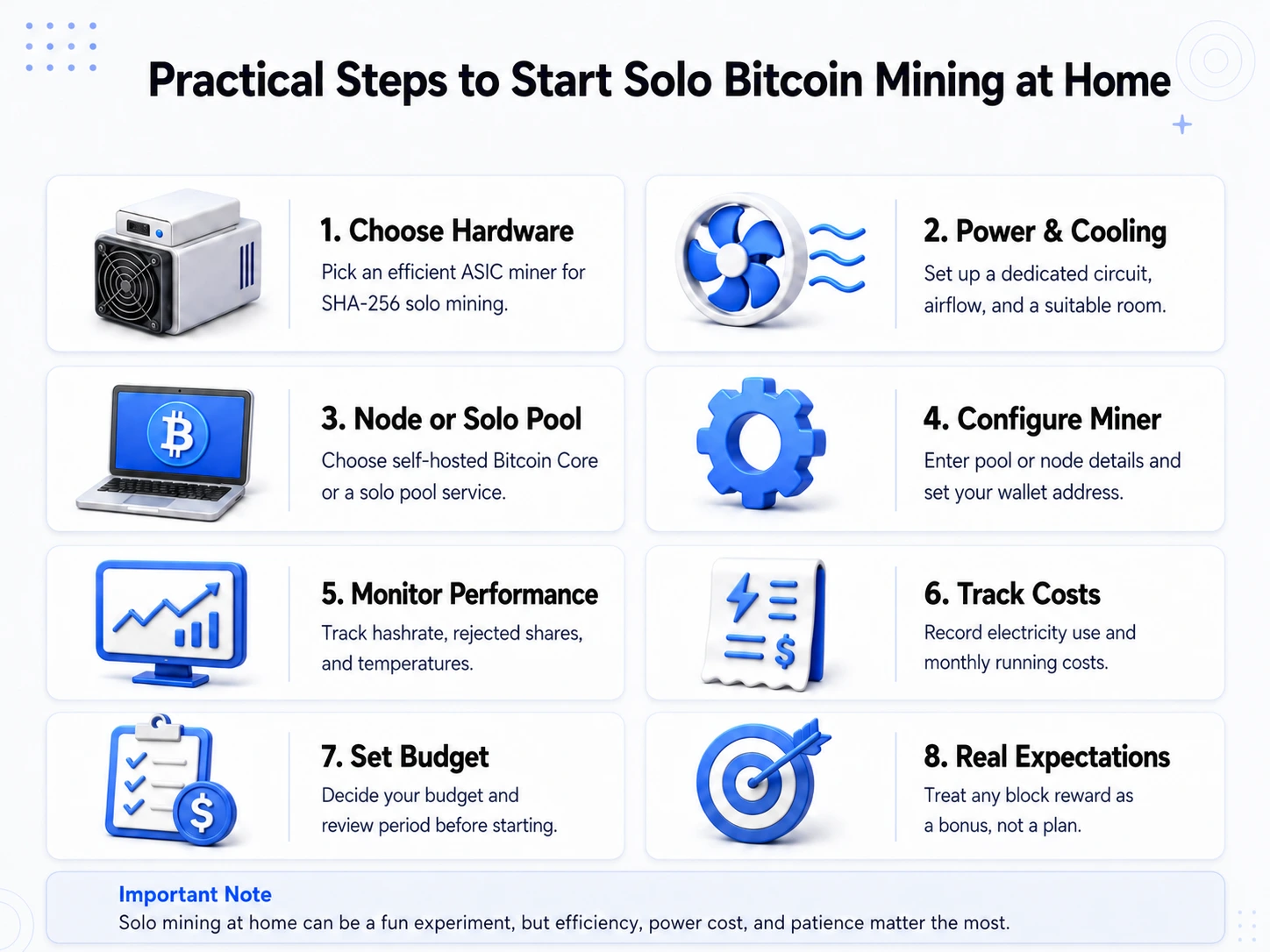
If you’ve weighed the odds and still want to try solo mining, here’s how to actually set it up.
Step 1: Choose Your Crypto Miner Hardware. Pick an efficient ASIC miner. For SHA-256 solo mining, popular choices include the Antminer S21 XP, Whatsminer M60S, or similar current-generation machines. Prioritize efficiency (J/TH) since you’ll be running this continuously.
Step 2: Set Up Proper Power and Cooling. Make sure you have a dedicated circuit (often 240V for larger machines), adequate airflow or exhaust ventilation, and ideally a garage, shed, or dedicated space since these machines are loud and generate a lot of heat.
Step 3: Choose Between a Self-Hosted Node or a Solo Pool Service. Running Bitcoin Core yourself gives full control but requires technical know-how and storage space. Using a solo mining pool service (like Solo CKPool) is far easier for beginners and only takes a small fee if you actually find a block.
Step 4: Configure Your Miner. Enter the pool’s stratum address (or your own node’s address) into your miner’s configuration panel. Set your Bitcoin payout wallet address correctly; this is critical, since mistakes here can mean lost rewards.
Step 5: Monitor Performance and Temperatures. Use mining management software or the manufacturer’s dashboard to track hashrate, rejected shares, and temperatures. Overheating reduces efficiency and can shorten the lifespan of your hardware.
Step 6: Track Your Costs. Keep a simple spreadsheet of your electricity usage and cost. Even if you’re solo mining for fun, understanding your real monthly cost helps you decide how long you’re comfortable running the experiment.
Step 7: Set a Realistic Budget and Time Horizon. Decide in advance how many months you’re willing to run the machine before reassessing. Treating this like any other hobby budget, with a defined limit, helps prevent the sunk-cost feeling of “just one more month” turning into years of unplanned spending.
Step 8: Have Realistic Expectations. Treat any block reward as a bonus, not a plan. Set a budget for how much you’re willing to spend on electricity as an ongoing hobby cost, and stick to it.
What Common Mistakes Should You Avoid When Solo Mining?
- Underestimating electricity costs before buying hardware. Always calculate monthly running costs first.
- Using outdated or overpriced hardware. Older ASIC models often have poor J/TH efficiency, which eats into any potential profitability even with pool mining.
- Ignoring proper ventilation, which can lead to thermal throttling and reduced performance.
- Skipping wallet address verification before configuring the miner; a wrong address means lost rewards forever.
- Expecting solo mining to replace pool mining income. For small setups, it rarely will.
- Not researching import duties and shipping costs when purchasing hardware from overseas sellers, which can significantly affect your total investment. If you’re new to this, buying ASIC miners in the USA involves specific customs and duty considerations worth understanding before you order.
- Forgetting about tax obligations. Any Bitcoin received through mining, solo or pooled, is generally treated as taxable income at fair market value the moment you receive it, so keep accurate records from day one.
- Running hardware in an unsuitable environment. Dusty garages, humid basements, or poorly ventilated closets can shorten a miner’s lifespan significantly and void manufacturer warranties in some cases.
What Tax and Legal Factors Should US Solo Miners Know About?
Mining Bitcoin in the United States, whether solo or through a pool, comes with tax responsibilities that a lot of beginners overlook. The IRS treats mined Bitcoin as ordinary income at its fair market value on the day you receive it, meaning you owe income tax on that value even if you never sell the coin. If you later sell that Bitcoin for more than its value at the time you mined it, you’ll also owe capital gains tax on the difference.
A few practical points to keep in mind:
- Keep a running log of every block reward or payout, including the date, the BTC amount, and the USD value at that exact time.
- Set aside cash for taxes rather than assuming you’ll sell coins later at a good price to cover the bill.
- Track your equipment as a business expense if you’re mining as a registered business rather than a hobby, since depreciation and electricity costs may be deductible.
- Check your state and local regulations, since some jurisdictions have specific rules or incentives around cryptocurrency mining operations, particularly involving zoning, noise ordinances, and commercial power usage.
- Consult a tax professional familiar with crypto before tax season arrives, since mining income reporting can get complicated quickly once you factor in multiple wallets, exchanges, and mined transaction fees.
Solo mining doesn’t change any of these obligations. If you’re lucky enough to find a block, that entire 3.125 BTC (plus fees) counts as taxable income the moment it lands in your wallet, so it pays to think this through before you get your hardware running.
How Does Bitcoin’s Halving Cycle Affect Solo Mining Rewards Going Forward?
Bitcoin’s block reward gets cut in half roughly every four years, a mechanism built into the protocol to control the total supply of 21 million coins. The most recent halving occurred in April 2024, dropping the reward from 6.25 BTC to the current 3.125 BTC per block. The next halving is expected around 2028, which will cut the reward again to 1.5625 BTC.
This matters for solo miners because it means the potential jackpot shrinks over time in terms of raw BTC, even though the dollar value depends heavily on where Bitcoin’s price sits at that point. Miners often debate whether rising BTC prices will offset shrinking block rewards, and historically, price appreciation has helped smooth out the economics for the network as a whole. But for an individual solo miner calculating odds today, the size of the potential prize is one more variable worth factoring into your long-term planning, especially if you’re thinking about running the same hardware for several years.
It’s also worth noting that transaction fees make up a growing portion of each block reward as block subsidies shrink over time. During periods of high network congestion, fees have occasionally added a meaningful bonus on top of the base reward, something solo miners should keep in mind when estimating potential payouts rather than assuming the reward is a flat 3.125 BTC in every case.
Conclusion
Solo Bitcoin Mining is an exciting concept: full ownership of a block reward, no pool fees, and complete independence, but the math in 2026 makes it clear this is a long-shot strategy for anyone running just one or a handful of machines. With network hashrate approaching 1 ZH/s, the realistic odds for small home setups stretch into centuries, not years. Pool mining remains the far more practical choice for steady, calculable returns, while solo mining works best as either a hobby experiment with a set budget or a strategy for operations with serious scale. Whichever path you choose, picking efficient, reliable hardware is the foundation of getting the best possible outcome, and that’s exactly where Asicmarché can help you find the right equipment for your setup and budget.
Questions fréquemment posées
-
Is Bitcoin mining still worth it in 2026?
Yes, but mostly through pool mining with efficient hardware and low electricity rates, since predictable payouts make the math work. Profitability depends heavily on your J/TH efficiency and cost per kWh, so it’s not a guaranteed win for everyone.
-
Is it worth buying a solo Bitcoin miner?
Buying an ASIC miner for solo mining only makes financial sense at large scale, since a single machine faces odds stretching into thousands of years. For most home miners, the same hardware is better used for pool mining or as a low-cost hobby experiment.
-
Has a solo Bitcoin miner ever worked?
Yes, there have been rare, well-documented cases of individual miners with modest hashpower finding a full block through Solo CKPool and similar services. These wins are extremely uncommon and don’t reflect the average outcome for most solo miners.
-
Can you make money with a solo Bitcoin miner?
It’s possible if you get lucky and find a block, since you’d keep the full 3.125 BTC reward plus fees. Realistically, though, most solo miners spend far more on electricity over time than they’ll ever recover without hitting that rare jackpot.

Peter Davis
Peter Davis est un analyste accompli de la blockchain et un rédacteur technique avec plus de quatre ans d'expérience dans le secteur des crypto-monnaies. Son expertise couvre l'infrastructure de la blockchain, le matériel de minage ASIC et les marchés des actifs numériques, où il est reconnu pour traduire des concepts techniques complexes en analyses précises, perspicaces et accessibles pour un public mondial.
Avec une base solide dans la recherche technique et l'évaluation du marché, le travail de Peter se concentre sur le lien entre l'innovation de la blockchain et les stratégies pratiques d'exploitation minière et d'investissement. Ses écrits sont définis par la profondeur analytique, la clarté et l'accent mis sur les idées fondées sur des données qui guident à la fois les professionnels et les passionnés dans le paysage cryptographique en évolution.
Animé d'une profonde passion pour la technologie Web3 et les systèmes décentralisés, Peter continue de produire un contenu faisant autorité, axé sur la recherche, qui améliore la compréhension de la performance minière ASIC, de l'efficacité de la blockchain et de la dynamique plus large qui façonne l'avenir de la finance numérique