Résumé rapide
Biman’s Antminer Z15 Pro profitability depends on more than just its 840 KSol/s hashrate. It is built specifically for Equihash mining and uses 2780W of power, so the real profit comes down to ZEC price, electricity rate, network difficulty, pool fees, and uptime. If your power cost is low and the setup is handled properly, it can be a strong option for serious Equihash miners. But if electricity is expensive, the ROI can stretch quite a bit. So before buying, it is better to check current earning estimates, calculate your monthly power cost, and understand your break-even point clearly.
In this guide, we will break down how much power the Z15 Pro uses, how daily profit is calculated, what break-even really means, and how long ROI may take depending on your hardware cost and electricity rate. We will also look at the setup factors that can improve or reduce your actual mining returns.
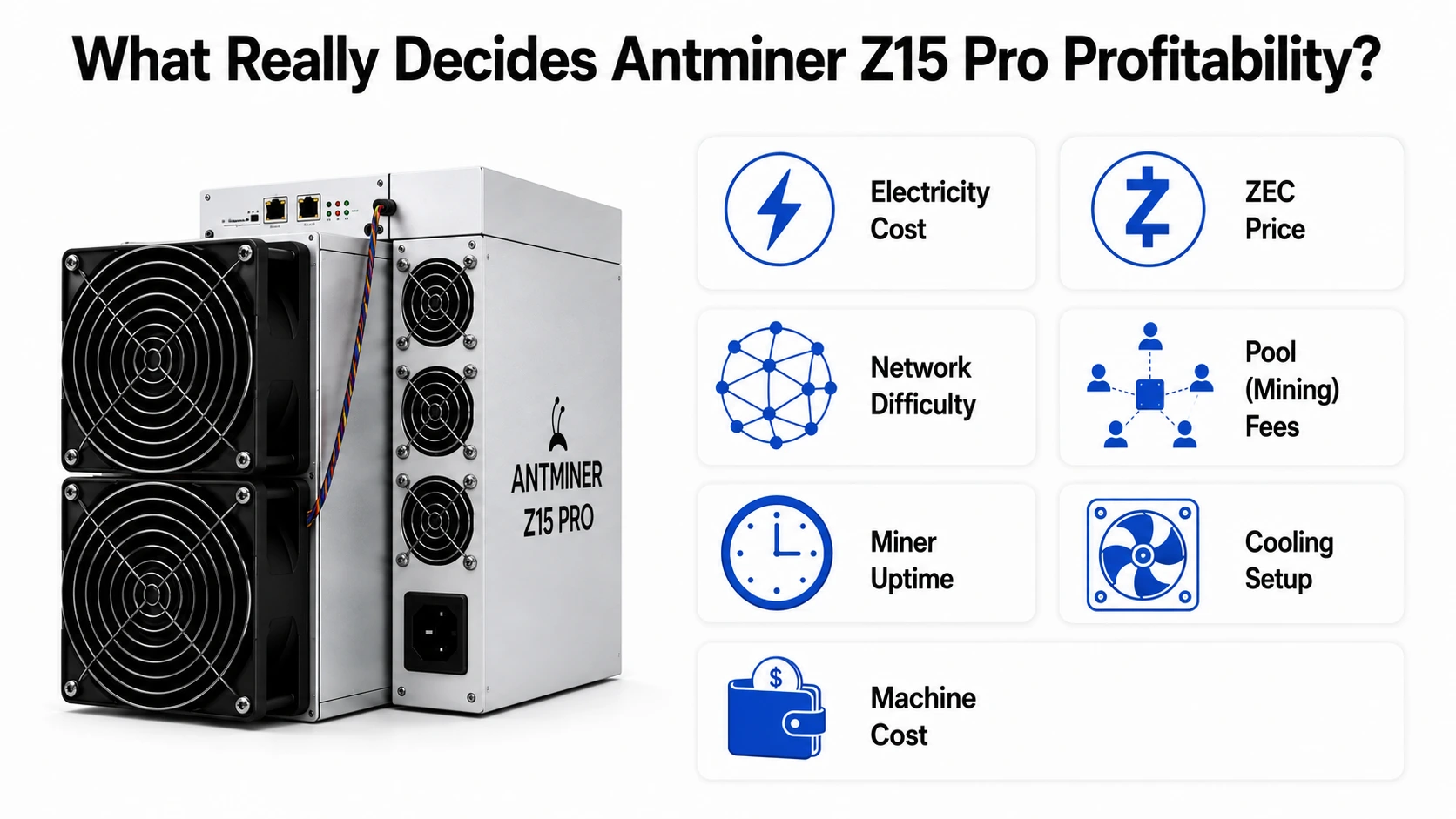
What Really Decides Antminer Z15 Pro Profitability?
There isn’t a fixed profit figure that applies to this Z15 Pro. On one day, the numbers might appear to be decent, but on the next day, the margins can get tighter due to the prices for coins, network difficulties, and rewards for pool players keep changing. This is what mining is all about. This is the reason why many buyers can get overly excited about the hashrate by itself. A high hashrate is essential; however, it’s not necessarily a sign of an increase in profit. It also requires power every hour, so the power bill will continue to run regardless of whether the market is performing well or poorly.
Z15 Pro runs on the Equihash algorithm and is employed to perform ZCash mining. On paper, it is estimated that 840 KSol/s is an impressive number for this class. However, the actual result will depend on the cost it takes to run the machine each day.
The most important aspects are:
- The cost of electricity per kWh
- The price is currently the ZEC price
- Network problems
- Fees for pool use
- Miner uptime
- Ventilation and cooling
- The cost that you paid was for the machine.
When evaluating the profitability of z15pro The most important thing to consider isn’t just “how much it makes?” The better question is “how much money is left over after power bills?”
Key Specs Used for Profit Calculation
Before diving into daily profits or ROI, these are the primary figures you should be aware of.
| Spécification | Détail |
| Modèle | Bitmain Antminer Z15 Pro |
| Algorithme | Equihash |
| Hashrate | 840 KSol/s |
| Consommation électrique | 2780W |
| Efficacité | 3,31 J/KSol |
| Main Coin | ZCash |
| Refroidissement | Dual fan |
| Niveau sonore | Around 72 dB |
| Connectivité | Ethernet |
In the calculation of profit, the two most crucial figures comprise is the amount of hashrate as well as energy consumption. Hashrate indicates the mining power of the machine. Power consumption is a measure of the amount of electricity required to run it. This is the reason why an ASIC miner can appear strong but not work in all locations. If the power rate is too high, the cost of power begins to eat away at the profits very quickly.
How Much Electricity Does It Use Per Day?
Z15 Pro uses 2780 watts, which is 2.78 kW. If it is running all day long, the daily power consumption is approximately 66.72 Kilowatts.
The formula is easy:
2.78 kW * 24/7 = 66.72 Kilowatts per day
If your mining machine runs continuously, it will consume approximately 66.72 daily electricity units. This is a part that many novice miners overlook. The price of the machine is a one-time cost, while electricity is a recurring expense.
| Tarif d'électricité | Coût d'énergie quotidien | Monthly Power Cost |
| 1 TP 22 T 0,05/kWh | ~3,34 $/jour | ~$100/month |
| $0.07/kWh | ~4,67 $/jour | ~$140/month |
| $0.10/kWh | ~6,67 $/jour | ~$200/month |
| 1 TP pour 22 T par 0,12 kWh | ~$8.01/day | ~$240/month |
| 1 TP 22 T 0,15 €/kWh | ~10,01 $/jour | ~$300/month |
In the range of $0.05 to $0.07/kWh, the machine has far more room to function. In the range of $0.10/kWh, the numbers have to be scrutinized. When the rate is over $0.12/kWh, the machine will continue to run; however, the profit margin will depend heavily on ZEC prices and the current mining reward.
How to Estimate Daily Profit
Daily profit isn’t the equivalent to daily revenue. Revenue is the money a miner makes before expenses. Profit is the amount left after the pool and electricity fees.
The fundamental formula is:
Daily Profit = Daily Mining Revenue – Daily Electricity Cost – Pool Fees
Daily revenue with Z15 Pro keeps moving. Certain days are better than others, and some look worse. This happens mainly due to ZEC price movements and network issues, as well as pool luck and fee structure. This is the reason it’s best to review a couple of real-time Z15 Pro profitability calculators before purchasing or operating the machine for a long period of time. They typically show the daily income, monthly earnings, power consumption, as well as the estimated ROI. This gives a more accurate picture than relying on hashrate by itself.
If, for instance, the machine is earning around $10 per day before electricity, and your power bill is about $4.67 daily, then your approximate net profit before fees for the pool is approximately $5.33 daily. If the daily income drops to $8, the revenue is much less. If it increases to $15 or $12, the setup begins to appear more relaxed. This is the reason why a single good mining day shouldn’t be the sole factor in the purchase in its entirety. Monthly or weekly averages are far more reliable.
What Is the Break-Even Point?
Break-even is the moment at which your mining earnings only cover the cost of running. There is no real money yet, but you’re not losing money with electricity, either.
In this case, the break-even power rate is based on the daily income. Because it consumes around 66.72 daily kWh, you can divide daily earnings by 66.72 to determine an approximate break-even rate for electricity. If the machine earns about 10 dollars per day without electricity, the break-even point is around $0.15/kWh. However, this doesn’t necessarily mean $0.15/kWh is an acceptable rate. Fees for pool membership, rejected shares or shares, downtime, and even small losses are still to be considered.
If your machine is earning less than $8 a day, then the break-even rate falls to about $0.12/kWh. If your electricity cost is already close to this level, there’s little room for error. This is the reason miners with less power have a greater chance of success. They can handle down days, changes in difficulty, or even lower prices for coins without crashing into losses immediately.
ROI: How Long Can It Take to Recover the Cost?
ROI is the point where the calculation becomes personal. Two miners could buy the same machine but have extremely different outcomes. One could have electricity that is cheap and a cheaper purchase price. A different one may have to pay more for the equipment and use the machine at an increased energy rate.
The formula for the base is:
Hardware Cost / Daily Net Profit = Estimated ROI Days
Here are a few basic examples:
| Coût du matériel | Daily Net Profit | Estimated ROI |
| $4,199 | $5/day | *840 days |
| $4,199 | $8/day | 525 days |
| $6,000 | $5/day | 1.200 days |
| $6,000 | $8/day | 750 days |
| $8,199 | $5/day | 1.640 days |
| $8,199 | $8/day | 1 025 days |
This is not intended to be a guaranteed payback table.
It is simply a practical way to understand how ROI can improve when the purchase price is lower or daily net profit is stronger. If you buy the machine at a good price and run it with affordable electricity, the ROI can look much more manageable.
With regular tracking, a mineur de crypto can also adjust expectations as ZEC price, mining difficulty, uptime, and daily earnings change over time. A simple ROI check is useful before buying, but it should not be treated as a one-time task. Mining numbers keep moving, so reviewing them every few weeks gives you a clearer idea of how the machine is performing and whether your setup is still on the right track.
How Can You Improve the Profit?
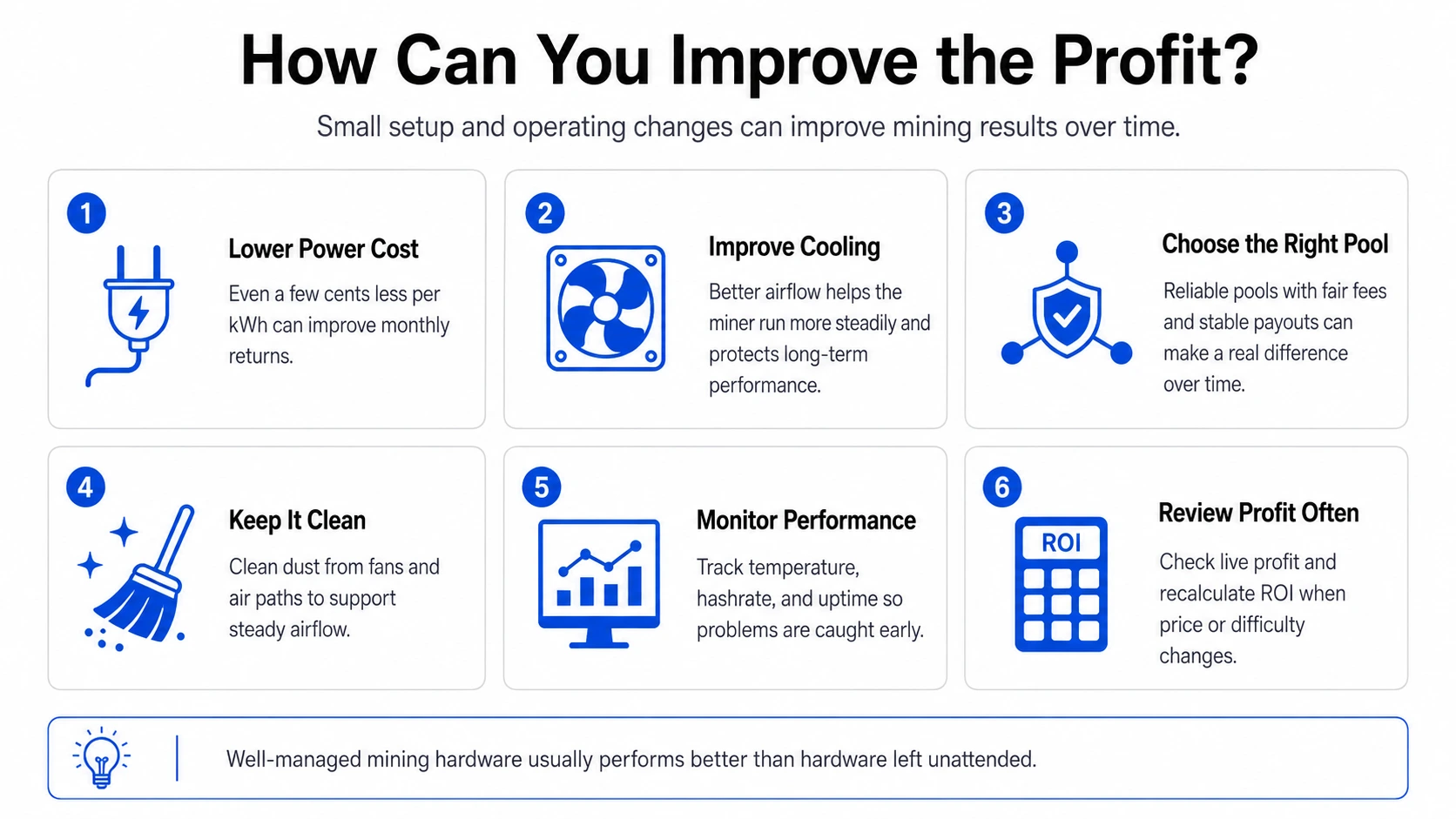
You can’t manage the market, but you control how you manage the machine. This is more important than most novices think.
The first thing to improve is the electricity price. Just a few cents per kWh can alter the results for a month. If you could operate the mining unit in a lower-cost location, at lower energy hours, or in a setting that has electricity scheduled properly, your numbers will increase.
Cooling is the second major aspect. It is the next big thing. Z15 Pro pulls 2780W, which means it generates plenty of heat. If the hot air is within the machine, it can be unstable. Fans can work more efficiently, temperatures may increase, and the long-term durability of the machine could suffer.
It is also crucial to choose the right pool. A reliable server with fair fees and regular payouts is much better than choosing the first one you find. A difference of 1% in fees might not seem like a lot for a single moment; however, over a period of time spent mining can add up.
A few simple practices can be helpful:
- Make sure the miner is in a space that is well ventilated.
- Get rid of dust from air and fan pathways
- Monitor temperature and hashrate, as well as the hashrate.
- Do not be concerned about an unsteady power supply
- Compare the live profit every couple of weeks
- Recalculate ROI if price or difficulty is changed
This kind of crypto mining equipment is most effective when it is properly managed and not simply plugged in and then left unattended.
Is the Z15 Pro Good for Home Mining?
Z15 Pro is a great choice for home use. It can be used at home, but only if the configuration is in place. It’s not the quietest desk-based miner. With a noise level of 72 decibels and 2780W power draw, it needs a good location.
A garage, a separate warehouse corner, or a hosted mining facility is more sensible than an office or bedroom. The noise and heat are two main concerns for homeowners. Also, the machine requires an efficient power system capable of handling the weight.
Before you attempt to run the test at your home, make sure to check these items:
- Is your circuit able to safely be able to handle the power demand?
- Does the airflow flow enough?
- Does hot air escape from the room?
- Is the noise level acceptable?
- Is your internet stable?
- Do you have the ability to keep dust in check?
If all of these are taken care of by a home-based miner who is prepared, you can use it. However, for the majority of people, it is designed for a serious mining area.
Should You Buy It for Profit?
Z15 Pro makes sense when the numbers are correct. It’s not a product to purchase just because the hashrate appears strong.
It could be a great choice if you’re experiencing high energy costs, would like to create Equihash coins, have adequate power infrastructure, and are aware that ROI will take some time. It’s also suitable for users who feel comfortable checking the profitability regularly instead of hoping for the same monthly returns for the rest of their lives.
It might not be the best choice if your power consumption is very high and you don’t possess a space that is dedicated, or you’re looking for in-depth, silent mining. It’s also not the ideal machine for Bitcoin mining because it was designed for Equihash and not SHA-256.
This means that the machine isn’t the issue. The more important thing is whether the power, speed, or cooling configuration, as well as space, can support it.
Conclusion
Antminer Z15 Pro’s profitability is contingent on a more than 880 KSol/s hash rate. The final results are attributed to the cost of electricity, ZEC price, network difficulties, pool charges, and the uptime cost of the machine. If you have low power and adequate cooling, it could be an excellent Equihash mining choice. If you are using expensive power, the margins can become a little tight, and ROI could be stretched.
Before you purchase, calculate the cost of power for each day as well as compare your live earnings estimates, and then check the break-even point. This small thing can prevent you from a costly error.
If the numbers match your specific setup, ASIC Marketplace offers the Bitmain Antminer Z15 Pro with specific product information to miners who require dedicated Equihash mining equipment. Do the math first before deciding if this machine is a good fit for your financial budget as well as your long-term mining plan.
Questions fréquemment posées
-
Is Antminer Z15 Pro a profitable device? Antminer Z15 Pro profitable?
Yes, it is profitable when the electricity costs are affordable and Equihash mining benefits are high. The final profit is contingent on the ZEC price as well as the difficulty of the network, pool fees, and the power rate you pay.
-
How much power will Z15 Pro use? Z15 Pro use per day?
It uses about 66.72 hours per day during continuous operation for the day. It is based on 2780W power consumption.
-
How much is the break-even power rate in this mining company?
The break-even price is based on the daily income. If the machine makes approximately $10 per day before electricity, the approximate break-even rate of power is similar to $0.15/kWh without pool charges.
-
What is the time frame for ROI with this Antminer Z15 Pro?
ROI is contingent on the hardware’s price and the amount of daily net profits. If the machine is valued at $4199 and generates a profit of $8 each day, then the payback time is 525 days. If the profit is less or the purchase price has risen, ROI takes longer.
-
What are the coins that Z15 Pro mine? Z15 Pro mine?
Z15 Pro mines Equihash-based coins. ZCash is the most popular choice, but it could additionally mine Horizen, Komodo, Pirate Chain, and Hush dependent on the pool’s support and current profitability.

Peter Davis
Peter Davis est un analyste accompli de la blockchain et un rédacteur technique avec plus de quatre ans d'expérience dans le secteur des crypto-monnaies. Son expertise couvre l'infrastructure de la blockchain, le matériel de minage ASIC et les marchés des actifs numériques, où il est reconnu pour traduire des concepts techniques complexes en analyses précises, perspicaces et accessibles pour un public mondial.
Avec une base solide dans la recherche technique et l'évaluation du marché, le travail de Peter se concentre sur le lien entre l'innovation de la blockchain et les stratégies pratiques d'exploitation minière et d'investissement. Ses écrits sont définis par la profondeur analytique, la clarté et l'accent mis sur les idées fondées sur des données qui guident à la fois les professionnels et les passionnés dans le paysage cryptographique en évolution.
Animé d'une profonde passion pour la technologie Web3 et les systèmes décentralisés, Peter continue de produire un contenu faisant autorité, axé sur la recherche, qui améliore la compréhension de la performance minière ASIC, de l'efficacité de la blockchain et de la dynamique plus large qui façonne l'avenir de la finance numérique